

Let’s talk about socialism
/Communists, Trotskyists, social democrats and one token American walk into a bar
Shadowy figures huddled around a table at the back of a subterranean pub in Prague. Arches of ancient stone enclosed the space, lit only by a few half-obscured lights. It was enough to give me a bit of a thrill, especially since we were plotting to thwart the military might of the world’s sole empire.
It was 2003, and the second Iraq war had just kicked off with obviously unverified claims about chemical and nuclear weapons. There had been a few small protests in the run-up to war, and I was one of the organizers, though mostly by a fluke. I happened to be sitting in a cafe with a couple of Czechs and a fellow American while the drumroll of war was getting louder, and we got to talking about how demonstrations should be planned—for safety if nothing else, since angry people would come out—to legally and civilly register our disagreement at the US embassy.
We’d spread the word and put up posters. With the invasion imminent, we organized another demonstration, expecting a few hundred people again. Two thousand came, crowding into the tiny street in front of the embassy, screaming out in bewildered disillusionment. Many Czechs still thought of Americans as “the good guys.” It had been less than fifteen years since they’d freed themselves from Soviet tyranny. That America could be selfish, cruel, and knowingly dishonest was a betrayal that hit deep and hard.
That’s why I was in this cellar four days after the war started, included in a meeting fraught with political factions. The surprise turnout had earned our little international protest group street cred, and I’d been appointed an ambassador for reasons that were becoming uncomfortable: 1. I was a token American, 2. I spoke Czech, unlike most of the expats, and 3. I was willing to talk to factions most of the Czechs we worked with weren’t, including Communist Party members, avowed socialists and Trotskyists.
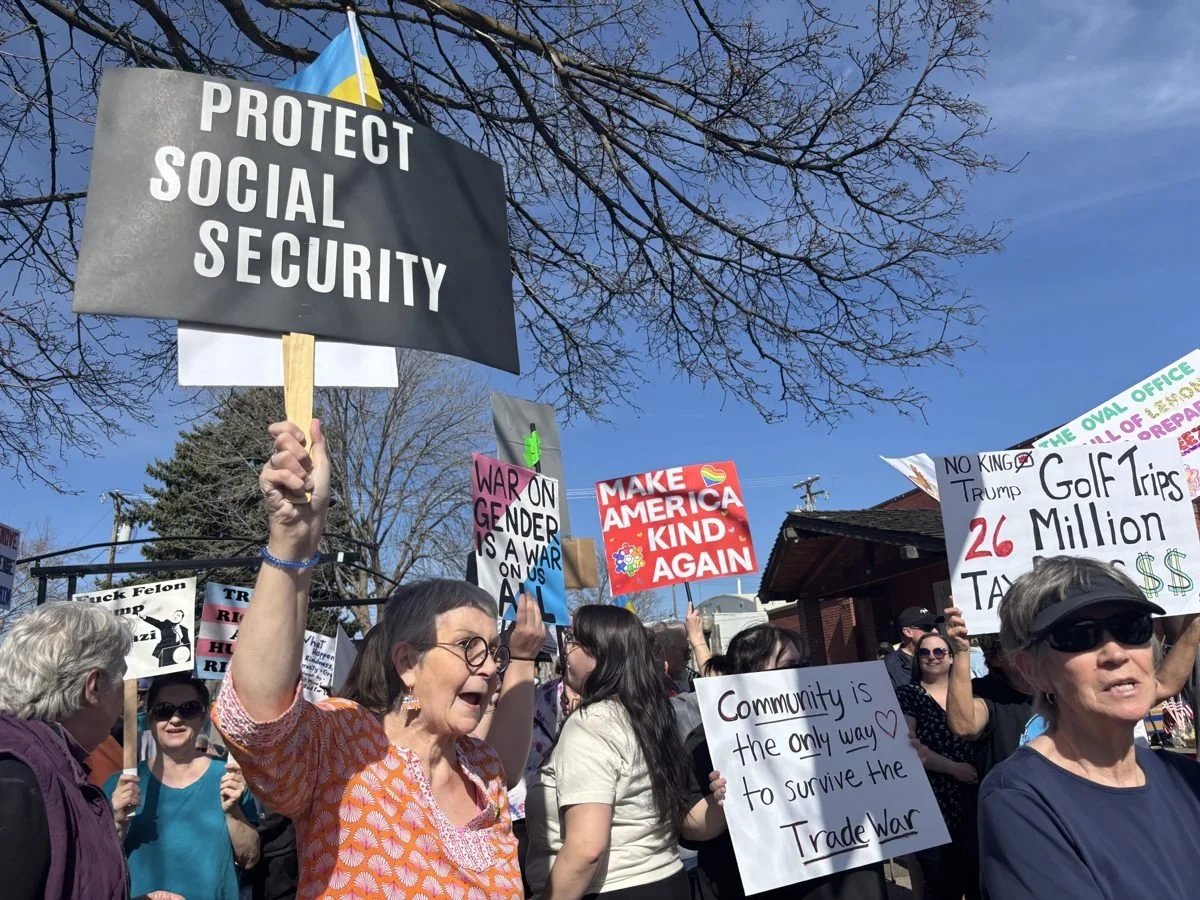
La Grande, Oregon No Kings protest: Image of several people in a crowd under a blue sky holding signs such as “protect social security” and “Make America kind again.” photo by Arie Farnam
Three young men leaned in with fierce intensity, two clean-shaven and one with a curly beard. A man in his forties with a stretched, somewhat frog-like face leaned back and smirked. A tall Egyptian in his sixties with a face that could have been carved from basalt sat in a dim corner.
I won’t go into all the ins and outs of local politics, but it quickly became clear to me that none of them agreed on much. Even the three younger men who’d come in together were each from a different “socialist” group. My role was much more of a buffer than a partner, and I learned to say, “Either the Communist Party keeps their banners out of the protest and we focus on ending the war, or our group will boycott,” with the calm assurance of someone who knew that a few thousand people would respond if she called. This was back in the early days of the internet, remember. We signed a thousand people up on a makeshift email list, and it was virtually their only source of independent information, so my words carried weight.
In 2026, all the accusations of “Communist!” and “Socialist!” in America bring me back to those heated evening debates with a smile. Certainly, the stakes in that Prague pub, as massive as they felt at the time, were puny by comparison—unless, of course, you were an Iraqi or an American soldier. The vast changes and desperation in much of the world today gouge deeper and harder.
So, I thought I’d talk a bit about socialism and socialists, since I learned about it in countries where various ideologies had actually been played out, at least to some extent. I’m going to distinguish between socialism and communism, as well as democratic socialism and social democracy, because these are terms we are hearing a lot today.
“Socialism” has about as clear a definition as “freedom” or “truth,” that is, muddy, disputed by just about everyone, and mostly bent to fit each party’s agenda. Even dictionaries can’t agree: Merriam-Webster’s simple definition calls socialism “a way of organizing a society in which major industries are owned and controlled by the government rather than by individual people and companies.” (Emphasis mine, here and below.)
The Stanford Encyclopedia of Philosophy, on the other hand, says socialism describes a society in which most economic production is “under social, democratic control.” A government and a society are not the same thing, and most of the fighting happens in that gap.
The dictionaries do at least agree that the key issue is who controls and benefits from large-scale economic activity. Americans tend to have far broader definitions. A Gallup poll in 2018 asked Americans, in an open-ended question, what they associate with the word “socialism,” and compared the answers with a similar poll from 1949. In 1949, the most common answer was “government ownership or control,” at 34 percent. By 2018, that had dropped by half, to 17 percent, and the top answer was “equality,” at 23 percent. Only 3 percent said “restriction of freedom.” That’s despite nearly seventy years of propaganda bombarding American society with the idea that socialism and communism are indistinguishable monoliths of totalitarian terror and oppression.
In that Prague pub, our meetings brought together hardline Communist Party members (who believed that “socialism,” in which the government controls the entire economy, would lead to “communism,” in which no one would privately own factories or land and people would be evolved enough to share nicely), Trotskyists (who believed a party bureaucracy had hijacked “the revolution” and deformed the Communist Bloc into something that wasn’t real socialism—some called it “state capitalism”—leading to authoritarianism), social democrats (who wanted to remain within capitalism but harness it for social benefit), and democratic socialists (who were not yet well understood at the time), along with a variety of Arab leftist groups.
Most of my Czech friends were vehemently anti-Communist (and anti-socialist for good measure). They had grown up under Soviet military occupation, in a totalitarian state that called itself socialist, with censored schools and media and a country stripped of resources by its pseudo-colonial overlord. When I first came to the Czech Republic in the early 1990s, I fell in with young dissident musicians and backpackers, and no one I knew wanted to touch anything leftist with a ten-foot pole.
Most of the Czechs in Prague who supported the international antiwar group were similar, which was why they sent me to negotiate with leftist groups about how the protests would be organized and who could claim credit. The biggest problem was the Communist Party, which was still a large, organized force with ample funding. I never heard the Communists talk about the war or the issues, but they’d show up at protests with new Soviet flags adorned with hammers and sickles. It would be like trying to hold an economic-justice protest in the US today and letting a white-nationalist group hand out Confederate flags. You might gain a few working-class white people, but you’d lose essentially everyone else. And the nationalist group would only do it for the press coverage and wouldn’t care that it had sabotaged the event. The Czech Communists were much the same.
And still, I had to fight hard to talk the socialist groups—which brought sizeable numbers of Czech students and Arab immigrants into our protests—around to a strict ban on Communist Party symbols at our public events, which we eventually worded as a ban on any political party symbols of any kind. It wasn’t that the socialists were friendly to the Communist Party, but most of them were either young enough to have been small children during the fall of the Communist regime or foreigners from the Arab world. In the end, our public statements and some street tactics co-opting and taking down Communist Party flags meant that Prague’s antiwar movement fared much better than similar efforts in other former East Bloc countries.
My partners in those meetings rarely asked me about my own politics, though I was variously accused of being a “naïve pacifist,” “a liberal,” “a Democrat,” and “a centrist.” In any event, I was widely seen as the “anti-socialist” of the group. At the same time, I worked most closely with the Iraqi Communists, who made up most of the Iraqi exiles I met in Prague.
Saddam Hussein’s government claimed to be “socialist” and jailed and persecuted “communists,” who were his rivals. Strangely, that didn’t stop the Soviet Union from arming him; Moscow was his main weapons supplier through the 1980s. The United States backed him too in those years, to keep Iran from winning the Iran–Iraq War. Iraqi Communists who escaped torture, imprisonment and execution fled to the Soviet Bloc, where fellow communist parties took them in, and many ended up in Prague before the Berlin Wall fell. One of them, the Iraqi Communist Party’s representative in Prague, later said a Czechoslovak Communist official had told him to keep quiet about “the fascism of Saddam Hussein.” So the Iraqi dissidents in Prague in 2003 who opposed Saddam were mostly avowed communists. Yet they had little in common with the hardline Czech Communist Party members, who mainly wanted Party control and seemed to have little interest in the antiwar movement or in social issues beyond that.
The difference for me was that the Iraqi and other Arab Communists never pushed their ideology on anyone. They worked with us in good faith as mature adult partners. So did the Czech socialist students after some initial concerns about how “anti-socialist” our group was going to be.
It was wartime, and we never really had time to talk about what anyone personally wanted other than an end to the war. I tried to explain at one point that my motivation came from how much the war was hurting Americans—not just through service members killed and wounded, but by undermining our democracy and setting up the United States for much worse authoritarianism yet to come. Yes, I and many others actually saw a lot of this coming. If you go back to what we wrote about the Patriot Act and the anti-democratic ways the war was prosecuted, the kinds of tactics we have seen in the past two years were top concerns.
But in my broken Czech, I said, “Americans are motivated because this issue burns us.” I meant that the war was affecting us personally, whereas for many Czechs at the time it was a matter of general principle. Unfortunately for me, the expression “burns” in Czech slang means that someone is a genius. In the noisy pub cellar, my words were widely interpreted as an arrogant assertion that Americans were smarter than everyone else. One of the nicer socialist students explained this to me later, truly surprised that I hadn’t known. Somehow, I managed to claw back from that diplomatic disaster and negotiations continued.
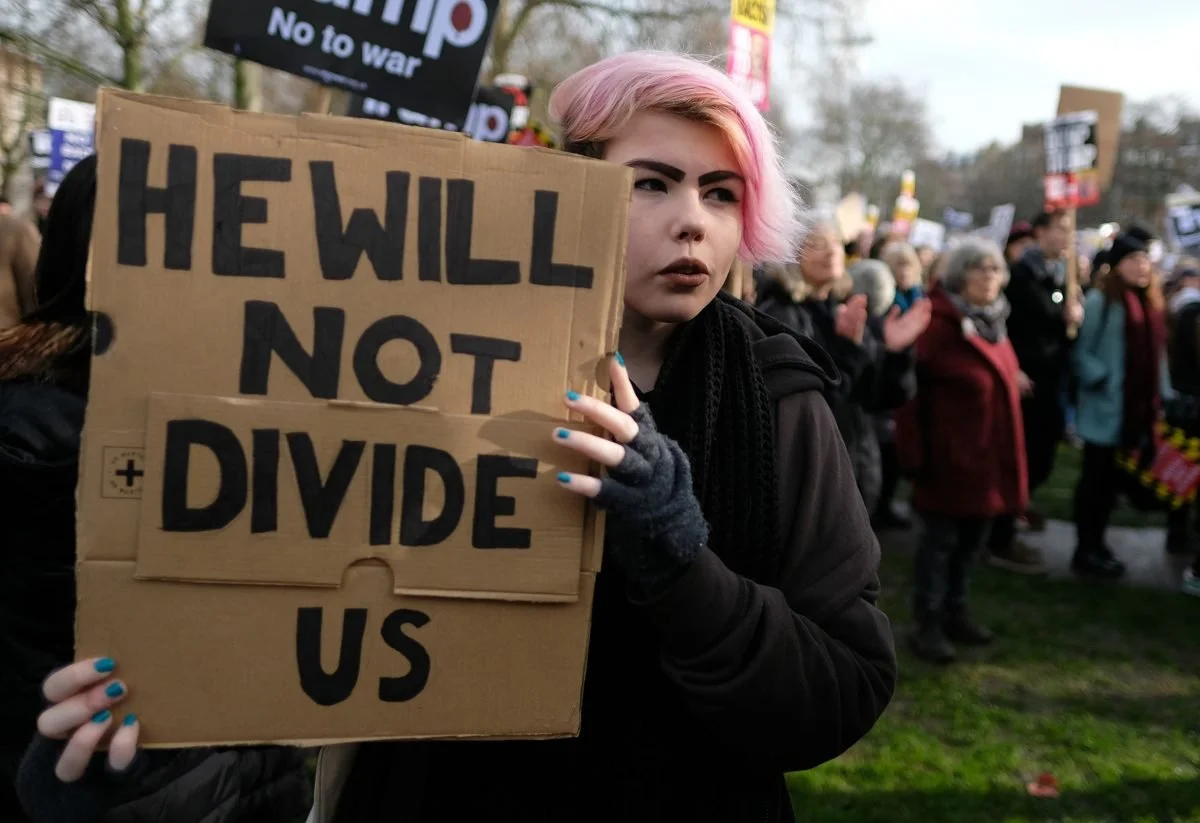
Creative Commons image by Alisdare Hickson: photo of a young woman with hair dyed pink and a cardboard sign reading, “He will not divide us.”
Had I been able to discuss socialism with them at the time, we would likely have found a lot of common ground. As an American who had grown up without regular access to health care, I saw what European social democracies had built as admirable and worth studying or even emulating. As a child, I had watched my giant, physically powerful father lie deathly ill for two weeks from a venomous spider bite because he couldn’t afford to see a doctor until my mother bartered for treatment. He was told the poison could have been fatal.
Still, I wouldn’t have agreed with the socialists on everything. Even the young students understood the differences among their own Marxist and Trotskyist ideologies, the Communist Party’s, and Western Europe’s social democracies far better than I did at the time. I didn’t want everything to be owned collectively, and I certainly didn’t want the government to control the economy as the East Bloc Communist states had. In fact, I didn’t particularly believe in collective ownership.
That too came from some rugged personal experience. When I was growing up in rural Oregon, my family were members of the Northeast Oregon Worker Owned Cooperative (NEOWOC), a company that did tree-planting, trail maintenance, and other forestry work on contract. If there is anything I’m over-proud of, it’s probably that. NEOWOC has become an intergenerational tribe far beyond the actual functioning of the company. And yet, the concept of collective ownership was not particularly successful in that case. What I remember from childhood and hear a lot about from those who were adult members is how management meetings were arduous, four-hour sessions full of drama and hard feelings. Collective ownership, it turns out, also means collective meetings.
Today, I know there are plenty of successful worker-owned and cooperatively owned companies, from the Mondragon cooperatives in Spain’s Basque Country, with about 70,000 workers, to Oregon’s own Bob’s Red Mill, which has been 100 percent employee-owned since 2020. My electric company, Oregon Trail Electric Cooperative, is member-owned, and in my experience it responds exceptionally quickly to power outages and treats members well, despite an energy policy that’s less sustainable than I’d like.
I’m probably closer to accepting the idea of collective ownership of companies and resources today than I was in my twenties. But that isn’t even what most people who call themselves social democrats or democratic socialists mean by those terms.
Both social democrats and democratic socialists favor policies that reduce vast inequalities of wealth, prosecute corporate crime and large-scale corruption as vehemently as petty crime or drug use, or more so, and put the good of most people ahead of unregulated systems that so often allow a few individuals to siphon off the profits created by the labor of others. If environmental damage by a company harms many people, even in small, incremental ways, democratic socialists and social democrats fall on the side of the many who are harmed.
At the same time, they may side with a large group of workers when an entire industry is threatened by environmental rules. When I was a teenager in the 1990s in Oregon, there was a real divide between environmentalists trying to protect the endangered spotted owl and communities that depended on the timber industry for survival. Democratic socialists might well back the working people over the protection of wild places mostly enjoyed by those with more wealth and leisure. That’s one way in which they and social democrats differ from the stereotype of a “compassionate liberal.”
Combining the words socialism and democracy means bringing the concept of majority interest from the democratic political arena into the economic world. What is good for the many is the goal, as it is with electoral politics.
What, then, is the difference, if any, between social democrats and democratic socialists?
Britannica draws the line this way: social democrats want to harness capitalism for social benefit, while democratic socialists want to replace it with an economy under democratic control. Most European social democratic parties gave up on collective ownership decades ago. Democratic socialists, at least on paper, haven’t. And very few people anywhere advocate for a society with no private ownership of factories, land or businesses at all, which would be “communism” (note the small c, indicating the actual ideology as opposed to an organized party).
So, of course, the epithets calling American Democrats “socialists” and “communists” in 2026 are silly. But you likely already knew that. Most of them aren’t even proper social democrats, like those in Europe. They may be open to some form of social safety net, at least compared to most Republicans, though in the party’s more corporate wing, even that is up for argument.
But then there’s the Democratic Socialists of America. Are they real socialists, you might ask, and do they go too far?
The DSA’s 2026 program, “Workers Deserve More,” is socialist in the dictionary sense. It calls for the public “to collectively own the key economic drivers that dominate our lives, such as energy production and transportation,” along with universal health care, tuition-free college and a Green New Deal. It also goes much further than anything in mainstream American politics. It proposes abolishing the Senate, replacing the President and Supreme Court with “an executive and judiciary chosen by and subordinate to Congress,” drafting “a new constitution” and abolishing police and prisons. When Fox News host Shannon Bream asked DSA co-chair Megan Romer, “Abolish the Senate?” Romer answered, “True.”
That program, though, was adopted by DSA’s National Political Committee, about two dozen people, not by a vote of its more than 120,000 members. Plenty of DSA’s own elected officials keep their distance from some of its planks. Francesca Hong, who narrowly lost Wisconsin’s Democratic primary for governor in August, said during her campaign that the national platform was “less of a concern for me.” Illinois state senator Rachel Ventura said, “defunding the police is the opposite of democratic socialism.”
In Prague, I had to navigate the political situation based on what each group actually did, not what they called themselves. By that measure, the DSA’s most powerful member, New York Mayor Zohran Mamdani, looks a lot like a European social democrat. In his first eight months, his appointees froze rents on about a million apartments and he started a 2,000-seat free childcare program. He’s worked on getting free buses and a tax on millionaires, though both have stalled. He’s planning city-owned grocery stores, straight out of the DSA program, but he also kept the police commissioner and added officers, which earned him criticism from the DSA itself. That’s moderate compared to the DSA’s official program, and in line with social democrats in Europe.
We’ll see whether Mamdani and others go as far as the somewhat more radical European democratic socialists or the DSA. Either way, their programs are not a horror show of authoritarianism, but neither are they business as usual with a few minor tweaks. There are some real socialist-esque ideas floating around in America these days.
Even though I was not a fan of the Czech Communist Party and would have argued with a lot of the socialist programs I encountered in Prague as well, the most important thing I learned in those pub negotiations was that these were individuals interested in activism and politics, just like those involved with our two parties back in the US. They weren’t a reason to panic. They were people to talk with about real issues. If they wouldn’t do that, and all they cared about was party power, that was the thing to worry about. It still is.