Pick a word – Runoff

(Note: I’m going to try something that you can participate in, if you like. Some of my blog posts are going to have a title starting like this one with “Pick a word” followed by a word with enough specificity to spark some thought and creative writing. If you’re a writer, this is a technique that can help you get the juices flowing in the morning. I’d love it if you’d share some snippets of whatever you write about my weirdly specific word choices in the comments.)

So, with no further ado: Runoff

Early spring is a special season in northeastern Oregon. It’s the season of brown runoff water in the well that tastes like clay. But in a good way.

a wild early spring, bunch grass and pine trees in the fading glow of evening under a dramatic blue-gray sky - image by Arie Farnam

I think there must be minerals in there that my body needs because there’s an instinctive pull toward this water.

Yes, it’s untreated and probably un-permitted well water. My family has had a well since before I was born. Most of the year, we are conserving water and obsessively checking the water level in the cistern that the well water is pumped to in order to gravity flow into the house.

But not in the early spring.

At this time of year, the last of the snow is melting in the high mountains. This year there was only a very little bit of snow, and the runoff is weak and already starting to dry up. The farmers In the valley are all worrying about a summer drought and everyone is worrying about wildfires in the summer months.

My family is busy filling big black tanks for an emergency fire-suppression supply of. The well and the cistern are still full, the seasonal creek--that runs between my mom’s house and my little writing retreat cabin—that we call “the studio”--is still trickling.

Runoff is water that’s here today and gone tomorrow. We can only store a little bit of it. It flows away through the soil, into the Grande Ronde, the Snake and the Columbia, and then we’re stuck, high and dry when the summer sun hits.

There are some things that can’t be saved and rationed. The runoff season is like that. I am ultra-busy with grad school and work, applications that are of crucial importance for the rest of my life. I’m in a fragile window at the end of my MFA program where the springs of the literary world may flow for me, just a bit. A recent MFA graduate is like a shiny new penny to editors. Not a big deal, still small potatoes, but shiny and fresh. Recent grads aren’t just any writers, since an MFA is a fairly major deal. And they haven’t had enough time to tarnish, to appear to be mediocre or lacking in writerly discipline.

I need to focus on my work right now, if I want to have a fighting chance to publish and make a living as a professional writer.

But I also know the creek won’t be running long. I need to go out to the ridge and hear the runoff burbling down the hillside under the wild plum trees. I need to breathe the moist, mossy springtime air and walk on the springy, tender earth before all the tough grass and shrubs start taking over. My whole body longs for it, and this is the only time for a whole year when it will be like this.

I love the ridge and the Blue Mountains, even in the scorching summer or the bleak winter months. But there is nothing like this time of year. The usually harsh and brittle land is soft and new for a few brief weeks. Most of the wildflowers aren’t open yet, though buds are everywhere, and tiny grass widows dot the meadows with pale purple.

And the soundscape is breathtaking. In the golden light of a spring evening, meadowlarks, mountain blue birds, and chickadees fill the luminous air with gentle melodic calls. There are no harsh screeches or caws from the crows and magpies just now. Only the sweetest songs—trills, coos and soft hoots. It’s runoff season.

It’s a season to contemplate effervescent things that one cannot grasp in the hand and save for later, the fleeting things none can horde.

We say snow melt is runoff. It is there one day and gone the next. We say teenagers “run off.” Sometimes it’s fickle friends who disappear into different interests or other schools. Sometimes it’s kids growing up and moving out as they should. Sometimes it’s frightened or angry kids running away from rough situations.

We also use the term “to run someone off.” This is a hostile, but active, role. One might run off a wild animal, a stray dog or a casual thief. These things are not precious and desired, like water or childhood or second chances. But they are precarious in their own way. They are all margin-dwellers, something or someone that exists on the edges of survival. These are the ones we run off.

Runoff. Ephemeral, uncaptured, free for you but also quick to flee. A thought and a moment to glimpse, to drink in, but not to grasp or to grab. The snowmelt is a gift of the dying winter. The fledging young is the fruit of a dying childhood.

Don’t hold. Don’t grasp. So quick, the seasonal creek is dry, it’s music silenced for another year. Far too early this time. But I must be changeable in a changing climate. Don’t grieve. Let go of what must pass.

A peek inside the Beltane story: Shanna and the Water Fairy

Readers have been waiting a whole year for the next installment of Shanna's story. Words fall quick but the pictures to make a story come fully alive take more time. 

Still the wait has been worth it. The third Shanna book has the most beautiful illustrations yet and a story that will keep kids breathless for each succeeding chapter--judging from my experience reading it out loud. 

This time eleven-year-old Shanna discovers a hidden spring on the city waste land behind her new school. When she learns that the spring and the pocket paradise of trees and flowers around it is to be bulldozed to make way for a new shopping mall, Shanna is horrified. Not only is the spring a beautiful place and the water is sorely needed to help irrigate the soccer field and school playground, she's also pretty sure there is something--or someone--magical about the spring.

After Shanna writes a letter of protest to the local newspaper, she and her eight-year-old brother Rye get a glimpse of the grown-up world of city politics. They learn about activism and how committed individuals can make a difference in a community. In the midst of it, they share the celebration of Beltane with their friends from many cultures and help to spread the love and passion for justice that infuses this special day.

While this is the third book in the Children's Wheel of the Year series and readers of the other books will recognize the main characters, the book can easily be read on its own. It is a real-world adventure story for kids who care about their community, their friends and the earth. 

Now with no further ado, here is an excerpt from the beginning of Shanna and the Water Fairy . If you would like to see how this story appears on a Kindle, you can click on the orange button to go directly to an Amazon Kindle preview of the book. No app or other download required.

Chapter One: The Spring

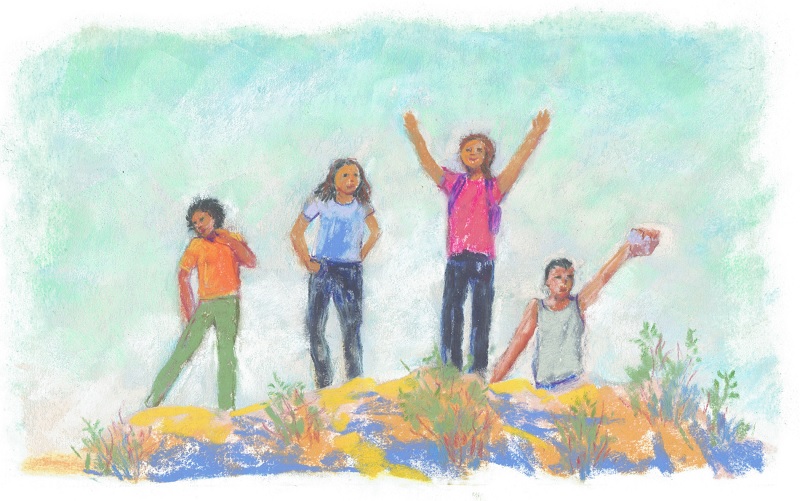
Shanna grasped the rough rock and pulled with all of her strength. She gulped in a great lung-full of the rich spring air and heaved herself over the last boulder just ahead of Rohan, Ella and Rebecca. 

“Queen of the mountain!” she chortled as she spun in a circle and waved her arms in the warm, free air.

Her friends pulled themselves up and collapsed giggling on the rock beside her. 

“You’re too fast!” Ella puffed, as she sucked on a scraped finger.

“I’ll beat you next time,” Rohan laughed as he pretended to tackle Shanna’s foot.

“You kids be careful on those rocks,” their teacher’s voice floated up to them from the trees below. “There could be rattlesnakes.”

“I think we’re making enough noise to scare away the rattlesnakes, Mrs. Baker,” Rebecca called down. “And you said we were supposed to find as many different kinds of rocks as possible.”

“Well, did you find any new rocks while you were scaling the mountain?” Mrs. Baker’s voice sounded like she was chuckling now. 

“I think so,” Rohan called down and he held up a speckled rock. “This might be granite.”
Another group of kids came running out of the trees to show Mrs. Baker their new rocks. They were led by a girl with light brown hair. She was Brandy, the most popular girl in the fifth grade. And she didn’t like Shanna. If she was entirely honest with herself, Shanna had to admit that she didn’t like Brandy either. 

But looking down from way up on the rocks, Brandy looked small and Shanna thought about how her new school wasn’t as bad as she’d first feared. Mrs. Baker, her class teacher, was a lot of fun. She had gray hair, but she still loved to go on field trips, and she found a way to do a lot of lessons outside—even math. 

This warm spring day they were collecting rocks for science. It was also for math though, because Mrs. Baker said they would be practicing percentages and graphs once they gathered all of the different kinds of rocks they could find on the waste land behind the school. 

The waste land was a long, low hill that ran up from the back of the soccer field through brush and rocks and a few scraggly trees to the new River View Condos. It wasn’t really a park and there was litter here and there among the boulders and water-starved trees, but Mrs. Baker said they had to learn as much as they could from it before it got bulldozed. 

Ella and Rebecca started looking for more rocks, walking up the gradual hill behind the Queen of the Mountain boulders. Shanna followed them at first, but then she saw dark green rocks down in a little gully under some particularly nice trees, so she slipped and slid her way down. 

As she got close she heard a splashing sound like water hitting a rock. Was someone pouring out their water bottle? What else would make that sound out here?

Shanna looked in among the trees. They didn’t look very high down in the gully, but they were actually bigger and less scraggly than most of the other trees on the wasted land. 

The whole country here was pretty dry and trees didn’t grow in big forests the way they had where Shanna used to live. There was usually just one or two trees together. But in this little gully there was a whole clump and the grass around them was lush and green. Out on the open hillside the grass was already turning yellow from the dry heat, even in April. Mrs. Baker called it a “drought.” 

Curious, Shanna stepped closer. In the little hollow under the trees the air smelled wetter. And the grass beneath her feet was brilliant green. Shanna saw something sparkle and flutter in among the trees. Maybe a butterfly.

She climbed over some big rocks and slipped in between the trunks of the trees. And there behind the trees were more flowers than she had ever seen outside a flower shop. Red, purple, yellow, blue, orange… They hung down the rocks and covered the ground under the trees.

Shanna looked around for the butterfly and there were at least ten of them, flitting in and out of the sunlight and shade. She was about to call out for her friends to come and see the beautiful scene, but something stopped her. 

One of the butterflies was different. It seemed to glow against the shadows under the trees and Shanna couldn’t see it right. It didn’t even look like a butterfly exactly, but it wouldn’t hold still so she couldn’t get a good look at it.

Instead it zipped back and forth as if showing Shanna the way forward. It dipped first at Shanna and then back further into the trees. Shanna walked carefully now, trying not to step on all the beautiful flowers. The air in the little grove of trees was sweet with the smell of them—almost overwhelming, so it made Shanna dizzy. 

And maybe she was just dizzy when she looked up from her feet again and stared. 

There in front of her was an even more amazing image. Flowers with delicate dew-speckled petals hung down all over a wall of boulders. And the rocks weren’t really dark green like Shanna had thought. Instead they were covered with thick, wet moss.

And out of a crack there came a sparkling trickle of crystal clear water. It leaped and splashed down the rocks below and filled a little pool, before trickling under the roots of a big tree and disappearing back into the ground. It wasn’t a stream exactly, because it just went back into the ground.

But that wasn’t even why Shanna stared. Right in the middle above the sparkling pool was her butterfly. But Shanna was sure for a wonderful, dizzy second that it wasn’t just a butterfly. It had the shape of a person with wings and it shone with a turquoise light. Its wings were violet purple like the flowers and its hair was a deep blue green. Shanna couldn’t see it much better than that.

Then it winked a deep greenish-brown eye at her and dove straight down into the water. In a flash and a sparkle of drops, it was gone. 

“Ella! Rebecca! Rohan! Come quick!” Shanna cried over her shoulder, too startled and amazed to rethink her shout. 

She dropped to her knees on the mossy rock by the pool of water and looked around as carefully as she could. Where had it gone? 

Had she seen what she thought she’d seen? A butterfly? Or… could it really be… a fairy? A real fairy?

The other kids came panting into the grove of trees with thudding footsteps muffled by the grass, and Shanna didn’t see it anymore whatever it was. She thought then that she shouldn’t have yelled, but it was too exciting.

“Wow! This is a really cool place,” Rohan said, looking around at the trees, the climbing and hanging flowers, and the little pool. “Good find, Shanna.” He grinned and ran a hand over one of the tree trunks.

“It’s like it called to me,” Shanna said, still caught in the feeling of wonder.

A story of cultural and religious diversity for the spring equinox

The gift of a friend,
The promise of the pentacle,
A new beginning…
And the courage to stand your ground.

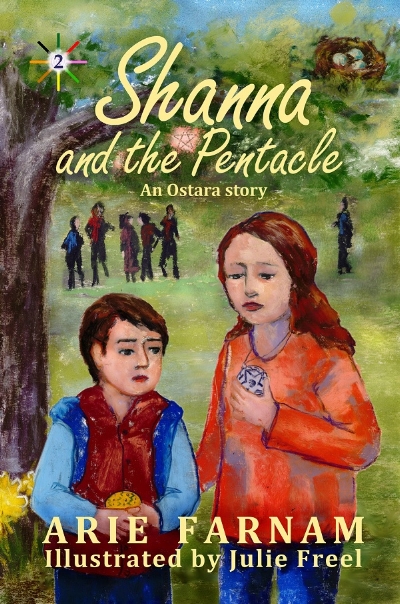
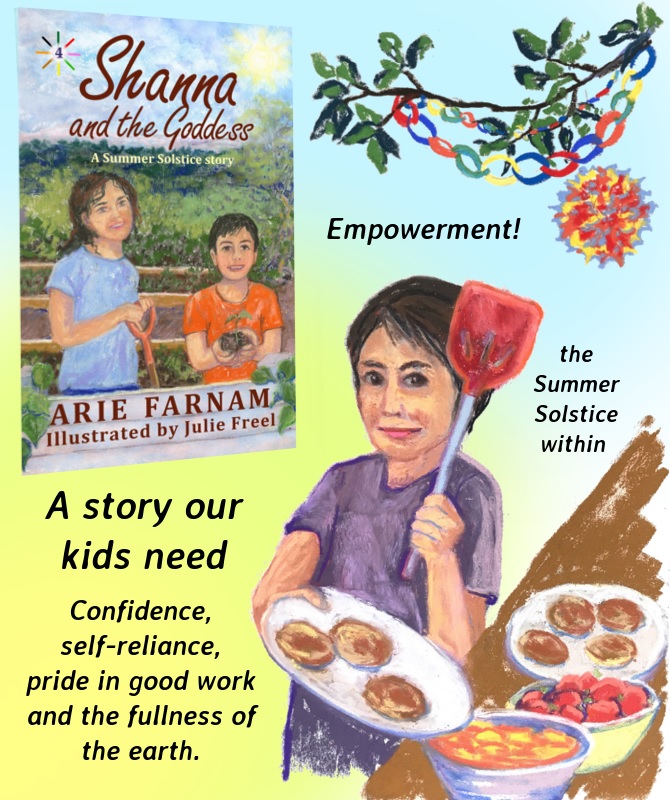
Shanna and the Pentacle is a story for earth-centered families to share the wonder of renewal and rebirth. The spring equinox (Ostara) is a time for buds and shoots, for the smell of wet earth and for asserting your true self. A new beginning can be hard but it’s worth it after all.

Ten-year-old Shanna and eight-year-old Rye are starting out at a new school just before Ostara. A teacher notices Shanna’s pentacle necklace and asks her to take it off. Brandy, a popular girl, says Shanna is going to “hell” and Rye has his own trouble with kids who say boys don’t draw or sing. Still the magic of Ostara is at work. Shanna and Rye are learning to enjoy the cultural diversity of their new school and help comes from unexpected sources.

Like Shanna and Rye, children from earth-centered families often stand out in mainstream society. Without strong identity and confidence, they struggle to choose their own path. The Children’s Wheel of the Year books provide concepts our kids need to face these challenges.

And they are a lot of fun. I never had kids get their teeth brushed this fast for story-time before we had these books. Thanks, Julie Freel, for the great illustrations that make it all possible!