Press bans and fear: How authoritarianism changes us

The community room in a rural library slowly fills with residents on a warm September night. This is a county that has voted deep red for decades in a district continuously held by Republican congressmen since 1981. A packed meeting of over sixty attendees for the town hall of a Democratic challenger is a curiosity in this town of just over twelve thousand.

There are more gray heads than any other color and precious few under the age of forty. But the energy of the crowd is fervent, leaning forward in their seats, ready and passionate. Not all are particularly convinced by the Democrat, though no one here speaks up in favor of the Republican incumbent. At first, there seems to be no media present, until a local blogger stands up and starts snapping photos with an iPhone.

Might this upstart candidate have a chance to beat the juggernaut of a Republican who has won the district with 60 to 68 percent of the vote in three consecutive elections? Does he stand a chance with a budget of reportedly $30,000 up against roughly $1.3 million on the Republican side? The crowd seems to hope so. Their questions aren’t so much about the candidate’s policies as about strategy. How does he propose to win?

The strenuous but positive atmosphere is shattered when a harsh voice interrupts loudly from the back of the room. “Are you recording?”

I’m that lone blogger/journalist, and I’m momentarily stunned. But I manage to blurt, “No!”

The voice continues, scolding, demanding that I stop taking pictures. Given my history as a person with a visible disability, I have huge social anxiety, and it is all I can do to ask whether there is a media ban. I turn to the precarious candidate, who is frozen in mid-sentence. “Are you not allowing pictures?”
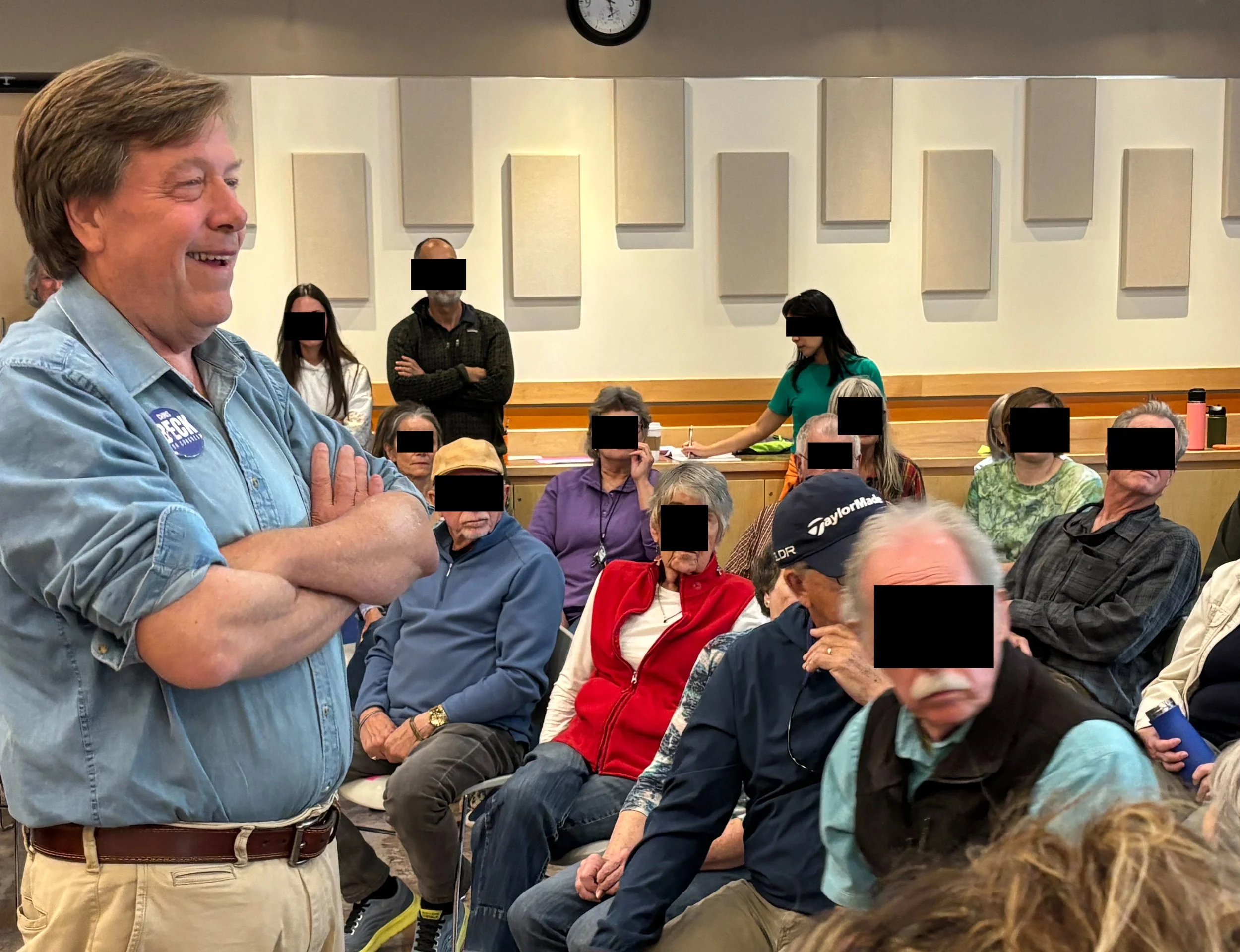
Chris beck, democratic challenger in a deep red district, talks with a crowd at a rural town hall where a member of the audience objected to photos, citing security concerns - the image shows a man talking to a room full of people with their faces censored by black rectangles - image by arie farnam

“No, n…n…no. Photos are fine.” He seems as shocked as me.

But my companion that evening taps at my leg. I can’t see the faces around me. I take photos, but that’s mainly because I’m good at composition. I’m still legally blind and the faces are all blotchy ovals without expression or distinction. I don’t know who has yelled at me or who might now be glaring. So, I sit down.

I don’t feel welcome. The general mood has soured considerably, and both questions and answers feel forced. "That was uncalled for," one woman whispers. Another comments, “She wouldn’t treat someone she respected that way." A half an hour later, I muster the courage to duck out the back door, giving a little wave in case anyone is watching for my reaction. The last thing I want to do is put more of a damper on this particular campaign.

I hoped that would be the end of it. But as it turned out, the person who scolded me was sort-of the organizer—at least the person who had helped Chris Beck set up this town hall, though he’d insisted on leading it himself, and apparently with good reason. Had there been a media ban of some kind announced? No, no one I spoke to had seen or heard anything of the sort.

Later that evening, I received a text from the organizer, demanding that I not publish any photos including her or her husband. The camera had been turned to capture the candidate plus some portions of the crowd, after all. And it hit me that this wasn’t just a controlling event coordinator with a poor understanding of free press coverage, but a person afraid for themselves and their family in a time of political repression and vindictiveness.

Was that reasonable?

Fear is rarely “reasonable.” It catches, reacts and grows like wildfire, unpredictably and usually in ways that are unhelpful. Certainly, we face significant political retribution in the U.S. today. That very weekend, reporters from CNN, Politico, and MS NOW were banned from the press areas of the White House for reporting that was mostly tepid and only sometimes rigorously fact-checked Trump’s statements. Naturally, those of us with opposition views get nervous and try to protect our identities when we can.

But this was a campaign event and a town hall where people from both sides were likely to meet, some expressly to argue with the candidate. The question about recording made a bit more sense if someone wanted to ask a sensitive question. But photos? How could being photographed in the audience of such an event be considered controversial?

Well, what if we were in Russia? In the period when a campaign event by an opposition candidate was even theoretically possible in Russia, being seen in the audience might well have been problematic, given that no one who wasn’t actively working for the regime as a spy would be there unless they were a vehement supporter of the candidate. Because that’s how Putin rolls. Surveillance would be guaranteed. Retribution might not be immediate, but the files would be kept for a time when “evidence” against you might be desirable.

I spent the next several days thinking about it, while an uncomfortable debate cropped up in our local activist discussion channel about me and my photos. Most people seemed to take the side of the organizer who had scolded me. One woman thought the camera was pointed too much toward the audience. Another speculated on how a media ban could be logistically carried out. The organizer claimed the library’s policy against photographing staff and patrons covered public events as well. A lawyer chimed in to state that it is legal to take photos at campaign events.

But that doesn’t really solve any of our problems or answer the thorny questions. Is it ethical to take such photos? Is it ethical to ban journalists or all photos at a public campaign event? Is it legitimate to be afraid of being identified in the audience, since people with opposing views do often attend town hall meetings in the U.S.? And if you think things are as bad as they are in Russia, shouldn’t we expect more discreet surveillance anyway? With Trump banning journalists, is this really something we should be emulating?

In Russia or the totalitarian states of the old Soviet Bloc, a media ban by opposition groups wouldn’t be on the table, not because their situation is (or was less dire. The opposition in Russia still faces worse repression than we do, regardless of how shocked we are at Trump’s recent actions. But in Russia, surveillance of any publicly announced event, whether an opposition campaign or a protest, would be guaranteed, whether it was visible or not. And any independent media coverage would thus be welcom, not as a means by which the authorities would grab the identities of those present but rather as documentation that is desperately needed, whether it can be used in media coverage or not.

In Trump’s America, with security cameras and smart phone location services constantly tracking us, it’s hard to imagine any advantage in banning photos that might include part of the audience at such a public event. Even local antagonism can’t be avoided. Every one of our outdoor public events is photographed by people driving or walking by. We’ve noted several photographers intentionally capturing every face in protest crowds. Some of us wear masks to try to avoid being recognized locally, because there are examples of threats and intimidation against people who oppose the MAGA movement, especially in rural areas like this.

I was trailed by a white pickup at a walking pace while I was out with my guide dog a couple of months ago. I do understand the fear.

But fear itself is also one of the greatest threats we face. All too often fear is wielded as a conscious weapon by authoritarian governments. It is meant to cause just such scenes—to turn likeminded neighbors against one another, to sow dissention and suspicion among opponents of the regime, and to ensure that efforts to oppose the regime stay quiet, unpublicized, and repressed. And it isn’t just fear that bleeds out of authoritarian regimes and into the thoughts and actions of the population.

When Trump banned major media organizations from access to the press areas of the White House, he did so in an intentionally shaming way, canceling the badges of reporters who were then dramatically refused access in front of their colleagues. Many of us share messages online about how "we are not the same." We say our opposition to this administration is not merely about political differences of opinion. It’s about things that go much deeper.

Bullying. Censorship. Banning journalists from legitimate public places. Intentional cruelty. Undermining democracy. These are not "political issues." These are moral issues. 

And it is not only right-wing politicians and groups that have engaged in them throughout history. Left-wing idealists with the best of intentions worked hard to build labor movements that, in some cases, developed into totalitarian regimes. I spent a lot of my journalistic career witnessing the aftermath of that in Eastern Europe.

That is why I, first and foremost, pay attention to the difference between political and ethical issues. We must guard against the creep of authoritarian thinking into our own groups. Authoritarian power. Shaming. Banning journalists from a campaign event. Those are not left or right, Democrat or Republican. That power dynamic is often spread by a regime that is so pervasive in its misbehavior that it causes citizens to mimic its tactics and turn on one another out of fear.

That is something that working as a journalist in countries with present and recent totalitarian regimes taught me. The problem isn't just the regime. Much worse is how such oppressive systems turn the people against one another, poisoning opposition groups with fear, infighting, and cynicism. This is a fascist regime that we're up against and the mutual suspicion and depression spreading in progressive groups across the country is one of the proofs of it.

We must also protect one another. Some people are more at risk than others in these times. I’ve obscured the faces in my photo to be as safe as possible, but the fact that we all had tracking devices in our pockets should banish any false sense of security. I urge everyone to learn about realistic security and privacy measures, including leaving phones at home and wearing masks. No one should be hassled if they choose to protect their own privacy.

But no one should be shamed for doing the work that needs to be done either. I was shaken by being publicly reprimanded, but I’d go through ten times that much if I thought it would help. The problem is that the change in the atmosphere of that room was palpable. No one wanted to say a peep. Some likely won't come again.

If only all the negativity just came from the regime!

It is hard to get along, to let slights go, to take personal safety measures, choose one’s own level of risk, and then be brave. But we know the alternative. As Chris Beck, the one person in the room with no hope of anonymity, said, "This is not about me. It’s bigger than any of us."

Strike a blow against bureaucracy: Freedom for multicultural names in the Czech Republic

My path to parenthood was a rocky one, slogging through infertility, an Eastern European adoption system and the judgments of many who felt a blind person shouldn't parent in the first place.

As well as those large boulders, there were some small, sharp stones on that road, not barriers but merely unpleasant jabs to endure. These were, for instance, lectures from bureaucrats about how wrong I was--wrong to think I could parent, wrong to adopt, wrong to accept children of another ethnicity, wrong in naming my child...

Creative Commons image by Jason Pratt

Creative Commons image by Jason Pratt

That last was one of the final rocks in my shoes, but one that I knew about from the beginning. I had heard rumors about the Czech Republic's name czar, an elderly linguist with the antiquated opinions of the 19th century. 

You see the Czech Republic has a name calendar. Each day of the year has been given a name, sometimes two. These were originally the feast days of saints and the custom dates to a time when immigrants were few and knowledge of the world beyond the little valley of Bohemia and the hills of Moravia was very limited.

Name days are still celebrated by many in the Czech Republic. Friends and family members give flowers, cards, chocolate and alcohol to those named after the saint in the calendar. As a result, being given a name that isn't on the calendar could represent a distinct denial of small gifts. 

This may have been one of the motivations for appointing a linguistics expert to control all foreign and uncommon names given in the country. Another reason given was to prevent people from having to correct the spelling and pronunciation of others.

I will admit that there are some small perks to this rigid naming system, once you have learned to pronounce all 365 or so names--no small feat with names like Zbyněk, Wilhelmina, Břetislav, Otýlie and Zdesislava--just to name a few. If you are ever called upon to pronounce another person's name without help, you theoretically have no problem. 

But the most commonly cited reason is the fear that classmates will ridicule a child with an uncommon name. Those who wished to give their child a common foreign name like Doug had to apply for a permit, while one could cheerfully and freely name a child Bonifác--one extremely rare Czech name that sounds just as ridicule-prone in Czech as it does in English, but which—none the less—gets a day on the calendar (May 14 to be exact).

That's why when I went to name each of my kids and didn't want to choose either the 30-odd actually used names on the Czech calendar--which results in my children's classes having only three names to share between eight girls and the like--or any of the ridiculous ones not in general use, I had to approach the name czar with polite pleas of supplication and suffer through one last lecture about my wrongness. 

The name czar warned me that my children, named Shaye and Marik, would suffer terribly in school because of their odd foreign names. In both instances, the name czar originally denied my request and I had to document the common use of the names in other countries.

Beyond the fairly popular English name "Shaye", "Marik" is a Slovak variant of the common Czech Marek and it saves my son from sharing his name completely with two other kids in his year. But the name czar did not like my choices.

Exhausted from years of this kind of ordeal in the adoption process and still unsure whether or not the authorities could revoke our children if we were too disobedient, my husband and I bowed our heads, produced all the needed paperwork and stuck to fairly standard names even when applying for something different.

But not everyone is such a lightweight, thankfully. Another mixed couple--an American of Native American Indian background and her Czech husband--won their two-year court battle with the name czar this past summer. They had to go all the way to the Czech Constitutional Court, the highest court in the land.

Tthe court struck down the name czar and the power to intimidate and harass families of diverse cultures. The court decreed that the law says only that parents must provide documentation, such as a mention on a baby-names website or another registry of names or evidence that a name has been used in the past. Upon the filing of this documentation with a county clerk, the parents’ name choice will be automatically accepted. 

My children are well into their school years with their mildly unusual names and they don't report any major difficulties. My daughter has mentioned that mean boys will occasionally chant bastardized versions of her name, but they do it to all the girls. She is mildly dismayed that her name rhymes with so many things because this gives the boys a bit more fodder.

Still she is strong-willed and does not want to use her bland second name Hana (mostly given to her to ensure that she would not miss out on name-day treats).

My son, on the other hand, is slightly sad that his does not rhyme with anything in English or even that much in Czech. I have had to correct officials a few times when they heard his name and assumed it was the more common Marek, instead of Marik, but my son is happy with is little bit of uniqueness and that is what matters in the long run.

I am relieved to hear of this small victory for common sense over bureaucracy and grateful to those who fought the long fight in court.  

How sure are you of right and wrong?

Thirty years after the war was over, a young father and history buff bought the shell of a house in the hills near a hotly contested border. He was a poor factory worker, but it cost only the equivalent of a month's salary because the old stone and timber dwelling was in desolate disrepair and the local fire department had been planning to destroy it in a practice drill. 

The new owner started to rebuild the house bit by bit. He wanted his children to grow up in the beautiful natural surroundings and he loved to learn about the tragic history of the land. He saved to buy new tools and materials and slowly over many years he rebuilt the old house to look like the pre-war photographs in the village archives. 

Creative Commons image by Heather Katsoulis

Creative Commons image by Heather Katsoulis

Then one day after the border was reopened, a middle-aged woman approached the house. She said she had lived there as a child, that the house belonged to her parents. Forty five years earlier when she was a child, militia men had come with guns and forced her family to flee. The armed men had stolen the family's bicycle, their only means of transportation, and forced them to walk over the mountains into the neighboring country with only those few things they could take with fifteen minutes warning. 

This is a real story. I knew both the man and the woman. They are real people. It's the kind of story that happens on contested borders. 

Ordinary people looking for a place of home and safety buy or stake a claim to land and homes. Other ordinary people are caught on the wrong side of a political, national, linguistic, racial, religious or economic divide are killed or forced to leave their homes. And so it goes.

And now tell me this. Who should own that house?

Should the man own it? He bought it with his hard earned wages, worked on it with his own hands and saved it from destruction. 

Should the woman own it? She was an innocent child forced to flee her home and she still has the birth certificates, deeds and other documents to prove that she should have inherited it. 

Your answer will probably depend on which border, which side of that border and which war you think I'm talking about. This isn't ancient history but a relatively modern and well-documented situation in which most of the questions can be answered. 

Take note of your instinctive answer and then consider whether the following facts change it.

The woman was part of a German-speaking minority and the house stands in the border region of the Czech Republic, then Czechoslovakia. The war was World War Two. Hitler annexed this border region of Czechoslovakia at the beginning of the war and the German-speaking minority was noted for significantly supporting the Nazis. 

That was the reason for their mass expulsion. Many, probably most, of the woman's group supported and cheered on the Nazis. And so--brutal and indiscriminate as it may have been--some people justify the forced expulsion of German-speaking people from Czechoslovakia.

But this woman was a child at the time, living in a remote rural cabin, no more to blame than any other child and less powerful than some.

I tell this story not to win sympathy for the Sudetten Germans. But rather to promote the practice of skeptical, mindful ethics.

If you were sure in the beginning of the story that the new owner should be compensated but the house should be returned to the old owner and then you changed your mind based on the added facts, you must admit that moral certainty is hard to come by. 

We want children of about ten years old to "know right from wrong." And yet educated and caring adults often find it difficult to say exactly what is right or wrong in a complex situation and which way the scales turn can depend on details that require an understanding of social, political, economic and historical forces. 

I don't personally have a definite answer for which is right or wrong in this real-life story that I stumbled upon as a teenager new to Czechoslovakia twenty-five years ago. The law here has retained the rights of new owners in that case. The man's claim is upheld by the law. But if the house had been confiscated by the Communist authorities and the family expelled after the Soviet invasion in 1968, the law would favored the old owners.

The law is not ethics. It's just the law. And one would be naive to believe that laws are consistent. 

Image by Arie Farnam

Image by Arie Farnam

I am happy to say that this woman did not demand her house returned or even seem bitter about the law. Instead she was thankful that the house had been preserved and reconstructed, so that it looked much like her beloved childhood home. The man invited her to come and stay and lovingly helped her to reclaim her memories and a family treasure buried on the property. Theirs was a story with a happy ending.

But so many similar stories are not. 

The past few weeks have had me thinking a lot about ethical dilemmas. The news has hit on story after story in which passions run high and there is more than one side with a claim. 

It isn't that I don't have strong opinions. I can clearly say that the killing of unarmed Palestinian protesters by Israeli soldiers is wrong, even a crime against humanity. But what exactly should be done to solve the situation? Whose homes should be sacrificed in a small country with limited land and water? 

That isn't so simple. One way or another in our crowded world, there are people in need without homes, often with a valid right to the land or homes where others, including those innocent and unaware of any injustice, are now living.

My entire native country is based on stolen land. And yes, we can say that those who have been wronged should be compensated, but by whom? Some of the descendants of those who stole from or enslaved others are wealthy from the profits of exploitation. Others are barely scraping by. And yet if there is a debt to pay, shouldn't everyone be required to pay all the same?

Even the question of the infamous Chinese prom dress leaves me befuddled. A white girl decided to go to the prom in a traditional Chinese dress, which she wore in inappropriate ways and seemed to mock in one photo. Many people are furious over this. It's called cultural appropriation, taking something from another culture, particularly one that has been exploited by your own in the past or present, and either claiming it as your own or using it inappropriately or mockingly.

Don't get me wrong, I can't abide people who set up shop as a "Shaman" or pen books on Native American spirituality who have no legitimate connection to either Siberian or Native American culture. Making a profit off of a stereotyped fakery poached from the struggling remnants of cultures nearly destroyed by exploitation is clearly wrong. 

But as I put Vietnamese spring rolls made with my own fresh garden greens down on the table for my children, while wearing a shirt with Guatamalan patterns, I am not so sure where the line is. I know where these things come from. I love them and treat them with respect. I want those cultures which have been endangered to be represented and kept alive. And I simply prefer the cuisine and color coordination of some cultures over others. But I can't say in every instance what is right and what is wrong.

If the girl with the Chinese prom dress had not publicly shared a mocking photograph of her dress, would it still have been wrong? Western prom dresses are, in my not-so-humble opinion, a fashion travesty of modern times. Please any culture that is willing to save us from them, please  step forward! Despite the problems, I still say the Chinese dress was the--hands down--prettiest in those photos.

Looking at all these less-than-clear-cut situations and modern problems, one is tempted to say that it all depends. Certainly, we should be critical thinkers and respect the opinions of others. It is tempting to say that there is no absolute right or wrong. Even when we teach children right from wrong when they are ten years old, we end up pointing out that a child in a storybook who steals food to survive is not really so bad. 

But these are terrible times to abandon ethics and claim moral relativism. Are the opinions of Neonazis equal to all other political opinions in political discourse? And if not theirs, then where is the line? 

We live in a time when political leaders preach an extreme religious doctrine and claim to be for high morals, while dallying with pornography, blatantly lying, taking and giving out huge bribes, poisoning their rivals, fixing elections and claiming it's legal, and abusing anyone vulnerable they can touch--without the scandals even making a large ripple. Gods help us, if we don't even know what is right and wrong anymore ourselves. 

Many intellectuals I have discussed this with say that an opinion is valid in so far as it is not against someone else or does not harm someone else. That seems like a good rule, but it is easier to to say than to apply.

Among the most vicious arguments I have seen in the past few days have been over the silent and non-violent actions of people protesting what they saw as deeply wrong. A week ago, dozens of graduates and their family members silently stood up and walked out of their own graduation ceremony at Notre Dame in protest as Mike Pence gave a graduation address.

When questioned, the protesters specifically mentioned Pence's support for extreme racist organizations and for Donald Trump's rabidly anti-Muslim policies. Pence is also noted for pushing extreme religious agendas and promoting the interests of large corporations, specifically the Koch brothers, in public policy. But regardless of whether one agrees with the reasons the protesting students walked out, the vicious verbal attacks and threats against them imply a certainty of the wrongness of protest. 

Pence himself called the banning of athletes who kneel to mourn the killing of unarmed African Americans during the National Anthem "winning." There is no question of right or wrong in that statement. It implies a game with winners and losers 

The actions taken to penalize the protesting and mourning athletes and their teams and the words often deployed against them are extreme, while their actions are mild, respectful and silent. 

I can understand a parent being upset if their child walked out of graduation to protest something the parent didn't understand or feel is important. I can even understand people brought up to believe that the National Anthem is sacred disagreeing with someone kneeling during it. But none of these are violent acts that harm another, and yet violence is threatened against those who take quiet actions in defense of their ethics. 

There are plenty of situations where I cannot say with certainty that I am right and another is wrong. Ddetails and historical context do matter. But I hope we will not lose the most basic concepts of right and wrong through this. If a person quietly stands, sits, walks or kneels to protest violence and hatred, they should have that right. I may not always agree with their side of the story, but I can always respect a quiet statement of ethical concern.

Corporate power and free speech

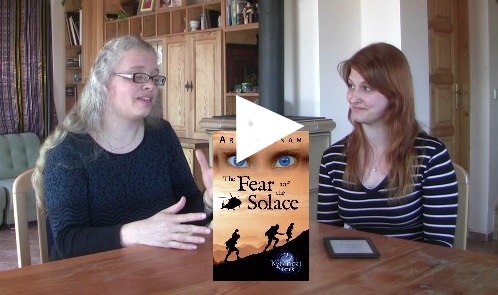
A video interview with author Arie Farnam

This is a repost of the first in a series of video interviews on hope and integrity in a perilous world. This interview focuses on the influence of corporations in society and how individuals respond with integrity. 

While the vast power of corporations often feels indomitable and the manipulation of our culture and media can be demoralizing, understanding of and resistance to tyranny is spreading.

As the progress of the past fifty years in civil, economic and environmental rights is under threat, we come to see that we have come a great distance and have much to believe in and lives worth defending. 

YouTube Link

YouTube Link

This interview also touches on how the struggle for social justice inspired my writing in 2014. The dystopian series that came out of that time is eerily predictive of our waking reality in 2017. That's why I'm reposting the video. As we struggle with immediate danger, we must also remember how we came to this situation in order to prevent its repetition in the future.

I write my stories because I cannot help myself. Writers must write. But I also write them to reach out and wake up the world from the malaise of apathy and despair. Mine are stories of hard-won and authentic hope and these video interviews tell how and why.

How to win the struggle against tyranny today

I received some hard news affecting the health and future of one of my children. And then I had to explain it to my husband after a particularly harrowing day He looks shell-shocked but also resigned, the way a lot of people look when discussing politics these past few months.

These days there seems to be nowhere to go to get away from the hard rain drumming down, whether personal or political. Any media you turn on is likely to either numb you, deepen your despair or coat everything in a somewhat sickening layer of figurative candy.

Creative Commons image by Hartwig HKD

Creative Commons image by Hartwig HKD

After my husband stumbled off to bed, I was about to turn in myself when I got a call from across the world, my adult niece phoning in edits to a manuscript. After that kind of day, there are few conversations I'd gladly stay up for, but this was one. 

Even so, as we decompressed after the editing work was done, she said almost the exact same despairing words that one of the characters in my contemporary dystopian series says, "It just seems like the bad guys win every time." 

I had not yet settled from my own fears or thought about the future for my family. Instead I was jolted into that disturbingly realistic fictional world by her momentary despair. It's a story about a kind of cult that controls hearts and minds in what looks like modern America and promotes corporate interests to the extreme. Those who resist the resulting tyranny always seem to be on the retreat, trying to shelter the most vulnerable among them and to salvage a sense of personal freedom. 

I wrote this some years ago, based on a premise and plot designed twenty years before that. But its relevance today is often uncanny. I wonder if George Orwell ever wished his book 1984 wasn't so right on.

Two years ago, when the Kyrennei Series first became public it was considered a dark and sometimes painful story. This was strange to me because I wrote it out of a sense of hope. Not the "smile and all will be well" sort of hope, but the sort of hope that keeps me going when both the present and the future look bleak. 

I wanted to reach out to my niece across the 5,000 odd miles between us and give her a hug. Not that she can't stand up on her own. She's been doing it for some time. But simply because I understand.

Here is the antidote to despair that another character offers in the story and the answer I gave to my niece on that midnight call: "I don’t know where this tyranny came from, but the hatred and greed that drives it seem to be endemic to humanity. I don’t think it is going to go away. That doesn’t mean we don’t win though. With every kid like Rowan who can raise his head, despite what he has been dealt, we win. With every child who grows up free, with every refugee rescued, we win. We win every day that we remain free in ourselves because that’s a day when we don’t lose."

I wake up in the dawn on too little sleep and muddle through the morning routine, which involves actions of resistance to the corporate and social oppression in the real world--chores for our urban homestead (part of mitigating climate change and ensuring my family's relative independence from corporate, chemical-laced food supplies), getting children ready for school while denying demands for sexualized clothing for an eight-year-old (part of the struggle to foster an informed and free-thinking next generation and to give one young woman time to understand gender dynamics before making her own decisions about her body as an adult) and dispensing herbal medicine that has kept us healthy for ten years without pharmaceuticals (part of the struggle to avoid being held hostage by corporations due to health needs).

Mine is a humble role in the struggle, feeding chickens and children. But every action is part of remaining free.

When there is a moment of peace, I light a candle and take a cup of tea.  Part of my mind is still with the fictional characters who cropped up the night before. A phrase from the freedom fighters in the book is still going through my head, "One more morning."

That's all they say. I made it to another dawn without giving up my hope and inner freedom. This day, I won. 

There are those who hold power in our real world who do resemble villains from a dystopian fantasy. And they have said in no uncertain terms that they want to destroy all who resist them. Larry Klayman, an influential lawyer, is heading efforts to put opponents of the Trump administration in prison. Neo-Nazi groups openly declare that they wish to destroy people of color, people of other faiths, immigrants, refugees and their friends. Donald Trump himself has declared that those who wish to protect the earth from climate change and other effects of corporate excess should be wiped out once and for all. 

It is not fun to contemplate. But contemplate this. They are failing. 

They can do many harmful things, but every time we get back up and resist in public or private ways, we win. Their stated goals are thwarted when we create moments and spaces of freedom. 

This is not a matched fight. One side desires control and mastery over others. The other side wants only peace and freedom in their own homes. While it is terrible in many ways, it gives us many chances to win. 

Know that you are not losing. Your persistence is their worst fear.

"Virtue signalling" versus "This is my life"

I go pick up my six-year-old son from kindergarten and he says a big kid from another class chased him and hit him repeatedly on the playground. Then he says another kid is calling him a racial slur.

I delicately ask the teacher if there have been any issues, and she explodes at me. "I don't want to hear it! I know for a fact that if there is any conflict, then your son started it. I don't care what anyone saw or what he says. He did something first. I know that. It's the way he is. It's in his background." 

Image by Arie Farnam

Image by Arie Farnam

I should have known not to bring anything up with this teacher. The other teacher swears my son is no more rambunctious than any of the other boys. She says they're all difficult. But mine is the only one not considered "white" by the standards of the country where we live.

He hides behind the shelves in the kindergarten boot room, eyes wide and mouth trembling. That night we have the discussion I've been dreading. Sex? Are you kidding? Imagine being afraid of discussing the birds and the bees!

Parents of black boys in America know this discussion though and I wonder if they dread it as much as I have. It goes like this: "I know it isn't fair, but for your own protection, you must never ever hit back. They will judge you more harshly because of the color of your skin and eyes." 

Again. this is kindergarten.

After the kids are in bed, I get online. It's work but it also involves blogging and discussing issues with people around the world. One of those issues is the ban on people from seven majority Muslim countries entering the US. And someone throws the accusation of "virtue signalling" at me because I express support for refugees who are affected by the ban. 

Initially I didn't even know what the epithet meant, I've been out of the country so long. But I looked it up and the gist of it is that I'm white so there is no way I could really be against racism and Islamophobia. I just say I am in order to "signal" how "virtuous" I am in an attempt to avoid anti-white backlash. So goes the logic of smug white commentators.

The absurdity of the past two weeks is staggering. I pride myself on being able to engage "the other side" with compassion but, dear goddess, how do you communicate across this canyon? 

If I tried to explain my day to the "virtue signalling" slinger, I might as well be speaking Urdu. 

I don't claim to know what it is like to be Black or Muslim in America. But I do have this little window into the issue of race because of the fluke of weird Czech attitudes toward ethnicity. I get enough of a window to know that I'm not experiencing the full extent of it by far.

And here's what my week is like:  

Refugees - Creative Commons image by Steve Thompson 

Refugees - Creative Commons image by Steve Thompson 

A gay lawyer friend and I helped a disabled immigrant with housing and paperwork the other night. After all, he was one of only a handful of people who stayed on a tough job with us one time. Then I go downhill skiing and I steer primarily by the sound of skis scraping on either side of me. I miss the days when I had a guide for blind skiers.

Then I come home and my good friend born in Syria who I've known for fifteen years and who ten years ago married an American and moved there is worried about whether or not she'll ever see the rest of her family again. (Oh, and her family is Christian, as are more than 20 percent of Syrians). I wish I could hug her long distance. I wish I could do anything but feel helpless.

I plan to go for a weekend to the home of the transgender friend with kids who I didn't used to know is trans. I have a short and pleasant Facebook conversation with a colleague I once went through a war zone with, who is also a Muslim and a former refugee. I'm glad to know he and his family are safe and well. Then I go out in subzero temperatures to feed animals and water overwintering plants in the urban homesteading that keeps our carbon footprint low.

When I say I am against racism, homophobia, ableism and other forms of bigotry and when I say I care about humanitarian and environmental issues, I'm only standing up for myself, my friends and my family just as you would if the storm troopers were at your door. 

Now I hear that there are protests in airports against the immigration ban for people from those seven countries which have lots of Muslims but oddly not nearly as many terrorists as the countries not banned. There are crowds of people standing on guard while Muslims pray in US airports.

I'm glad there is this outpouring of support for people who have had it rough for many years and who have generally suffered through it in silence and alone, trying to be nicer and less physical than everyone else, even while they were attacked, so that they wouldn't be labeled as "aggressive Muslims."  

I can't help but remember a trip back to the US five years ago. I was standing in an interminable security line with my kids--then no more than toddlers. I finally reached the point at which we were to enter the machines and checks and I noticed a family standing near by outside the line.

"We'll miss the flight," the woman said quietly but I heard. I am legally blind but I also made out the scarf around her head, wrapped in that way that I know usually means a Muslim. Her husband and two small children stood pressed near her, but he said nothing. All of their faces were a deep golden brown, likely with Middle Eastern or South Asian background.

I thought I understood. They had been held up and knew they didn't have time to stand in the line. Many other people would have begged to be allowed to cut in line, and with small children most would have been allowed. But they were too terrified to draw attention to themselves. 

I made a quick decision and stopped inching forward. Then I beckoned to them to join the line. The man's head jerked up and I thought he must be amazed, even though I couldn't see his expression well. The woman pushed him forward a little and the slid into the line in front of my kids. I heard a rumble behind me, coughs and someone pushed me roughly from behind. There were some coughs but nothing overt, yet.

My heart hammered in my throat. I am not a coward about most things but I have had plenty of reason to be afraid of public judgment and crowd disapproval. I whipped around, ready to defend myself and thrust my white cane, which I carry in confusing environments like airports, even though I can walk without it out to the side and demanded of the people behind me in line, "Have you got something to say?" 

The crowd stilled and I turned back around, the back of my neck and head burning as if their gaze could light me on fire. Still I felt a thrill inside. I had managed it. The Muslim family moved off quickly with only mumbled thanks. I gained no public approval or virtuous status that day. I did gain a bit more courage to act on my conscience, even when I may be publicly judged however.

This isn't "virtue signalling." This is my life. These are my people. You slander and malign them or you threaten to take away our basic rights, you ban people of another minority faith even if it isn't the exact same one as mine or you mock someone who shares a profession AND disability status with me, and you are much more likely to see my not-so-virtuous side. 

The 2017 List: 13 things to bring into the new year

With some truly depressing 2017 lists out there, I want to add a couple that might actually come in handy... or at least crack a smile.

Here is the Rebel With a Pen list of what to take with you when leaping into 2017:

  1. Chocolate

  2. A solar panel

  3. A manual for communicating with racists

  4. A Canadian passport or at least least a maple leaf bumper sticker

  5. Your entire library of books

  6. Wool socks

  7. A couple of 1960s protest albums

  8. Food stockpiles

  9. A bomb shelter

  10. Your family and near neighbors

  11. A first aid kit with extra bandages

  12. Your ability to laugh in the face of disaster

  13. Your generosity of spirit when it comes to people you might feel like judging

And with some of the bizarre wish lists out there, I figured that my brand of fantasy wouldn't seem far fetched at all. Here's my wish list for 2017:

  1. I wish Donald Trump would get on TV, laugh really loud and say, "Just kidding!" And then go back to his moocher lifestyle and leave us in peace.

  2. I wish everyone in the media would suddenly realize they should actually listen to scientists. Then science and climate discussions would be at the top of the news cycle all year long.

  3. I wish oil executives would realize the Indians own that land in North Dakota and that squeezing every last drop of oil out of the sand in Texas is not going to prolong their gluttonous lifestyle for very long anyway so they might as well start thinking about long-term survival.

  4. I wish my kids would wake up January 1 and realize that bickering defeats fun.

  5. I wish the next president would declare a new New Deal consisting of building solar panels to go on every roof and a light-rail system serving the entire country.

  6. I wish all the teenage ISIS fighters would get a deep hankering to go live with their mothers and watch TV until they're forty.

  7. I wish all bombs, missiles and munitions as well as all guns not in a safe under lock and key would mysteriously disappear on January 1.

  8. I wish someone brilliant would invent a way for writers and artists to make a living at their craft.

  9. I wish Microsoft would go bankrupt and have to sell off all of its parts to independent programmers who want to make an honest living.

  10. I wish our society would begin taxing the use of natural resources instead of the labor of the working poor and the funds would be put toward educational opportunity, urban greenspaces, rural public transit and subsidies for high quality cottage industries.

  11. I wish a benign virus would evolve and spread among humans which deactivates the part of the brain that categorizes according to skin color, speech pattern and the appearance of a person's eyes.

With those sweet and optimistic thoughts in mind, I wish you a very happy (and peaceful) new year!

Surviving the new reality

Rain drums on the roof as I write. I am on enforced rest. Doctor's orders. I could cry for joy over the rest, except that the eye surgeon has forbidden me to express intense emotions. 

But you get the idea. I don't feel sick but I'm supposed to stay inside, keep warm, not work much and be at peace. I know, I wish I could spread it around a little too.

The only downside of this is a feeling of vulnerability that comes with the isolation.  I hesitate to venture out much, even on-line. I am a bit breakable and the world has suddenly become doubly harsh.

Creative Commons image by Sepp Schimmer

Creative Commons image by Sepp Schimmer

I saw a post from an old work colleague about attacks against people of color in the US. I wrote in a quick reply of support and bittersweet humor. And instead of solidarity, my old office-mate lashed out at me, labeling me an "sheltered white expat." 

I instantly had the urge to fight back. I'm not one who takes things lying down or turns the other cheek. Sure, I'm white and I know better than many white people what privileges and protections that entails. I am highly aware when I meet police officers that I am wearing the backpack of white privilege--then and many other times. I also know that when any country is in the grip of fear that there is an understandable anger toward emigres--those who left, no matter how good their reasons. 

On the other hand, I'm also a person with a significant physical disability. I'm up against the wall in this too. My children are not white and they are newly naturalized citizens. Will we ever be able to go back to visit my home and family again? That is not an idle question in these post-election days. We are also in a country (the Czech Republic) that Donald Trump has pledged to put a military base in. We are isolated for the moment, but far from off the hook. 

Still, I bit my lip and said none of that. I know well the furious emotions raging in my colleague's post. I replied only to express more simple and direct support for her. I told her I am an ally and I understand her words. She and another friend continued to express anger and rejection toward me. There was no reconciliation. 

I am worried.

I'm saddened to lose a connection to someone I enjoy simply due to these terrible times. But I am even more worried by what this negative interaction among allies means for our people--the people of our country, citizens and non-citizens, all cultures and all backgrounds. We're stuck in this together, after all. 

My home county in Oregon reportedly voted 67 percent for Trump. There are people I call friends who did and likely even a few only moderately distant relatives. And if I cannot meet a friend who agrees with me in support and solidarity, if we are so divided that I am the enemy even when I am not across the political divide, how... oh gods, how will we live with those who really do hate and choose a hateful leader? 

Let's take a moment to forget that Trump even exists. 

Sigh. Now doesn't that feel better? 

But wait a minute. There's a problem. We've made Trump disappear but we haven't made the many people who vehemently support him disappear. Sure, we can say they are a minority, as few as 20 percent of the nation and not even most of the voters. But they are enough and we have to live with them, Trump or no Trump.

I have always felt this because of where I grew up, far from the cosmopolitan and high-thinking coasts. I love visiting Portland, Seattle, New York or Francisco for precisely this reason. Our bubble of acceptance and freedom feels so good. 

But we forget that this is not all of the nation at our peril. We ignore rage at our peril. We belittle politically incorrect antagonism at our peril. We've seen that now.

I know it is hard to think about surviving the next four years. But we will... most of us at least. And here is how I propose to do it:

Creative Commons image by Peter Roome

Creative Commons image by Peter Roome

  • If there is a registry for Muslims, get on it. I'll be a Muslim on paper.  If we're all on the list, the list will have no teeth.
  • Talk to Trump supporters. Really talk and listen. Listen to what motivates them, what they are upset about. Share your thoughts with respect and without contempt.  They are people and most people are susceptible to change, even if slow change.
  • Promote facts, everywhere, over and over again. The media will not help, so we have to do it. Talk about facts, post them, remember them, make lists. Don't let up about climate change.
  • Explain white privilege, primarily if you're white. Explain it again and again and again until you're sick of it and then explain it to more people. There is no way we're as sick of explaining it as Black, Hispanic and Native American people are.
  • Talk to the person no one is talking to at a gathering. Invite the disabled colleague or classmate to whatever. Connect. 
  • Make your circle bigger. Whatever it is you can give easily, put it in. Got a neighbor with younger kids who could use some of your nicer used clothes? Got extra veggies from the garden? Got wood or materials or whatever? Buy less, trade more, reuse more. Gain your security from community.
  • Take care of your own basic needs with as little resources as possible. Reduce plastics and fossil fuels in whatever ways you can. And remember you'll do more and better if you're rested, healthy and fed. Don't wait to be taken care of. Stand strong, think ahead, link arms.

My hope is with you.