
Ice as healer, as delight, as dire need as well as terror
/Nearly every day, I walk with my guide dog Conway on Fir Street toward the railroad crossing to the downtown area of La Grande, Oregon to shop at the health-food store, to put up protest posters or to pick up a prescription for my mom, who is recovering from knee surgery. For weeks, the weather has been cold but extremely dry in Eastern Oregon. There isn’t a speck of snow or ice in the valley, and the sun was brilliant.
On one particular block, we have to steer off the sidewalk and into the grass, because someone scattered salt on that sidewalk when snow and ice seemed likely in early January, but it hasn’t come for several weeks, and with the weather so dry, the salt remains to sting and erode the paws of a patient working dog, who wouldn’t flinch but would spend the evening nursing raw feet, if I’m not careful.
Ice--its presence, its ravages, its absence, and the need for it--is the tangled theme of my life these days. For the first time in my life, I’ve been the caregiver for my mother, instead of the other way around, while she recovers from surgery. Three times a day, I lift chill, wet bottles out of the machine that bathes her knee in ice water to keep the swelling to merely twice its normal size and replace them with bottles frozen hard as stone from the outside freezer.
My hands are cold. The sub-freezing air stings my face when I step out early in the morning to let Conway pee and switch out the ice bottles. Conway frolics across the yard and spins around the dormant lilac tree, delighted with the glittering ice crystals left on the grass by morning dew.
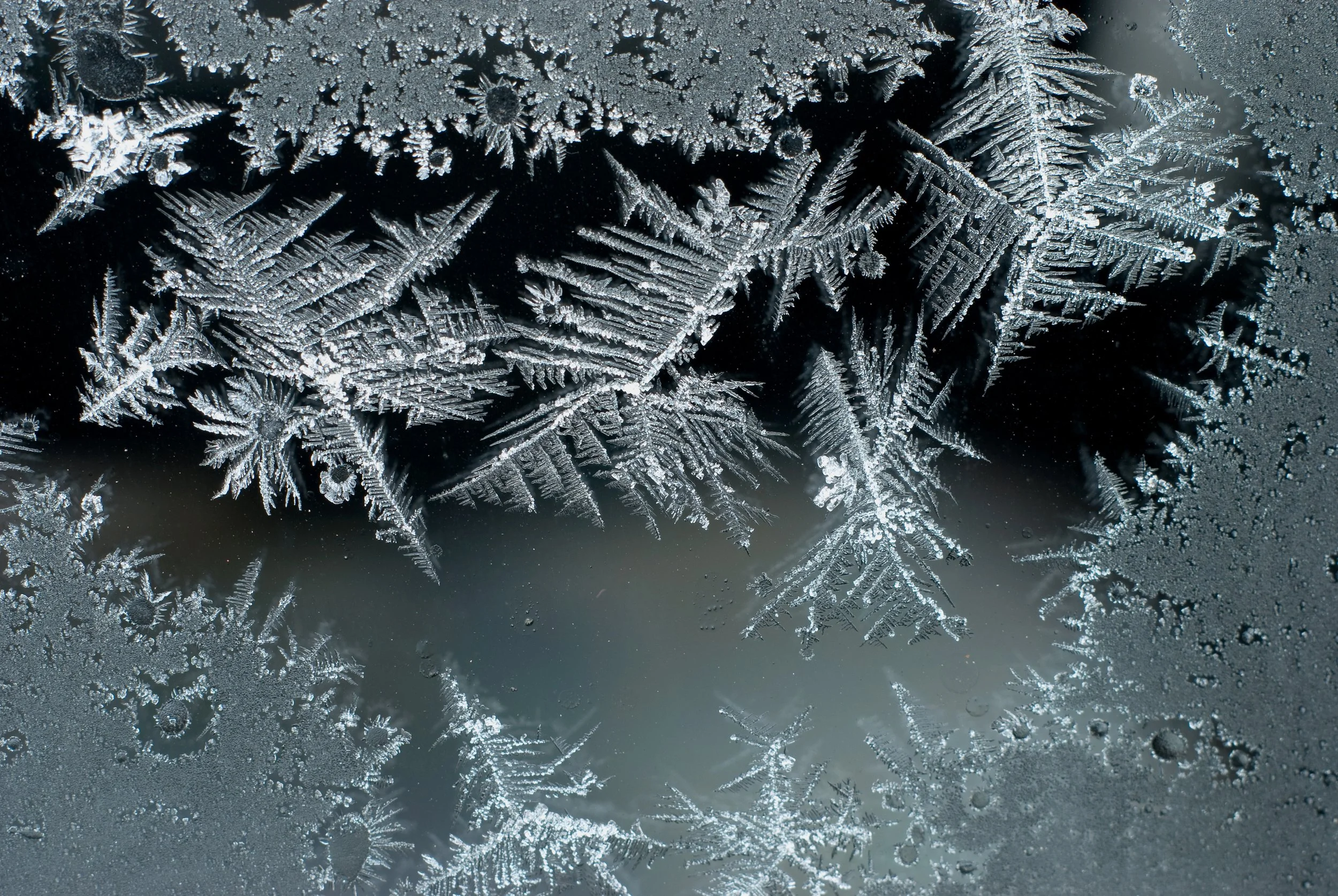
Creative commons image by Eric Wüstenhagen - Ice crystals shine in the light against a dark background
Ice is good. It’s a blessing, a healing, a joy. And I actually wish we had more of it right now, for the sake of the summer drought and the glaciers melting at the earth’s poles. Now the weather is breaking but bringing a drizzle of rain and warmer temperatures, instead of ice and snow. No one even talks about climate change anymore. Not in my town. Not on the news.
I say the word “ice” a couple of dozen times a day in reference to the roads, the weather, my mother’s knee, the state of my unreliable freezer or Conway’s delight. But of course, because I’m a journalist and a news junkie, I hear it hundreds of times per day in an entirely different context.
The cries of Native American grandmothers arrested while driving home, of the mother of an abducted US-citizen teenager, of the family of another US citizen--an elderly man--led outside in the extreme cold of Minnesota in his underwear, of a pregnant woman slammed to the pavement with a heavy knee in her back, of peaceful protesters beaten and pepper-sprayed directly in the face, and of those watching as a second citizen was shot down, murdered in cold blood echo from my tablet.
My mother pleads for me to use headphones. She knows, but she is trapped in a recliner with her knee up in the air, soaked in ice. She has no defenses.
ICE. It chills me every time I say the word in this context. I catch a ride downtown to a protest, where our signs rail against ICE. This time I don’t bring Conway. His ears are too delicate for the shouting, and we never know when things might get rough, even here. Even legally blind, I’m more equipped to handle crisis than my anxious, highly trained guide.
Not to mention the fact that I walk everywhere alone in this town most of the time, and I don’t need another way to be easily identifiable to the rabid cultists who blare by in their coal-rolling pickups, spitting hate and curse words out their windows. Cowards that they are, they don’t attack when there are a few hundred of us at a protest, but like wolves, they look for those who have been separated from the crowd.
I feel ice shoot down my spine as a pick-up truck slows and follows me for a couple of blocks on Fir Street. I don’t look around, but there is little reason for the vehicle to move at my walking pace, other than recognition and politics.
So, I wear a mask at protests. Icy wind chills my face after an hour and a half in the cold anyway. I return to the warmth of my home and change out the ice bottles in the machine again. Now the news says the United States is on the brink of invading Greenland, the land of glacier ice, named deceptively by ancient Vikings who didn’t know about oil and rare minerals, but claimed the frigid coast for Denmark anyway. As Europe lodges bewildered diplomatic protests, the US president says NATO allies are a greater threat to America than China or Russia.
I spent time in Russia and Kazakhstan back in the 1990s. The cold was as severe as it has been recently in Minnesota. It was cold so brutal that any bare skin could be frostbitten within minutes. Day-time temperatures topped out around negative twenty degrees Fahrenheit in the even in November.
For a time, I worked with an Afghan newspaper editor named Aref Jahesh, trying to make a video documentary about migration. He brought me to the homes of his friends and family, fellow Afghan refugees, and I’d sit on the floor with the children, eating flat bread with exquisitely spiced chutneys. Afterwards, we’d walk out into the frozen streets of Alma Ata, the ground covered with a sheer layer of black ice and a light dusting of new snow. Multiple times each day, Jahesh would take a step, shout and land hard on his back against the ice. I’d skate over to him on my heavy-treaded boots and give him a hand up.
Finally, one day he complained and asked why I never fell. He did actually have good boots too, for a wonder. I thought about it all that day, and in the end, I told him my theory. As a legally blind person, I always walk on suspicious ground. I’m never sure of the reality I think I see through extremely blurry vision. I always walk as if there could be ice or an unexpected gray-on-gray curb at the next step. I’m always ready to adapt.
Today, just listening to the news, I feel like Jahesh walking on that invisible ice.
Reality is shifting. There’s no ice under my feet here, though there should be in late January. Instead, my inner world feels slick and unreliable. Wasn’t it just a few years ago, I was on the other side of the Atlantic and worried about the expansion of NATO because of its implications of imperialism?
We pray for ice and glaciers, though we are cold. We fear ICE scouring the land, disappearing our neighbors, beating up random passersby, shooting to kill. The NRA is standing up for a liberal protester killed ostensibly for just having a legally carried gun. Progressives and leftists cling to NATO as the last hope of the free world. The US administration is closer to dictators in Russia and China than it is to Europe.
My hands are freezing. My ears are warm inside bulky headphones. I can no longer stand alone on this slippery surface.