
Bones on the ridge: A memory of genocide in the land
/I have always sensed grief in the land of my birth—love too, but also a vast and tender, barely covered grief.
When we give a land acknowledgement at events, we say “This is the land of the Nimiipu or Nez Perce people, the Umatilla, the Walla Walla and the Cayuse peoples.” Most locals know someone with Nez Perce or Umatilla or Walla Walla ancestry. But there are few Cayuse.
When I was a teenager, my dad had a blunt explanation: “There was a massacre. It was retaliation for something that happened over the mountains. The white settlers massacred a whole village—Cayuse, I think.”
For years, that was all I knew of it, and I envisioned this village out in the middle of the beautiful Grande Ronde Valley. That’s where you’d put a village, isn’t it?
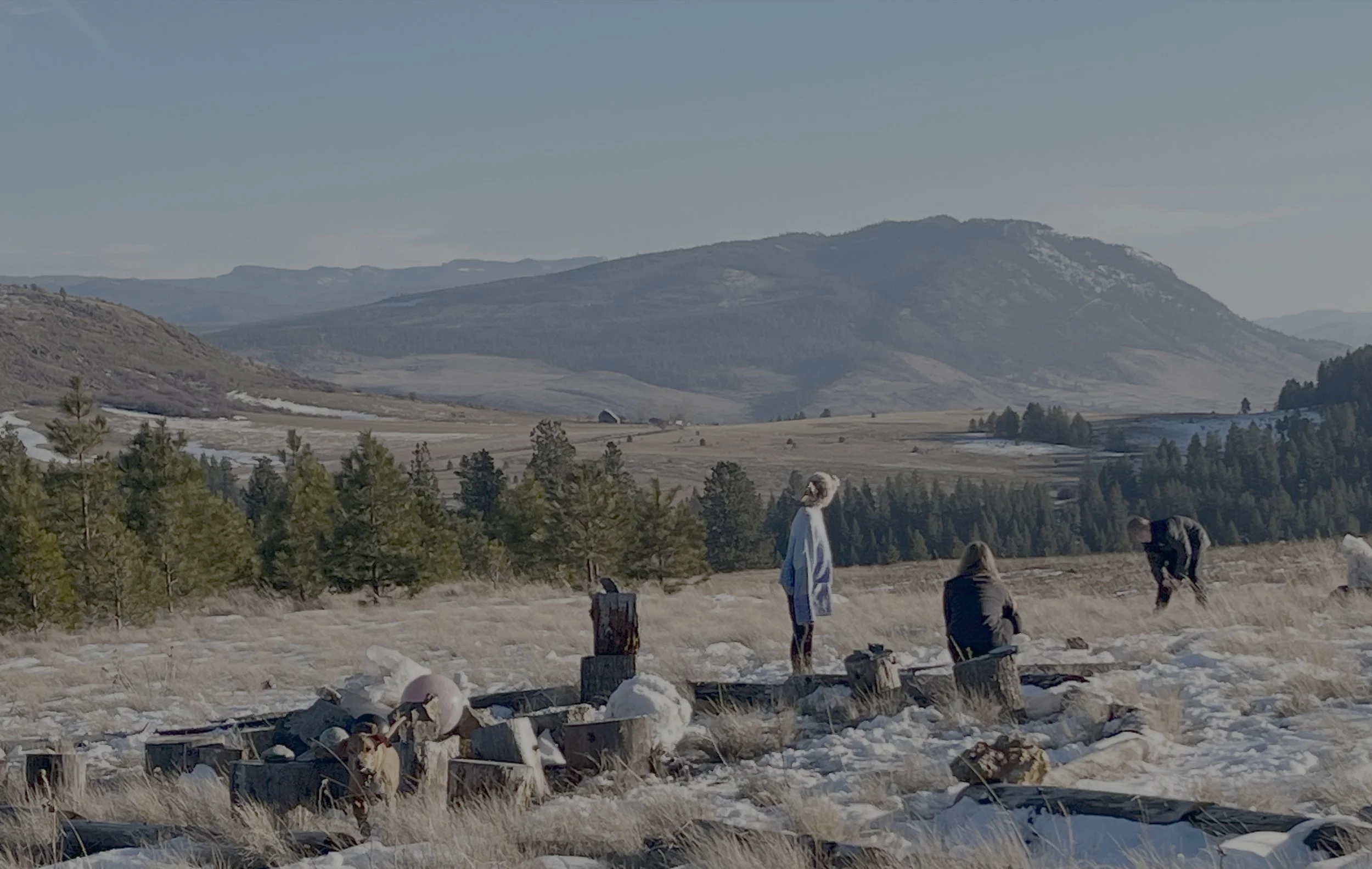
A photo of distant women looking out from the top of pumpkin Ridge toward a vista of rolling meadows and a mountain against the cool blue sky of early spring. Image by arie farnam
Recently, I decided to go looking.
First, I found that the massacre had indeed been named “the Grande Ronde Massacre” by historians, confusing a lot of students of history because there is a town called “Grande Ronde” on the far side of Oregon. But it was here, in the valley. It has the historical distinction of being the greatest loss of life in the state of Oregon, during what white historians call “the Indian Wars.”
Could this be why I have always felt a fragility in this land, like a body on the brink of tears? I grew up living very close to the land, growing much of our own food, spending nearly every day outdoors, covered in dirt and brush scratches. I loved our ridge, Pumpkin Ridge, at the far end of the Grande Ronde Valley.
I wasn’t a particularly astute child and I think I took a lot of things for granted, especially my hard-working mother. But somehow, even as a self-centered child, I didn’t take the ridge for granted. I stroked rocks, hugged trees and thanked flowers. I truly felt gratitude for the land.
My brothers and I also wandered freely across the entirety of Pumpkin Ridge, regardless of barbed-wire fences and the frustrated remonstrations of the ranchers, whose cattle we liked to chase with wooden swords.
To the south, there was the woodlot where edible mushrooms grew, a friend’s ranch and the road to the little store in Summerville where we bought candy. To the west, there was the highest part of the ridge, rugged slopes of gray, igneous boulders and pine trees and then a windswept prairie covered with wildflowers. To the North, there were houses with a few other kids, ponds and embankments where kids could build dugout forts. To the East, where our home faced, there was a large cattle pasture and beyond it a second high ridge.
I liked to hike up to the east ridge, where the wildflowers were particularly spectacular and look back at our little cabin across the hollow. But as a child, I was afraid to go further. Once I ventured into the grassy swale beyond the ridge-line and felt a wave of unprovoked, intense fear. The fences were no tighter than anywhere else, but I felt an intuitive barrier.
Forbidden!
As an adult, I pushed beyond that boundary but the land there still felt eerily silent. There were flowers but not much bird song. Pesticides used by the ranchers, I thought. Then, on the road down to Elgin, I came over the hill on a walk last year, and the whole slope was clearcut. The smell of diesel and dying trees, the jumble of earth and logs and branches, like coming across the scene of a rape or murder, the victim still splayed out on the ground, but the deed done and nothing to be done but cry.
I doubled over, sobbing. The grief I had felt in the land for so long, wracking my body with pain. I squatted down on the dirt road for long minutes, trying to pull myself together. Why? Who still does clearcuts these days? They know better. It destroys the land for so long. With the dry summers, it’s nearly impossible for trees to regrow.
I pulled myself together and went home, swearing I’d never go to that side of the ridge again.
Over several months, a niggling, whispering demand returned to my mind again and again. I must find the location of the Grande Ronde Massacre.
When I found the description in an article in The Oregon Encyclopedia by William L. Lang, I felt—rather than a bolt of shock that it could be so close to the place where I grew up—a deep recognition. Of course, it was there. My body had known it all along.
Just below that eastern slope of the ridge the Grande Ronde River loops through secluded, rocky meadows between the tiny towns of Summerville and Elgin. It was there at the foot of our ridge that the Cayuse and Walla Walla peoples had a summer village in the early 1800s. The gentle meadows between the river and the pine forest were an ideal habitat for camas, the bright blue flowers with nutritious tubers that they harvested and stored for yearlong sustenance.
In 1856, Isaac I. Stevens, then governor of Washington Territory, sent men out to hunt down and kill all “hostile Native forces.” Some were regular army. Others were “volunteers.” It was payback for an attack on white miners hundreds of miles away, over on the far side of the Cascades. Col. Benjamin Shaw, who led one band of those “volunteers,” discovered the location of the village.
Shaw rode out on July 17, 1856, with 175 mounted… (I struggle with the word here. Lang uses the euphemism of “volunteers.” I’m tempted to say “terrorists” but in a more sober frame of mind one might say “paramilitary combatants.”)
Whatever they were, they swept down on a camp full of women and children who were out digging camas and gathering other plants. There were a few young warriors present with horses, but most of the men were away. Those few boys stood little chance to defend their families.
Shaw wrote in his report, “The enemy was on the gallop for 15 miles, and most of those who fell were shot with the revolver.” This detail out of the past stabs into me. They chased these villagers for fifteen miles. A revolver is a close-range weapon. You don’t use one in a battle against armed fighters. You use it from the saddle, on people running on foot, close enough to touch. Most of them were women and children.
Another bit of the record comes from a Capt. Walter DeLacy under Shaw’s command. “Such was the impetuosity of the charge that many of their women even were unable to escape and were overtaken in the pursuit.” The exact number of those killed isn’t known, though scholars estimate that at least sixty, most of them women and children, were murdered, based primarily on the writings of DeLacy and other corroborating evidence.
These kinds of stories, lost in the past and told mainly in numbers, often feel divorced from reality and human emotion. DeLacy’s description of objects is particularly disturbing: “At least 200 packs were scattered over this distance, containing all their winter provisions, furniture, mats and in fact everything they possessed. In returning from the pursuit, we burned all of these as far as camp…we came to the Indian village, where 120 lodges were counted. It was burnt.”
I hope some escaped. The marauders estimated 120 dwellings, and scholars say something over sixty people were killed. But they were stripped of all of their gear. Shaw rounded up several hundred horses, took the best of them for his company, and slaughtered the rest. The soldiers knew that the remaining civilian population would starve in the winter without their horses.
As my country enters a new war in a distant land, I am shamed and saddened. I tell people about what I learned of the Grande Ronde Massacre and no one knows the history. It happened about 2 miles from where I was born in the loft of a scrap-lumber shack. There should be a monument. It should be taught in school, so that we learn from history.
If we, as a nation, remembered better what our country came from, might we think more deeply when choosing leaders, who might jet off to start new wars?
I am a granddaughter of the colonizers in this valley. I share blood and history with them, and I feel no natural right to roots here. But I can’t change my deep connection to the land, or my gratitude for having been born here. My body also sensed the grief and wounding of the earth on the east side of the ridge even before I knew its history.
Does the earth track our genes or bloodlines? Or does the body of the land call to the humming, throbbing body of soft flesh, pulsing blood and hard bone and whisper that we choose who we will be with each step we take from here on forward?