Press bans and fear: How authoritarianism changes us

The community room in a rural library slowly fills with residents on a warm September night. This is a county that has voted deep red for decades in a district continuously held by Republican congressmen since 1981. A packed meeting of over sixty attendees for the town hall of a Democratic challenger is a curiosity in this town of just over twelve thousand.

There are more gray heads than any other color and precious few under the age of forty. But the energy of the crowd is fervent, leaning forward in their seats, ready and passionate. Not all are particularly convinced by the Democrat, though no one here speaks up in favor of the Republican incumbent. At first, there seems to be no media present, until a local blogger stands up and starts snapping photos with an iPhone.

Might this upstart candidate have a chance to beat the juggernaut of a Republican who has won the district with 60 to 68 percent of the vote in three consecutive elections? Does he stand a chance with a budget of reportedly $30,000 up against roughly $1.3 million on the Republican side? The crowd seems to hope so. Their questions aren’t so much about the candidate’s policies as about strategy. How does he propose to win?

The strenuous but positive atmosphere is shattered when a harsh voice interrupts loudly from the back of the room. “Are you recording?”

I’m that lone blogger/journalist, and I’m momentarily stunned. But I manage to blurt, “No!”

The voice continues, scolding, demanding that I stop taking pictures. Given my history as a person with a visible disability, I have huge social anxiety, and it is all I can do to ask whether there is a media ban. I turn to the precarious candidate, who is frozen in mid-sentence. “Are you not allowing pictures?”
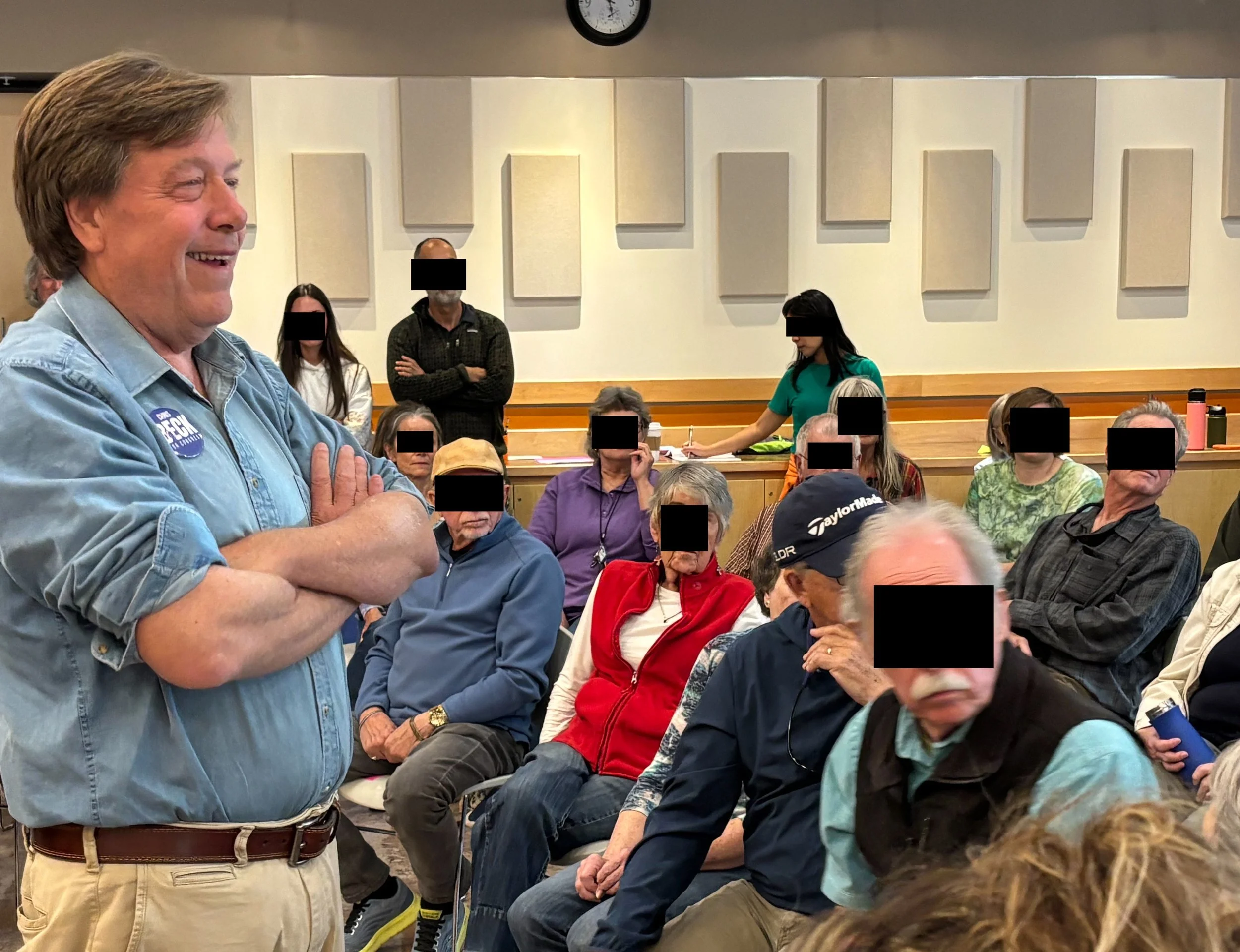
Chris beck, democratic challenger in a deep red district, talks with a crowd at a rural town hall where a member of the audience objected to photos, citing security concerns - the image shows a man talking to a room full of people with their faces censored by black rectangles - image by arie farnam

“No, n…n…no. Photos are fine.” He seems as shocked as me.

But my companion that evening taps at my leg. I can’t see the faces around me. I take photos, but that’s mainly because I’m good at composition. I’m still legally blind and the faces are all blotchy ovals without expression or distinction. I don’t know who has yelled at me or who might now be glaring. So, I sit down.

I don’t feel welcome. The general mood has soured considerably, and both questions and answers feel forced. "That was uncalled for," one woman whispers. Another comments, “She wouldn’t treat someone she respected that way." A half an hour later, I muster the courage to duck out the back door, giving a little wave in case anyone is watching for my reaction. The last thing I want to do is put more of a damper on this particular campaign.

I hoped that would be the end of it. But as it turned out, the person who scolded me was sort-of the organizer—at least the person who had helped Chris Beck set up this town hall, though he’d insisted on leading it himself, and apparently with good reason. Had there been a media ban of some kind announced? No, no one I spoke to had seen or heard anything of the sort.

Later that evening, I received a text from the organizer, demanding that I not publish any photos including her or her husband. The camera had been turned to capture the candidate plus some portions of the crowd, after all. And it hit me that this wasn’t just a controlling event coordinator with a poor understanding of free press coverage, but a person afraid for themselves and their family in a time of political repression and vindictiveness.

Was that reasonable?

Fear is rarely “reasonable.” It catches, reacts and grows like wildfire, unpredictably and usually in ways that are unhelpful. Certainly, we face significant political retribution in the U.S. today. That very weekend, reporters from CNN, Politico, and MS NOW were banned from the press areas of the White House for reporting that was mostly tepid and only sometimes rigorously fact-checked Trump’s statements. Naturally, those of us with opposition views get nervous and try to protect our identities when we can.

But this was a campaign event and a town hall where people from both sides were likely to meet, some expressly to argue with the candidate. The question about recording made a bit more sense if someone wanted to ask a sensitive question. But photos? How could being photographed in the audience of such an event be considered controversial?

Well, what if we were in Russia? In the period when a campaign event by an opposition candidate was even theoretically possible in Russia, being seen in the audience might well have been problematic, given that no one who wasn’t actively working for the regime as a spy would be there unless they were a vehement supporter of the candidate. Because that’s how Putin rolls. Surveillance would be guaranteed. Retribution might not be immediate, but the files would be kept for a time when “evidence” against you might be desirable.

I spent the next several days thinking about it, while an uncomfortable debate cropped up in our local activist discussion channel about me and my photos. Most people seemed to take the side of the organizer who had scolded me. One woman thought the camera was pointed too much toward the audience. Another speculated on how a media ban could be logistically carried out. The organizer claimed the library’s policy against photographing staff and patrons covered public events as well. A lawyer chimed in to state that it is legal to take photos at campaign events.

But that doesn’t really solve any of our problems or answer the thorny questions. Is it ethical to take such photos? Is it ethical to ban journalists or all photos at a public campaign event? Is it legitimate to be afraid of being identified in the audience, since people with opposing views do often attend town hall meetings in the U.S.? And if you think things are as bad as they are in Russia, shouldn’t we expect more discreet surveillance anyway? With Trump banning journalists, is this really something we should be emulating?

In Russia or the totalitarian states of the old Soviet Bloc, a media ban by opposition groups wouldn’t be on the table, not because their situation is (or was less dire. The opposition in Russia still faces worse repression than we do, regardless of how shocked we are at Trump’s recent actions. But in Russia, surveillance of any publicly announced event, whether an opposition campaign or a protest, would be guaranteed, whether it was visible or not. And any independent media coverage would thus be welcom, not as a means by which the authorities would grab the identities of those present but rather as documentation that is desperately needed, whether it can be used in media coverage or not.

In Trump’s America, with security cameras and smart phone location services constantly tracking us, it’s hard to imagine any advantage in banning photos that might include part of the audience at such a public event. Even local antagonism can’t be avoided. Every one of our outdoor public events is photographed by people driving or walking by. We’ve noted several photographers intentionally capturing every face in protest crowds. Some of us wear masks to try to avoid being recognized locally, because there are examples of threats and intimidation against people who oppose the MAGA movement, especially in rural areas like this.

I was trailed by a white pickup at a walking pace while I was out with my guide dog a couple of months ago. I do understand the fear.

But fear itself is also one of the greatest threats we face. All too often fear is wielded as a conscious weapon by authoritarian governments. It is meant to cause just such scenes—to turn likeminded neighbors against one another, to sow dissention and suspicion among opponents of the regime, and to ensure that efforts to oppose the regime stay quiet, unpublicized, and repressed. And it isn’t just fear that bleeds out of authoritarian regimes and into the thoughts and actions of the population.

When Trump banned major media organizations from access to the press areas of the White House, he did so in an intentionally shaming way, canceling the badges of reporters who were then dramatically refused access in front of their colleagues. Many of us share messages online about how "we are not the same." We say our opposition to this administration is not merely about political differences of opinion. It’s about things that go much deeper.

Bullying. Censorship. Banning journalists from legitimate public places. Intentional cruelty. Undermining democracy. These are not "political issues." These are moral issues. 

And it is not only right-wing politicians and groups that have engaged in them throughout history. Left-wing idealists with the best of intentions worked hard to build labor movements that, in some cases, developed into totalitarian regimes. I spent a lot of my journalistic career witnessing the aftermath of that in Eastern Europe.

That is why I, first and foremost, pay attention to the difference between political and ethical issues. We must guard against the creep of authoritarian thinking into our own groups. Authoritarian power. Shaming. Banning journalists from a campaign event. Those are not left or right, Democrat or Republican. That power dynamic is often spread by a regime that is so pervasive in its misbehavior that it causes citizens to mimic its tactics and turn on one another out of fear.

That is something that working as a journalist in countries with present and recent totalitarian regimes taught me. The problem isn't just the regime. Much worse is how such oppressive systems turn the people against one another, poisoning opposition groups with fear, infighting, and cynicism. This is a fascist regime that we're up against and the mutual suspicion and depression spreading in progressive groups across the country is one of the proofs of it.

We must also protect one another. Some people are more at risk than others in these times. I’ve obscured the faces in my photo to be as safe as possible, but the fact that we all had tracking devices in our pockets should banish any false sense of security. I urge everyone to learn about realistic security and privacy measures, including leaving phones at home and wearing masks. No one should be hassled if they choose to protect their own privacy.

But no one should be shamed for doing the work that needs to be done either. I was shaken by being publicly reprimanded, but I’d go through ten times that much if I thought it would help. The problem is that the change in the atmosphere of that room was palpable. No one wanted to say a peep. Some likely won't come again.

If only all the negativity just came from the regime!

It is hard to get along, to let slights go, to take personal safety measures, choose one’s own level of risk, and then be brave. But we know the alternative. As Chris Beck, the one person in the room with no hope of anonymity, said, "This is not about me. It’s bigger than any of us."

Who we are supposed to hate

First, let me tell you a story, a real-life adventure in the “Wild East” of the early 2000s.

I was backpacking through Ukraine during a frigid March with American freelance photographer Kirt Vinion on the trail of a rumor about illegal coal mining operations in the Donetsk region. We’d been on the rails and the cold streets for three weeks and my stamina was wearing decidedly thin. A contact of a contact of a contact finally led us to the apartment of a woman named Svetlana in a mid-sized, out-of-work coal-mining town.

She’d agreed to put us up for the night and get us connected to local people who knew about the mafia operations in the old mine tunnels. Kirt offered her money for her trouble, but that wasn’t what she wanted. Svetlana was educated and she knew a couple of foreign journalists, thread-bare as we might be, could be important in the struggle for a better future for her town and region.

The heat had been off for months and Svetlana kept all four burners of her range stove going, trying—mostly futilely—to heat her apartment. She said the future would be bleak unless the mafia could be brought under control. She took us to a local pub in search of food, and several rough-looking men surrounded us and loudly stated that they were going to kill us. Svetlana played cool, said her “Papa wouldn’t like that” and they melted away.

Creative Commons image by John Karwoski

“Everyone has connections,” she shrugged. “It’s how we survive.”

The next day a local writer friend of hers smuggled us out of town, lying down in the back of his hatchback. The “Papa” trick hadn’t quite worked well enough, they said. Vasya, the writer, dropped us off at the edge of a leafless woodlot as snow began to fall again and told us to walk down the track to the right for two kilometers, then turn left at the fork and we’d find “it.” He sped away before I could get clear on what “it” was.

There was no cell signal out in Eastern Ukraine in those days. This was all low tech, so we shouldered our packs and hiked. I could tell Kirt was uncomfortable and doubting my language interpretation skills. I was, however, much happier out in trees, away from too many people. Snow or no snow, this I could handle.

Sure enough, after some anxiety and floundering around, we came to a tiny, dilapidated village bordered by towering slag heaps. We stumbled out of the trees and a wirery old man came out of the nearest house, grinning from ear to ear with delight.

“Valeriy,” he told us his name was. He gave us hugs and double-cheeked Russian kisses and hustled us into the warmth of his “kitchen,” which was an open-sided shed in his garden enclosure. There he had a fire going and he started to fry up a small pile of potatoes. My hunger was almost overpowering. We hadn’t eaten a decent meal in a week and we hadn’t had anything to eat all day—with our escape from death threats and all.

When I thought I couldn’t stand it a second longer, Valeriy divided up the fried potatoes, sprinkled on salt and we fell to ravenously. “Yes,” we’d found the right place, he confirmed, bobbing his head up and down. “Yes,” someone had told him to expect us.

“Svetlana?”

Well, he didn’t know her exactly, but through someone else, a grape vine, one way or another, he knew about us and wanted to help.

“Tonight, you sleep!” Valeriy boomed heartily. “Tomorrow you will see the mines.”

“Will the mafia be upset that we’re here?”

“No, no, silly worries,” he guffawed. “Don’t worry. You’re safe here.”

The next day, true to his word, Valeriy introduced us to his relative-of-some-sort Vasily, who led us into the woods and introduced us to two different teams of illegal mine workers. One group was crawling in and out of a ventilation shaft in the a wooded draw half a mile outside the village.

While Kirt got outfitted to accompany the miners underground, I sat talking to the young women who made up a good part of the crew. They were in their late teens, little more than girls, but their faces were hard and black with coal dust. They showed me the hundred-pound sacks of coal they had drug up out of the shaft by hand without equipment beyond old helmets and headlamps.

“Isn’t it dangerous?”

“Of course it is, but there is no food here without money... The state controls all the farmland. If we don’t work, we don’t eat and neither do our children.”

Where were the older people? I asked. Mostly anyone over thirty was so sick with lung diseases from breathing the coal dust that they could no longer work. The crews got younger and younger every year, the girls told me.

The second shaft we visited went straight down like a well. There was a twelve-year-old working there, squirming into places the adults were too large to reach. “Yes,” they worried. The women in that group showed me the shrine for a group of colleagues who had died in a cave-in a month earlier. But here the same desperate explanation was repeated, and their gaunt faces and the fact that we could barely find food to buy despite our hard currency made it very believable.

We returned to Valeriy’s house exhausted that night but excited to have finally found what we had been looking for all those weeks. Valeriy had more planned for us the next day. He talked animatedly about how good this land had once been to his family. Showing me a portrait of Joseph Stalin, he kept in a place of honor in his living room, he explained that his parents had been resettled here from some place in northern Russia. They’d been hungry all the time and here the land was open.

“No one living on it,” he smiled, thinking back to his childhood. “The soil grew food as easily as weeds, and there was coal and good jobs for everyone.”

I was practiced at not showing my shock. I’d interviewed on both sides of grisly wars before and I knew how to keep an interested, open expression and just ask questions. But I picked at his memory a bit, tried to ferret out any concern over Stalin’s image in the rest of the world. Nope. Nada. If Valeriy had any clue that Stalin was not widely considered a working man’s hero, he was a better poker face than I.

We bedded down in the living room, covered in beautiful Russian wool carpets, paintings and antique furniture. Obviously this household had once known much better times.

Then, at five o’clock in the morning, as light was just breaking through the trees, Valeriy shook me awake. His face was drawn and ghostly white. His hands trembled and his voice rasped in a terrified whisper.

“Get up! You’ve got to get out now! Go! The FSB is coming for you! Someone snitched.” The FSB is supposed to be the Russian secret police, but colloquially that could mean anything from paramilitaries to mafia to rogue state actors.

Valeriy’s terror was all the more contagious because of his certainty of safety the day before. Kirt and I threw on our packs and ran through the trees on a trail behind Valeriy. We burst out of the woods along side a narrow highway and Valeriy flagged down a bus with letters spelling out Kyiv across the front.

“Don’t come back,” he called out as we swung aboard.

That was my experience in Eastern Ukraine in a nutshell. The most important theme across the whole week we were in the region was the incredible kindness of complete strangers, who—usually for no self-interest that I could discern—risked everything to help, shelter us, smuggle us from place to place or direct us to the next contact, all because they knew the medieval system of mafia-run, black-market coal mining that employed the labor of starving children was terrible and untenable.

The chain of good-hearted, brave people it took to get Kirt and me to that story was humbling. We published it in a major feature for the international newspaper The Christian Science Monitor. It inspired other researchers, but sadly it likely didn’t lead to any immediate improvements in the lives of the people of those desperate villages.

We tried, but the work of a journalist is to highlight one crisis after another. Usually, the follow up falls to others.

But today that story takes on new significance, and my knowledge of Eastern Ukraine—such as it is—is sought out due to the current war. I’m always hard pressed in these conversations to explain, “No, really these people were Russians. They spoke Russian… Yes, they helped us. They probably saved our lives a few times… Yes, they had portraits of Stalin… Yup, they were clueless… Yes, they literally shared their last remnants of food with us.”

And damn it! That is not a political statement. It is just a fact.

Yes, the Russian invasion is wrong, illegal and unwarranted. Yes, even in the East where there are a lot of “ethnic Russians,” it’s still wrong. Putin is a madman. So many Russians are duped by propaganda. Valeriy was. He thought Stalin saved his family. Heck, maybe Stalin did save his family, after he murdered a third of the Ukrainian population, which was why all that good farmland was empty and waiting for Russian resettlement back in the 1930s.

That doesn’t make it less of a fact that Svetlana, Vasya, Valeriy and Vasily risked their lives to help us, a couple of shoestring American journalists, get the word out about the excesses of their mafia overlords, That doesn’t erase their kindness and courage. And it does not mean I will ever hate all Russians or feel comfortable around the online vitriol and hate speech about ethnic Russians in Ukraine.

It’s understandable, and if your family or friends are under bombardment or held hostage in a blockade, you get some free passes to emote, in my book. But don’t ask me to go along and laugh at sick jokes about killing scared young recruits who don’t know where they are. I’ll work on planning routes for refugees and aid workers until I am sleep deprived and tottering, but hate has nothing to do with it.

I know there are Russians who do know the truth of the matter and they are horrified and ashamed at their state’s actions. They have my sympathy, not my hate. I’ll help them too, if I can.

And those who don’t know… Those who are taken in by the propaganda? I hope they’ll get out of that and force this war to stop. I’ll help there if I can too, and I know to be careful, because those guys who threatened to kill us in the pub, they were ordinary small town Russians too.

This isn’t naïveté. It’s just realism. People are people here or over there.

If given a chance, some people will go to extremes, grab all they can for themselves no matter who it hurts, hurt others just for kicks or a sense of power, scream hate and even kill. People here have that capacity, when they think they have the backing of those with power, as they did on January 6, 2021. And people there do too. The greater the feeling that violence is condoned, the greater the atrocities.

It isn’t a fundamental difference in humans. It’s just whether or not we let the bad wolves in our midst be in charge with guns or whether we insist on good wolves and the rule of law.

No matter the times or the conflict, there is always someone we’re supposed to hate. Most often, it seems like it’s right-wingers and rural “conservatives” preaching hate against this or that group, sometimes someone we’re at war with, sometimes someone coming to work the hard, dirty jobs they don’t want.

But the war in Ukraine has seemed to give educated, liberal folks a weird kind of license to hate. And the terms and jokes I’ve heard out of people I thought were level-headed and kind are sobering.

It’s one more reminder that no category really matters, not left or right, not ours or theirs. What matters—and it matters a great deal—is what kind of person an individual chooses to be right now in the moment, relating, thinking, talking. That line you cross when you let a little hate speech go because it feels good to release some of the pent up frustration, that’s the line that matters.