Press bans and fear: How authoritarianism changes us

The community room in a rural library slowly fills with residents on a warm September night. This is a county that has voted deep red for decades in a district continuously held by Republican congressmen since 1981. A packed meeting of over sixty attendees for the town hall of a Democratic challenger is a curiosity in this town of just over twelve thousand.

There are more gray heads than any other color and precious few under the age of forty. But the energy of the crowd is fervent, leaning forward in their seats, ready and passionate. Not all are particularly convinced by the Democrat, though no one here speaks up in favor of the Republican incumbent. At first, there seems to be no media present, until a local blogger stands up and starts snapping photos with an iPhone.

Might this upstart candidate have a chance to beat the juggernaut of a Republican who has won the district with 60 to 68 percent of the vote in three consecutive elections? Does he stand a chance with a budget of reportedly $30,000 up against roughly $1.3 million on the Republican side? The crowd seems to hope so. Their questions aren’t so much about the candidate’s policies as about strategy. How does he propose to win?

The strenuous but positive atmosphere is shattered when a harsh voice interrupts loudly from the back of the room. “Are you recording?”

I’m that lone blogger/journalist, and I’m momentarily stunned. But I manage to blurt, “No!”

The voice continues, scolding, demanding that I stop taking pictures. Given my history as a person with a visible disability, I have huge social anxiety, and it is all I can do to ask whether there is a media ban. I turn to the precarious candidate, who is frozen in mid-sentence. “Are you not allowing pictures?”
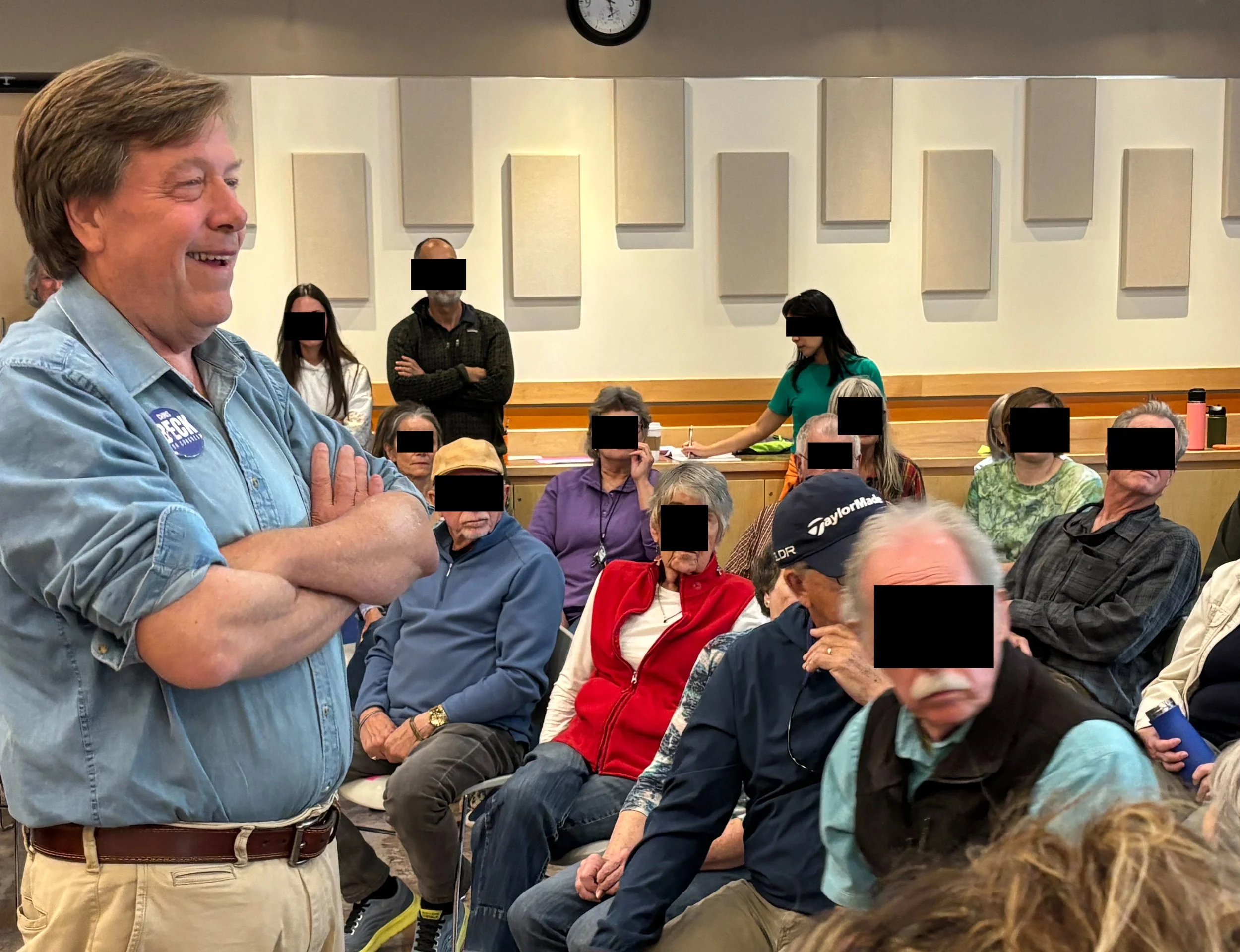
Chris beck, democratic challenger in a deep red district, talks with a crowd at a rural town hall where a member of the audience objected to photos, citing security concerns - the image shows a man talking to a room full of people with their faces censored by black rectangles - image by arie farnam

“No, n…n…no. Photos are fine.” He seems as shocked as me.

But my companion that evening taps at my leg. I can’t see the faces around me. I take photos, but that’s mainly because I’m good at composition. I’m still legally blind and the faces are all blotchy ovals without expression or distinction. I don’t know who has yelled at me or who might now be glaring. So, I sit down.

I don’t feel welcome. The general mood has soured considerably, and both questions and answers feel forced. "That was uncalled for," one woman whispers. Another comments, “She wouldn’t treat someone she respected that way." A half an hour later, I muster the courage to duck out the back door, giving a little wave in case anyone is watching for my reaction. The last thing I want to do is put more of a damper on this particular campaign.

I hoped that would be the end of it. But as it turned out, the person who scolded me was sort-of the organizer—at least the person who had helped Chris Beck set up this town hall, though he’d insisted on leading it himself, and apparently with good reason. Had there been a media ban of some kind announced? No, no one I spoke to had seen or heard anything of the sort.

Later that evening, I received a text from the organizer, demanding that I not publish any photos including her or her husband. The camera had been turned to capture the candidate plus some portions of the crowd, after all. And it hit me that this wasn’t just a controlling event coordinator with a poor understanding of free press coverage, but a person afraid for themselves and their family in a time of political repression and vindictiveness.

Was that reasonable?

Fear is rarely “reasonable.” It catches, reacts and grows like wildfire, unpredictably and usually in ways that are unhelpful. Certainly, we face significant political retribution in the U.S. today. That very weekend, reporters from CNN, Politico, and MS NOW were banned from the press areas of the White House for reporting that was mostly tepid and only sometimes rigorously fact-checked Trump’s statements. Naturally, those of us with opposition views get nervous and try to protect our identities when we can.

But this was a campaign event and a town hall where people from both sides were likely to meet, some expressly to argue with the candidate. The question about recording made a bit more sense if someone wanted to ask a sensitive question. But photos? How could being photographed in the audience of such an event be considered controversial?

Well, what if we were in Russia? In the period when a campaign event by an opposition candidate was even theoretically possible in Russia, being seen in the audience might well have been problematic, given that no one who wasn’t actively working for the regime as a spy would be there unless they were a vehement supporter of the candidate. Because that’s how Putin rolls. Surveillance would be guaranteed. Retribution might not be immediate, but the files would be kept for a time when “evidence” against you might be desirable.

I spent the next several days thinking about it, while an uncomfortable debate cropped up in our local activist discussion channel about me and my photos. Most people seemed to take the side of the organizer who had scolded me. One woman thought the camera was pointed too much toward the audience. Another speculated on how a media ban could be logistically carried out. The organizer claimed the library’s policy against photographing staff and patrons covered public events as well. A lawyer chimed in to state that it is legal to take photos at campaign events.

But that doesn’t really solve any of our problems or answer the thorny questions. Is it ethical to take such photos? Is it ethical to ban journalists or all photos at a public campaign event? Is it legitimate to be afraid of being identified in the audience, since people with opposing views do often attend town hall meetings in the U.S.? And if you think things are as bad as they are in Russia, shouldn’t we expect more discreet surveillance anyway? With Trump banning journalists, is this really something we should be emulating?

In Russia or the totalitarian states of the old Soviet Bloc, a media ban by opposition groups wouldn’t be on the table, not because their situation is (or was less dire. The opposition in Russia still faces worse repression than we do, regardless of how shocked we are at Trump’s recent actions. But in Russia, surveillance of any publicly announced event, whether an opposition campaign or a protest, would be guaranteed, whether it was visible or not. And any independent media coverage would thus be welcom, not as a means by which the authorities would grab the identities of those present but rather as documentation that is desperately needed, whether it can be used in media coverage or not.

In Trump’s America, with security cameras and smart phone location services constantly tracking us, it’s hard to imagine any advantage in banning photos that might include part of the audience at such a public event. Even local antagonism can’t be avoided. Every one of our outdoor public events is photographed by people driving or walking by. We’ve noted several photographers intentionally capturing every face in protest crowds. Some of us wear masks to try to avoid being recognized locally, because there are examples of threats and intimidation against people who oppose the MAGA movement, especially in rural areas like this.

I was trailed by a white pickup at a walking pace while I was out with my guide dog a couple of months ago. I do understand the fear.

But fear itself is also one of the greatest threats we face. All too often fear is wielded as a conscious weapon by authoritarian governments. It is meant to cause just such scenes—to turn likeminded neighbors against one another, to sow dissention and suspicion among opponents of the regime, and to ensure that efforts to oppose the regime stay quiet, unpublicized, and repressed. And it isn’t just fear that bleeds out of authoritarian regimes and into the thoughts and actions of the population.

When Trump banned major media organizations from access to the press areas of the White House, he did so in an intentionally shaming way, canceling the badges of reporters who were then dramatically refused access in front of their colleagues. Many of us share messages online about how "we are not the same." We say our opposition to this administration is not merely about political differences of opinion. It’s about things that go much deeper.

Bullying. Censorship. Banning journalists from legitimate public places. Intentional cruelty. Undermining democracy. These are not "political issues." These are moral issues. 

And it is not only right-wing politicians and groups that have engaged in them throughout history. Left-wing idealists with the best of intentions worked hard to build labor movements that, in some cases, developed into totalitarian regimes. I spent a lot of my journalistic career witnessing the aftermath of that in Eastern Europe.

That is why I, first and foremost, pay attention to the difference between political and ethical issues. We must guard against the creep of authoritarian thinking into our own groups. Authoritarian power. Shaming. Banning journalists from a campaign event. Those are not left or right, Democrat or Republican. That power dynamic is often spread by a regime that is so pervasive in its misbehavior that it causes citizens to mimic its tactics and turn on one another out of fear.

That is something that working as a journalist in countries with present and recent totalitarian regimes taught me. The problem isn't just the regime. Much worse is how such oppressive systems turn the people against one another, poisoning opposition groups with fear, infighting, and cynicism. This is a fascist regime that we're up against and the mutual suspicion and depression spreading in progressive groups across the country is one of the proofs of it.

We must also protect one another. Some people are more at risk than others in these times. I’ve obscured the faces in my photo to be as safe as possible, but the fact that we all had tracking devices in our pockets should banish any false sense of security. I urge everyone to learn about realistic security and privacy measures, including leaving phones at home and wearing masks. No one should be hassled if they choose to protect their own privacy.

But no one should be shamed for doing the work that needs to be done either. I was shaken by being publicly reprimanded, but I’d go through ten times that much if I thought it would help. The problem is that the change in the atmosphere of that room was palpable. No one wanted to say a peep. Some likely won't come again.

If only all the negativity just came from the regime!

It is hard to get along, to let slights go, to take personal safety measures, choose one’s own level of risk, and then be brave. But we know the alternative. As Chris Beck, the one person in the room with no hope of anonymity, said, "This is not about me. It’s bigger than any of us."
Have I lost the fire?

An old acquaintance popped up recently telling me about demonstrations against the latest distant war and asking what I’m doing about it. There was a time when I would have been in the thick of it, full of hope, anger and the fire of passionate creativity.

I distinctly remember being twenty something and making pacts with a different friend to never let the fire of passionate activism, creativity and adventure go out. We swore to kick each other in the pants if the other ever wavered. But she’s gone, and I’m afraid I may have lost the fire.

What I didn’t know in my twenties was that soul-sucking, creativity-sapping hard times don’t always come in the form of tear gas, night sticks or bullets. As bad as those things are, there are things that will make you beg for something as easy to fight as a clear and distinct bad guy. And I’m not even talking about the inner demons of mental illness or the parasites of addiction. I managed to avoid those, though life has taught me a lot more compassion for others who didn’t slip the traps.

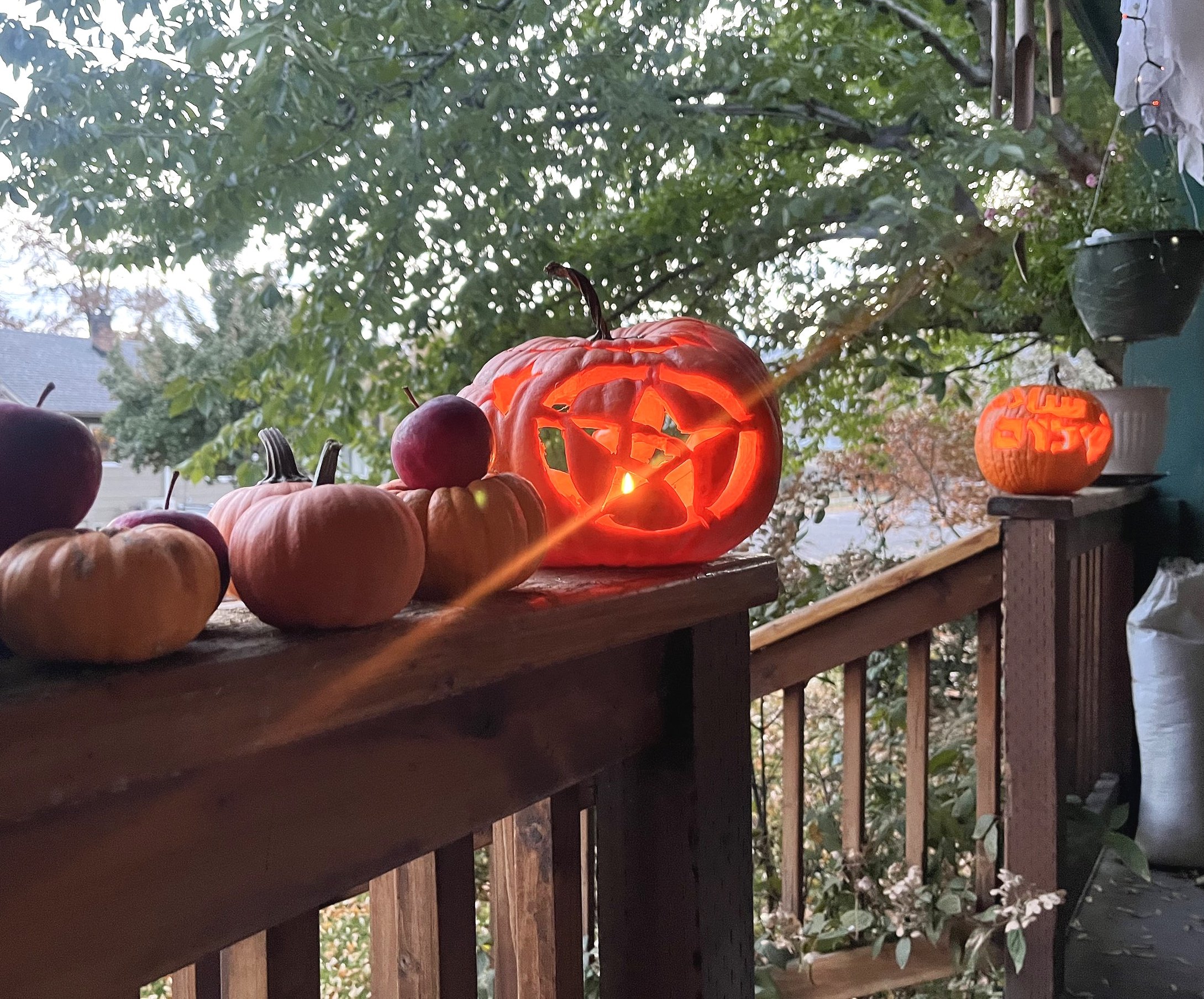
Image by Arie farnam - a porch railing holding pumpkins with candles inside portraying a pentacle and the word peace in different languages

I had freedom—just enough money to make my own choices and set my own course. I had transferable skills. I could go where I wanted and didn’t have to worry about the needs of others very much as I did. I mistook that privileged existence for deep caring about activism and great creative talent. It’s a common misconception.

Twenty years ago, I got sucked into the black hole of health problems which gave way to family responsibilities which led to worse health problems and much heavier family responsibilities. That’s what happened to my fire. It was buried under a mudslide and I’m still trying to find out if there are any smoldering embers left.

When I was in my late twenties, I gave up my last chances in newspaper journalism to lead antiwar protests. This isn’t something I’ve made a big deal about publicly. Potential employers wouldn’t see it as admirable, after all. I couldn’t stay in journalism and lead protests against the war in Iraq in a major international city at the same time. Journalists have codes of objectivity that preclude that sort of thing and no employers would allow it.

As a twenty-something, I don’t think I entirely thought through the potential consequences of that choice. I had a hot fire in me. I was watching the world explode with protest over a war based on lies, pushed by the questionably elected administration of my home country. It wasn’t happening in Prague yet, and the groups willing to try were marginalized and vulnerable to cheap attacks about supposedly being anti-American. I wasn’t just one more body in the streets for a protest. I was an American who also spoke the local language. Who could more credibly make the case that the protest was about human rights, rather than about being ideologically against the United States?

At that moment and in that place, there was a reasonable hope that I could make a real difference by joining and even leading the protests. The professional sacrifices felt worthwhile. Over the next two years, I was often cast into the role of negotiator between various factions. I had an acquaintance from my old political reporting who ran with the Czech Communist youth organization and friends in the staunchly anti-Communist student block. In a European capital city like ours, numbers of protesters mattered in terms of national policy and relations with the US. I worked to get both sides to come to events, while leaving their antagonistic or self-aggrandizing political banners at home.

Since my negotiating skills proved moderately handy and my rudimentary Arabic had once calmed a tense situation on the first day of our protests, I was also assigned as the negotiator for the Czech and international blocks in discussions with the local Iraqi dissident groups. That wasn’t easy, but it definitely gave me a sense of purpose and of my usefulness in the moment.

My primary counterpart on the Iraqi side was a guy named Ahmad. We worked together closely for months, and then his brother was killed by American soldiers in Iraq in a case of mistaken identity. The incident brought the war home to us. We swore it wouldn’t impact our budding friendship.

That was the last time I remember people losing their jobs or academic opportunities in the US over antiwar protests. Even though I had to make some sacrifices in my own career, I wasn’t directly fired or discriminated against for political reasons. But at the time, there were cases of suspension on college campuses as well as jobs or tenure lost in a variety of places because of people getting involved with antiwar protests.

Today the situation appears even more extreme, not just for people working in media but also in academia, law offices and even completely unrelated industries. I’ve lost track of the prominent journalists who’ve lost their jobs or been forced to resign. The pressure on college professors and students is intense, with even the entirely nonviolent Jewish Voice for Peace organization suspended at universities.

I can’t help but follow the news. People talk about shutting it out. I could just as well shut out thousands of people being killed in my own country or in my extended family. I don’t see the people under the bombs as foreign or as strangers “caught up in ancient enmity.” I’ve been too close. I have PaIestinian and lsraeli friends. I’ve also been in villages under shelling. I’ve had to hide huddled on the floor between the beds while renegade paramilitary forces out for revenge tore apart the neighborhood and bullets struck the gutters and wall just outside my window.

The news of the real world isn’t something I want to be able to shut out. But this time, there isn’t anything I know of that I can do that will matter. I’m in a small rural town where most people have very sparse information about what’s happening and have formed their opinions mainly based on the leaders they are used to listening to. And while the United States is involved in a significant way, another American speaking up about it in this case isn’t going to make a lick of difference, especially not out here in the sticks.

My heart goes out to those friends of mine who are personally affected. Every war is terrible. Innocent people always end up dying by violence, starvation or preventable illness. This war is even more heartbreaking than most to me because of the particularly intractable background and the fact that I know people on both sides of the conflict, none of whom have any realistic possibility of doing anything as individuals to help the innocent people being killed or to move toward peace. The Jewish people protesting the war in the US have the most chance of active agency at the moment, and they are doing admirable activism and often paying a heavy price for it.

When Russia invaded Ukraine, I spent the first few months volunteering to aid refugee evacuations because I had language and map-reading skills that were sorely needed. When Extinction Rebellion appeared to have a real shot at changing high-level European climate change policies, I dropped everything and was willing to get arrested and work with people who I didn’t always get along with to save lives. I wish there was a clear thing to do to make a difference right now. Even better, I yearn for a bad guy whose demise would actually be helpful.

Maybe it’s a symptom of growing up more than of the actual situation. I have realized my own futility. There is no way to win a war like this, and I have neither a useful identity nor any skills to put toward in the cause of peace or to aid the survival of individuals, even in a small way. But I did swear to hold onto the fire, and I wonder where the passion of my activism and creativity has gone.

I have a few little embers, barely glowing in the palm of my hand—the idea of going back to college and getting a master of fine arts degree. It may not help the world much, but it would give me a bit firmer ground on which to stand and from which to do useful and helpful things. But of course, this means entering the world of academia, and in my case, applying for scholarships, at a time when the silence required for career success is at odds with my conscience.

A recent ACLU open letter to colleges and universities across the United States criticized the penalizing and suppression of antiwar student groups during the scouring of Gaza, saying “It echoes America’s mistakes during the McCarthy era.” Students have lost competitive fellowships and job offers over peace-oriented social media posts. The only PaIestinian member of Congress was censured for words of heart-felt compassion for the victims of violence on both sides.

We all stand at the wall now in our own individual ways. We are forced to choose. Who will stand up, speak up, lose their voice, go to jail or lose opportunities as a result? Who will duck their head and hope to speak up more effectively another day? This is one of those times history will ask about.

I nurse my little embers. My fire is not burning brightly now. I’m barely hanging on. So, I change Ls to Is and Is to Ls to avoid the roving bots of censorship and academic blacklisting, I reach out privately to comfort grieving friends and I swallow back the hot words of protest.

Corporate power and free speech

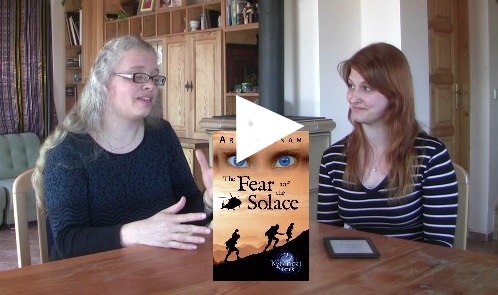
A video interview with author Arie Farnam

This is a repost of the first in a series of video interviews on hope and integrity in a perilous world. This interview focuses on the influence of corporations in society and how individuals respond with integrity. 

While the vast power of corporations often feels indomitable and the manipulation of our culture and media can be demoralizing, understanding of and resistance to tyranny is spreading.

As the progress of the past fifty years in civil, economic and environmental rights is under threat, we come to see that we have come a great distance and have much to believe in and lives worth defending. 

YouTube Link

YouTube Link

This interview also touches on how the struggle for social justice inspired my writing in 2014. The dystopian series that came out of that time is eerily predictive of our waking reality in 2017. That's why I'm reposting the video. As we struggle with immediate danger, we must also remember how we came to this situation in order to prevent its repetition in the future.

I write my stories because I cannot help myself. Writers must write. But I also write them to reach out and wake up the world from the malaise of apathy and despair. Mine are stories of hard-won and authentic hope and these video interviews tell how and why.

The 2017 List: 13 things to bring into the new year

With some truly depressing 2017 lists out there, I want to add a couple that might actually come in handy... or at least crack a smile.

Here is the Rebel With a Pen list of what to take with you when leaping into 2017:

  1. Chocolate

  2. A solar panel

  3. A manual for communicating with racists

  4. A Canadian passport or at least least a maple leaf bumper sticker

  5. Your entire library of books

  6. Wool socks

  7. A couple of 1960s protest albums

  8. Food stockpiles

  9. A bomb shelter

  10. Your family and near neighbors

  11. A first aid kit with extra bandages

  12. Your ability to laugh in the face of disaster

  13. Your generosity of spirit when it comes to people you might feel like judging

And with some of the bizarre wish lists out there, I figured that my brand of fantasy wouldn't seem far fetched at all. Here's my wish list for 2017:

  1. I wish Donald Trump would get on TV, laugh really loud and say, "Just kidding!" And then go back to his moocher lifestyle and leave us in peace.

  2. I wish everyone in the media would suddenly realize they should actually listen to scientists. Then science and climate discussions would be at the top of the news cycle all year long.

  3. I wish oil executives would realize the Indians own that land in North Dakota and that squeezing every last drop of oil out of the sand in Texas is not going to prolong their gluttonous lifestyle for very long anyway so they might as well start thinking about long-term survival.

  4. I wish my kids would wake up January 1 and realize that bickering defeats fun.

  5. I wish the next president would declare a new New Deal consisting of building solar panels to go on every roof and a light-rail system serving the entire country.

  6. I wish all the teenage ISIS fighters would get a deep hankering to go live with their mothers and watch TV until they're forty.

  7. I wish all bombs, missiles and munitions as well as all guns not in a safe under lock and key would mysteriously disappear on January 1.

  8. I wish someone brilliant would invent a way for writers and artists to make a living at their craft.

  9. I wish Microsoft would go bankrupt and have to sell off all of its parts to independent programmers who want to make an honest living.

  10. I wish our society would begin taxing the use of natural resources instead of the labor of the working poor and the funds would be put toward educational opportunity, urban greenspaces, rural public transit and subsidies for high quality cottage industries.

  11. I wish a benign virus would evolve and spread among humans which deactivates the part of the brain that categorizes according to skin color, speech pattern and the appearance of a person's eyes.

With those sweet and optimistic thoughts in mind, I wish you a very happy (and peaceful) new year!

A video interview with Arie Farnam on the US media, corporate power and dystopia today

Media video interview snapshot.jpg

This is the first in a series of video interviews by the hearth on issues of social and environmental justice and how I deal with them as a writer. Please share this far and wide and add your voice in the comments. 

While the vast power of corporations often feels indomitable and the manipulation of our culture and media is often depressing, it is worth remembering that we can use their tools to connect people. People have made progress in the past fifty years. Civil rights, the ADA and the beginnings of independent media were built by the quiet hands of many people like you and me. I'm not exactly a celebrity and my interviews reflect that. I'm a writer and mother by the hearth, speaking truth to power and being true to spirit. You are welcome here and we'll find common ground.

I write my stories because I can't help myself. Writers must write. But I also write them to reach out and wake up the world from the malaise of apathy and despair. Mine are stories of hard-won and authentic hope and these video interviews tell how and why.