The un-dying profession

A sun-scented breeze sweeps off of Wallowa Lake in Northeastern Oregon, wafting through the great ponderosas and up the slopes of the Eagle Cap mountains, passing as it does a rare gathering of a dying breed.

I’m not even talking about the wildlife, though there’s that. The deer may be plentiful in the park near the lake, but most others are barely hanging on. And so, it is for us—the writers. The summer intensive of my master’s in fine arts program begins with the writers’ conference called Fishtrap, which takes place at the Wallowa Lake Lodge each summer. This year, it’s scrambling to make up for thousands of dollars in cuts to arts funding even while most of the attendees pay hefty fees to attend.

I can’t guess exactly how the other writers feel, though the atmosphere feels a bit strained. No one mentions politics from the podium, except with oblique calls for donations to make up for the budget cuts. We’re now living in a country where writers lose their jobs or encounter blackouts for criticizing fascist secret police operations, a gold-encrusted wannabe dictator or a genocide funded largely by our taxes. We’re also living in a time when AI threatens to take over what few writing jobs are left.

While I don’t know what most of the attendees think, my fellow grad students talk. Some say they just want to focus on writing “for self-expression.” Those pretend that jobs and publishing don’t really matter. Maybe they don’t have student loans or rent to pay. But others glance sideways and grimace when the subject comes up.

We’re students gearing up to enter a field that may well be going the way of blacksmithing. Many of us are taking out substantial student loans to do so. And none of us really wants to acknowledge it.
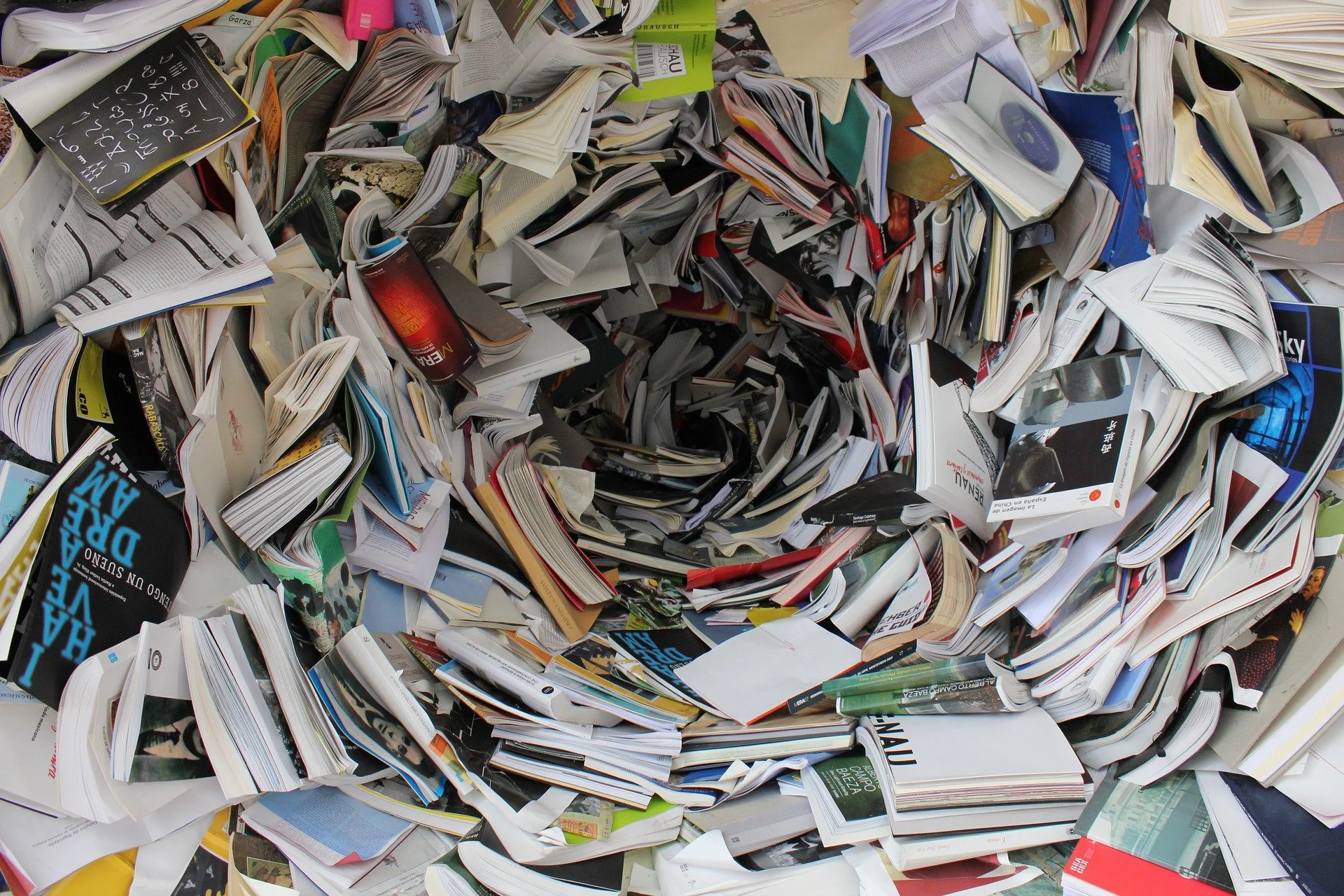
Image of books spiraling into a black hole - via pixabay

Right now, free versions of AI can write a business letter, press release or high-school-level essay better than 80 percent of the population. Teachers are in despair, trying to figure out how to curb the rampant use and abuse of AI by students to get around assignments that are meant to teach the skills to become part of the 20 percent who use words creatively and originally… and thus better than AI.

And yet, one has to wonder. Will there come a time when even creative and original writing is produced (or simulated) by some of the better AI systems, and even the best writers—the “masters” of the craft--will become obsolete?

The sense of quiet despair is palpable along the lakeshore. Is it among my classmates or just in my own head?

After we return to the dry, air-conditioned university classrooms following the Fishtrap conference, a professor asks how many of us have submitted to literary magazines recently. There’s an uncomfortable silence while we all avoid her gaze. We’re graduate students, not fifth graders, but no one wants to be on the spot for this one. She’s clearly disturbed by our response. She expected some of us to be slacking. But all of us?

We love to write. We’re all passionate and full of ideas. We are ravenously hungry for someone—our classmates, our professors, our parents, anyone—to read what we write, but we keep that quiet. It’s uncool to be too desperate. The biggest reason we aren’t submitting to magazines is the pervasive sense that it won’t matter, that we won’t get published in anything that anyone reads, that few people read books or literary magazines these days, that no one makes a living writing anymore unless they’re famous. 

The bottom line is that there are too few writing jobs and too few readers and far too many of us.

Statistics say 99 percent of publishing funds go to celebrities and established authors. That leaves only 1 percent for the rest of us. And AI is rapidly gobbling up the crumbs of writing jobs that have traditionally been ours to divvy up between the masses of hungry, highly skilled and yet unknown writers.  

Twenty percent of the population can write well enough to draft a decent statement. Probably 10 percent can write creatively. Five percent can craft a publishable book. Five percent of the English-speaking population is a lot of people (about 18 million people at the moment).

Heck even the 1 or 2 percent who are truly talented and committed add up to a lot of people. And writing jobs have never been plentiful. According to statistics only 0.03 percent of the working population makes their living primarily from writing. 

So, that’s the reason for the awkward avoidance, but we keep the mood positive. We laugh in the teeth of the storm that threatens to wipe us off of this sketchy professional sandbar.

How can storytelling be a dying trade?

Storytelling is as old as humankind. I mean prostitution might be the oldest profession, but only because it predates our species. I’ve read archeologists who speculate that it is storytelling--not tools or language or fire--that differentiates us from animals. And that’s nothing against animals, just that their form of storytelling might not provide us with that satisfying zing of a complete story—curiosity, concern, need, resolution.

Will we really be okay if AI tells the stories from here on out, if people who want to write, just write for their own desk drawers or computer files, and learn to accept the lack of response?

Some people might think that’s okay.

But there’s a fundamental reason why I don’t agree. Stories are good and useful and even entertaining, but most importantly, stories are how we develop empathy. We come to see the world through the experiences of others from the time we’re babies listening to others talk about experiences or people they know. But if we’re lucky, we’re also read to, and we learn to read. We watch movies and today we go online. And mostly what we find is some form of story.

A lot of the stories today are essentially advertisements, whether for products, people or ideologies. They manipulate emotions and often shut down empathy. That’s largely because they claim to tell “your” story, the reader’s or viewer’s story. Whether oral or written, factual or fictional, stories about other people’s experiences give us little windows into other worlds and hence empathy.

And empathy is the one thing that has kept human society largely stable and livable, through all the political, military and social storms of the millennia. When things get too far out of balance, it’s empathy that brings us back. But today, increasingly there are those who are losing empathy, and I think it’s a story deficiency.

So, while we writers feel lost in the winds of the market these days, while I don’t know how we’re going to make a living at this, I know that we’re on the very frontlines of what our world most needs. We are the storytellers and whatever we write, even it isn’t earthshaking, even if it isn’t the greatest thing ever written, is essential and momentous.

The stories we write give brief glimpses into worlds that are different from a reader’s world in some way. Story must grip the reader and pull them into that different world to be effective. That’s one reason why stories must be entertaining. It’s not an added benefit. It’s essential.

So, skill does matter. We need to learn from one another, from conferences, from school, from writing groups and workshops, from copious reading and a ton of practice writing. But we must also keep the stories coming.

Because the world needs stories. This world with Empathy Deficiency Disorder needs writers.

Why study writing or art in the age of AI?

And I’m off… out of the door and down the path, tripping along with a staff and a pocket handkerchief (or some such) on a new adventure that will likely be rather uncomfortable, but may eventually make a good story.

My Master of Fine Arts program is truly underway with readings for a couple of weeks at the beginning of summer term and then two-weeks of intensive seminars and workshops from morning ‘til night in the Eastern Oregon mountains. This has my blood flowing again. It’s been a couple of decades since I was last exhilarated.

And while this is tame compared to some of the adventures I undertook “back in the day,” it is a strange time to be studying writing or any kind of art, even if my ostensibly sensible reason is that I can always teach online if the market remains recalcitrantly focused on celebrities. With AI writing and art surging across the internet, the future of creative professions is more in question than at any time in the past.

Over the centuries and millennia, art and literature have weathered technological limitations, economic depression, political repression, the malaise of unsatisfying debauchery, black holes of inspiration, market saturation, celebrity obsessions and even the lethargy of widespread prosperity in the 20th century. There have been many times when writers and artists have bemoaned the state of the field or even cried the end of art.

Image of a young girl in a white dress drawing in a notebook on grass - Creative commons image from fawke of flickr.com

Yet, somehow AI is a whole new level.

If a lay person sometimes can’t differentiate between AI writing and the work of a skilled human writer, isn’t it finally all over for us? Why on earth would I devote the time, not to mention the money, to study creative writing at the highest level? The market has already shown that only a tiny fraction of publishing will include new, non-celebrity authors. Self-publishing is dead in the water as a means of livelihood, though it may be fun for family or interest-group memoirists.

And yet…

I am embarking on this course of study most of all because it brings me joy and delight, a rare feeling in this of all years. The prospect of spending two years discussing word-craft and story with fellow writers feels to me like I am seven-years-old again, entering the old general store at the end of the long bike ride from Pumpkin Ridge, gazing at the racks upon racks of bright-colored candy laid out before me—pure delicious sweetness and a much needed reward for a lifetime of grindstones.

Yes, some of us just love writing or art so much that the hope of making a living at it is mostly a matter of wishing not to have to have a day. job. We aren’t looking for riches, just a way to scrape by and write all day. But let’s try to be sensible or reasonable here. Other than childish self-indulgence, is there still value in writing as a calling, a profession or a high art?

The modern world is so full of cynicism and cliche that when I first contemplated this post, I found myself balking. A little voice inside me cried out that it doesn’t matter if there is any reasonable reason. We NEED art! I NEED writing! Nothing else matters.

But after wading into some of the initial reading for my courses, including for a workshop by Oregon writer Kim Stafford, I did find “good reasons” that we need human writers. To list a few:

  • Good fiction is one of the few times we truly absorb someone else’s perspective. This world is in sore need of empathy and AI, for all its uses, will never be a substitute for that.

  • Writing in all its forms is communication, a way to bridge gaps and impart both emotions and sensations. Readers may not always know where or how, but we still need that call from one to another.

  • We need, for instance, to raise the alarm of climate change and ecological destruction, a theme that has become prominent in my courses. AI could possibly mimic this kind of writing, except that most of it has not been done yet, the field of environmental writing is still young.

  • AI writing uses a set number of words to say a specific thing. It does not know nuance or how to write between the lines. It doesn’t do emotional complexity. In a polarized, black-and-white society, the capacity of human writers to say things subtly and in shades of gray is essential.

  • In a media culture where facts have become mutable, corruptible and expendable, story is a desperately needed antidote. Facts may be obscured and statistics manipulated by those with money and power, but one’s own true story still remains in the hands of each individual person. It can be faked, but there’s a zing to authenticity that is palpable and hard to manufacture. It’s the weapon of the human writer.

  • While one can stand on a street corner and shout or even post a shouting YouTube video today, writing still remains a uniquely empowering means of expression. Once an individual has versatile writing skills, that person will never be as trapped or as vulnerable to exploitation as they would have been without it. Teaching writing then is the work of empowering others.

These are just a few of the things that have come to me as I dive into my first courses. Can you think of any more “good reasons” to pursue writing? Post them in the comments. <3

I don’t know how financially lucrative the writing profession will be over the next ten or twenty years. That is unpredictable and likely rather bleak. But if past experience with artisan skills that have faded in recent generations carries over, it may well be that within a few decades, solid word-smithing skills may become rare and precious.

The hidden threat from AI art and writing

Even those of us who live under metaphorical rocks—mostly constructed of the stacks of books we’re reading—have heard of the controversy surrounding AI writing and art. Actors and writers went on strike in Hollywood for three months. Artists are protesting across the internet.

To many outside these fields and even to some within them, the narrative goes something like this: Artists and writers work hard to create masterpieces and they are already under-compensated. Now companies are going to use AI to analyze vast piles of copyrighted material and generate similar work without compensating the artists and writers who produced the original art and books used in the analysis. If you love the work of artists or writers, you should be upset about this because your heroes are going to be robbed.

And that isn’t wrong. The fields of art and writing are notoriously competitive and underpaid for 99.99 percent of those who work in them. Adding extra ways for companies to unfairly exploit professional artists and writers is a terrible idea.

Creative Commons image by mu hybrid art house

But all that sounds theoretical and most AI experts, when pressed, will tell you that it hasn’t really happened yet. Well-known artists and writers haven’t actually lost any money to this phenomenon… yet. And at that point in the conversation, most people who paid attention at all, tune out.

It’s a theoretical future problem. I’ve got 99 problems that are acute today.

However, we almost never hear about the actual harm being done right now by AI in the fields of art and writing. It’s likely that that is because it does not affect anyone wealthy or well-known. It doesn’t plagiarize great or original works. It just silently takes the jobs which artists and writers don’t love but which provide the bread and butter for 90 percent of us working in these fields.

Take for instance the little line-drawing illustrations of goofy no-name characters in a child’s math book. A. Who drew those? B. Was that person a real artist? C. Could just anyone draw them?

Answer key: A. Someone you’ve never heard of. B. You better bet they are. C. No way! I dare you to try.

Take the description of a product or service on a website or in a brochure. Likewise, someone wrote that. They might have been just regular staff, but if they are, the copy is probably lackluster. They were most likely a writer or a writer in training. If that ad is any good, chances are that the person who wrote it dreams of writing a book or a short story.

There are thousands, even millions of these little unimportant writing, drawing and design jobs in our modern world. You never hear the names of those artists and writers and you’d have to dig very deep into the small print of credits to find them, if they are even listed. These writing and art tasks are sometimes combined with other roles in the corporate world, but the writing and art aspects of the jobs are often the part that gives the person doing them a sense of purpose and self-actualization.

And many working artists and writers use jobs like this as a “day job” to tide them over in hopes that they may someday be able to make a living creating independent art or stories. And many of those who do “make it” and become professional, full-time artists and writers got a lot of their experience and training from these minor, unsung creative tasks.

AI is taking these jobs. Not theoretically in the future, but right now. AI may not yet be able to create cutting-edge art or completely flawless, nuanced text. But it can and does create simple line drawings for every type of publication under the sun and rough drafts of a lot of technical and advertising copy. Writers become editors of AI text. Artists become technical designers, plugging AI-created images into templates.

And that may not sound so bad, until you realize that with this technology, one writer can edit the text that ten would have previously written from scratch. One artist can format images in an hour that would have previously taken them ten hours to create on their own.

I hear about the results of this daily. A friend mentioned off-hand that her sister who used to write speeches for a major corporate CEO as a full-time job is so “successful” that the jobs of seven other writers have been consolidated and she now writes remarks for seven CEOs and their public relations departments. My friend thought this meant her sister was moving up in the world, but the job she was doing before was also a full-time job. She got only a very small raise to do the jobs of six other writers. And this is because the companies she works for use AI to generate text, which she merely refines.

And the six other writers? They had to find other jobs and given that this is happening across the industry, the chances are that they didn’t find jobs that entail creative writing.

These basic creative jobs are disappearing. They aren’t the jobs artists and writers most want. They aren’t particularly fun or all that creative. They’re just jobs that use and foster writing and artistic skills, jobs that have provided basic livelihoods ever since the invention of the printing press.

No one gets very upset about this in public discussions about AI because those weren’t the sought-after jobs anyway. But the cost is going to be high.

First, writers and artists who have not yet broken into full-time professional work in their fields will have to find other jobs, often more exhausting jobs, often jobs where they can’t utilize their primary skills in writing and art. It isn’t the end of the world, but for many of us these jobs provided not only a bit of self-respect but also a way to keep our skills sharp even when life and “the market” didn’t allow for much time to pursue our writing or artistic calling.

Second, there will no longer be much of a training ground for new artists and writers. You’ll either learn to be outstanding at your craft and then become well-known or you won’t. And this will exacerbate the trend of writing and art being a business where you have to be born into the right family or socio-economic circumstances to have a reasonable shot at a career. It will feed the monstrous celebritization of writing and art, in which a tiny elite make fabulous amounts of money, while everyone else makes little or nothing.

Third and possibly most insidiously, with even fewer paying jobs that utilize the skills of creative writing and artistic expression, schools and universities will eventually cut back their art and writing programs. Surely, people will still dream of being artists and writers and some education in those fields will be available for those who can pay. But when the social usefulness of a trade fades, so does it’s infrastructure.

For me, this is not theoretical, because I saw newspaper journalism undergo a preview of this process twenty years ago. For most of the twentieth century, it was possible for writers, artists or photographers to make a basic living producing material for the many magazines, newspapers and other periodicals that connected the world of that era. There were writers, artists and photographers who were regular employees of these publications, but generally the insatiable hunger for variety meant that there were quite a few freelance opportunities as well.

It was still a competitive and risky business to be in, but it was one that gave many creative people an outlet for expression, a start in the profession and a basic income. Both the expansion of the internet and changes in international news focus after 9/11 changed all that within a few short years in the early 2000s. And nine out of ten of my colleagues in newspaper journalism had to go looking for other jobs.

Many went into completely different fields. Others took up copywriting, technical writing or graphic design in the online world—shifting to fewer, less independent, more constrained jobs. When old journalism colleagues get together, someone will often quip about our profession having gone the way of blacksmithing—meaning that technological and social change has rendered us obsolete.

At the time, many hoped that this was only a market shift. Creative jobs would come back in a different form, they said. We’d be able to write website copy and technical manuals or design ads. And many have, but those were not really new jobs. They existed before and the writers and artists pushed out of mainstream journalism were joining an already crowded pool of content providers in the advertising and technical fields, which migrated online.

In the past twenty years, I have not seen much recovery in the availability of journalism jobs. Mostly the growth has been in the least creative types of jobs that still require some artistic or writing skills—such as technical and advertising copy, jobs where the artist or writer has zero say about the content and is nothing but an engine of creativity, directed by executives.

Just as our old journalism jobs didn’t return and better jobs didn’t replace them, I don’t believe the assurances that AI will only take the drudgery out of art and writing and leave us with the fun parts.

Certainly, those who are at the top of these professions have little to fear from AI at this point. But most paid journalism jobs disappeared twenty years ago and stayed gone. These unsung creative jobs in copywriting and basic art and design are being gobbled up by AI because our societies have chosen not to regulate the way companies can use intellectual property to train AI. That train has already left the station and reversing it at this point would be an immense task.