
Open letters: Dear Heather
/April 14, 2026
Dear Heather,
I’ve been writing to you in my mind for months now. My ritual is to set the alarm for six every morning. I struggle for consciousness in bed for fifteen minutes and check the weather while the wind chime calls in the gray light outside my window. Then, I listen to your letter on my phone while I make green tea with my little electric kettle.
I ration your letters, since you don’t write every single day. I only listen for that ten-minute interval while I make the tea. Then, I put it away. I don’t listen again until the next morning, unless you’ve written so much that there’s two full letters stacked up. Then, I might finish one later in the morning in between grad school assignments, bureaucratic meetings, and editing gigs—savoring it like sweets sneaked from my mother’s pantry when I was a child.
What would I do if you ever stopped writing these letters? I’d survive, I guess. But it would be devastating. I have never written back. I’ve thought of it. I’ve thought through whole letters to you in my mind. This is the first time I’ve ever written it down, and I won’t send this letter either.
But I’m writing today because you touch on a place near where I used to live in Central Europe. My friends there write either with bitter cynicism or cautious optimism. But you say it's the demise of a government built on “the idea that society works best if a few wealthy men run everything.” And that’s hope, isn’t it? After sixteen years of oppression. Still, you don’t push the hope too far, just a sign of positive change. We could do that, couldn’t we?
I’m glad you see that too. Not many people here are watching the news from Europe. My kettle marks me out as European here. So, when you wrote about that, I finally gave in and wrote down my letter to you. I’ll write but I won’t send it. You bring a bit of hope into my kitchen each day, even when your letters are deeply sad.
Arie
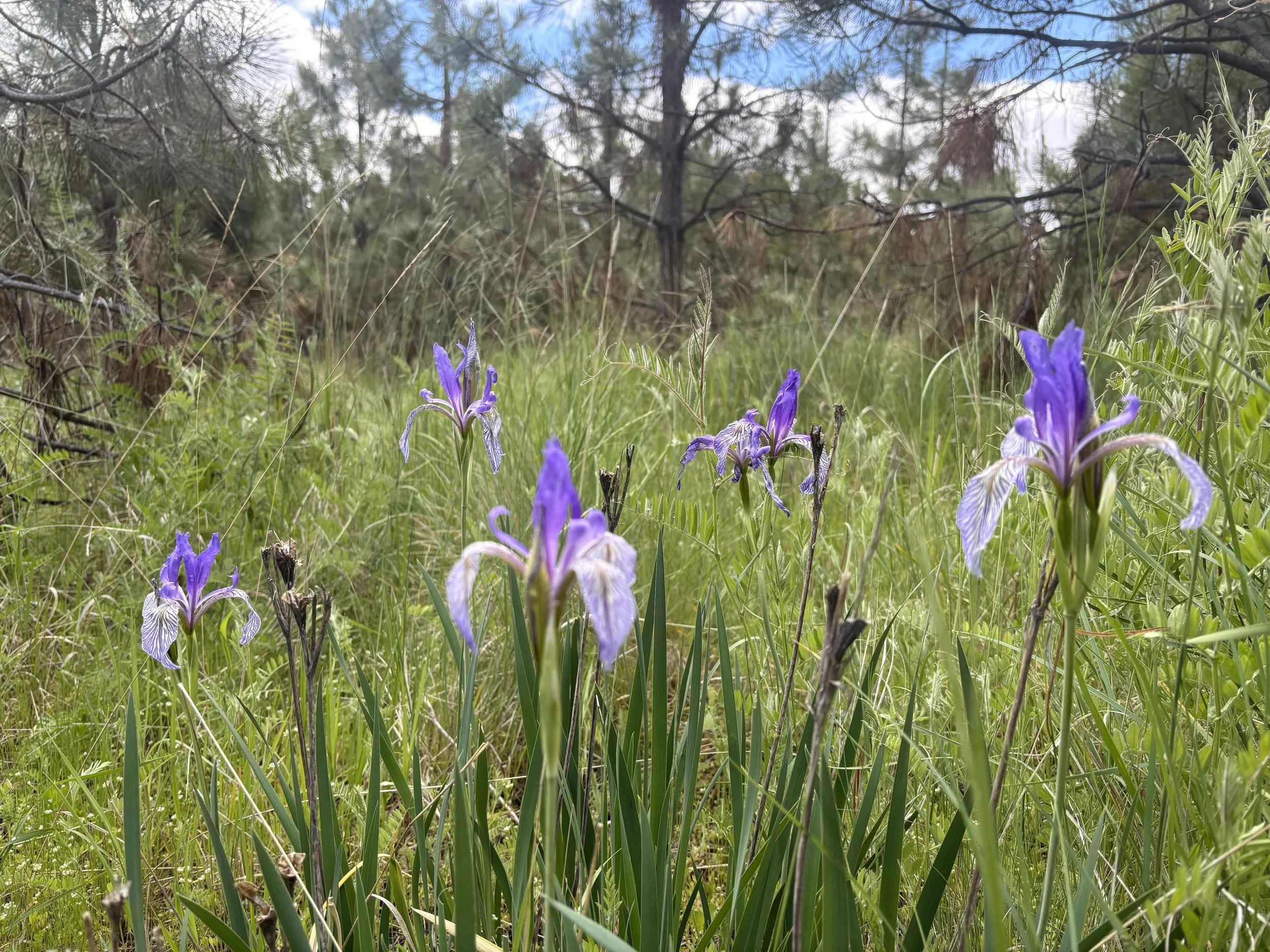
IMAGE of purple Rocky Mountain Irises in long grass - photo by Arie Farnam
April 16, 2026
Dear Heather,
My mother reads your letters too, you know. She doesn’t ration them like I do, so she’ll text me to urge me to read your latest. She has a harder time with hope than I do. I’m relatively tough. I’ve been through a few things, after all. But so has she. How does one stay that tender after living through everything she has. She tells me your letters keep her going.
I want to give her hope the way you do. I should be able to, right? Should I just focus on the positive more? Why is that so hard? My kids may be having a lot of trouble, but they’re still alive. We have food and a roof over our heads, even if it’s a bit rickety. She says our family is deeply dysfunctional and it’s her fault. She says she failed at the most important mission in her life. Not true. I came back, didn’t I? I tell her all the good things I got growing up the way we did—justice-centered values, empathy, understanding for struggling people, deep connection with the earth. Would I be the writer I am now if I hadn’t had that? She didn’t fail and if she did, aren’t I many times worse as a mother? She backs off then. She won’t let me say that, but she knows it’s true by the standards she set for herself—keeping the family together and all that.
This is why I am never going to send these letters to you. You don’t need to hear about our drama. In your letter today, you wrote about the grief after a dream is killed. You reminded me that the struggles I’m living have a long history and that how I respond matters. Your letters keep me hanging on.
Arie
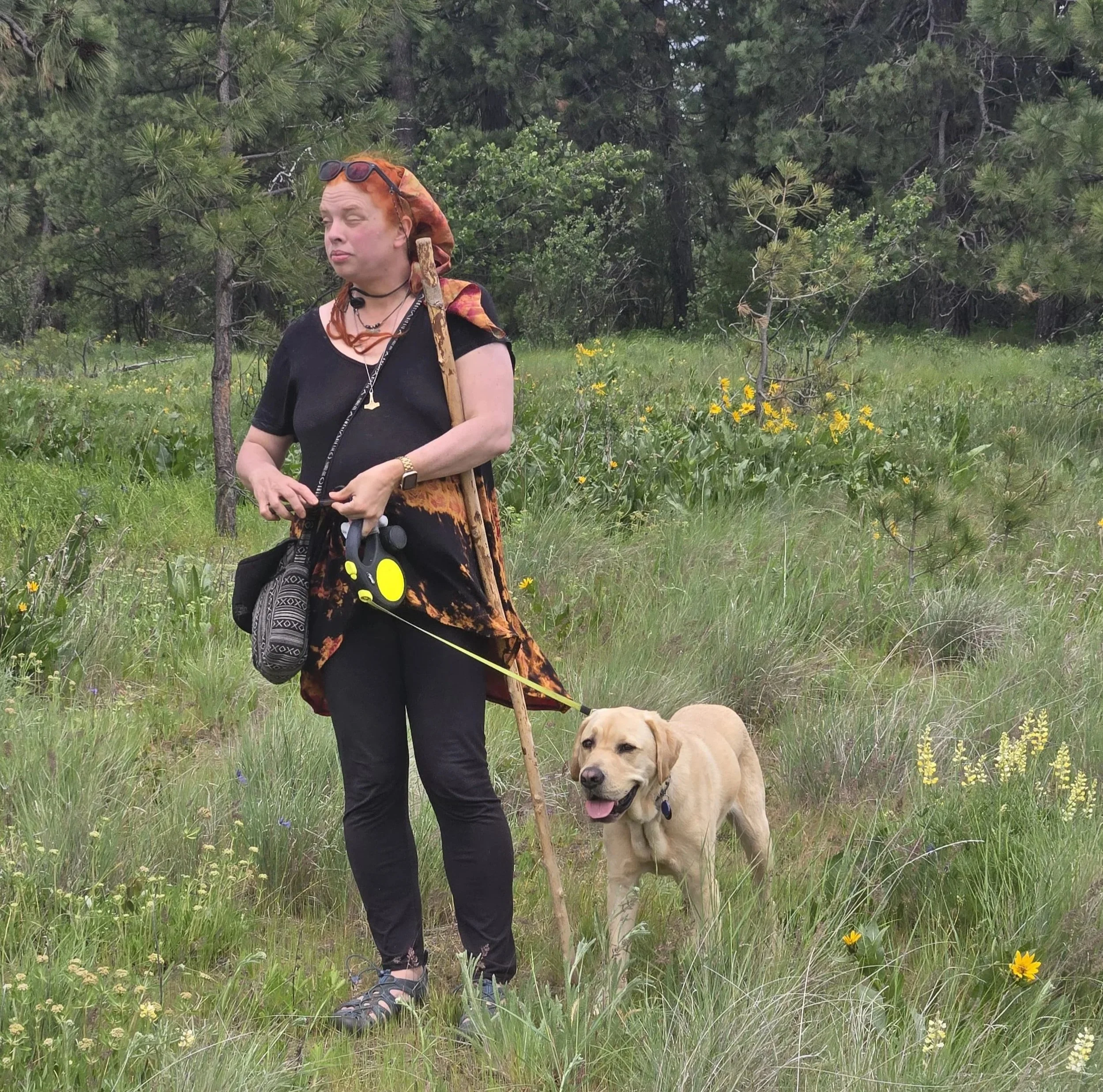
Image of a red-haired woman with a yellow lab in a meadow of wildflowers - Image by Julie Farnam
April 25, 2026
Dear Heather,
Obviously, the strain gets to you too. You sound exhausted. You keep saying in letter after letter that it’s almost over, that things are crumbling. He’ll be gone soon. But it doesn’t end. Somehow, the situation keeps getting worse. Just when it seems like everything is on the brink of collapse, more things fall apart. Then, you tell me about ever more depraved abuse and criminality.
But today you went on a tangent about international law, the founding of the UN, and all the structures that made the first four decades of my life feel stable and relatively privileged, even when we were living in a shack without plumbing. I remember learning about all that as a young adult. I was so hopeful that the grown-ups were going to nail down an international court. War was going to be a thing of the past. We already had what felt like a much more stable world. I tried to tell everyone about “international rule of law” when I was twenty. I was such a nerd. It was my first big thing. I was obsessed. That’s part of why it feels like you’re talking directly to me across the kitchen table. But I feel how tired you are too.
I wish I could offer you a cup of my tea, gentle greenish yellow, earthy flavor in a sand-colored ceramic cup. I hope you stay strong, because I don’t know what we’d do without you.
Arie
—
April 29, 2026
Dear Heather,
I love the historical rabbit holes you go down, and I love reading about history, even the dark parts of it. But today, your letter leaves me with a deep sense of shame. It’s not your fault. Really, it’s not. It’s his fault. Only his.
You know how they’re always saying that “white children shouldn’t be made to feel ashamed of being white” in school by being taught about the history of our country. I’m old enough that I wasn’t taught any of the things that make those old men so uncomfortable. Not in school at least. I was taught about Columbus in early September every year, then the Pilgrims by Thanksgiving, and the Civil War by May. That was it for history class, and it was mind-numbingly boring.
I learned real history only by reading on my own and by talking to people who lived it. It was amazing, thrilling, shocking, terrible, and tragic. But it never made me feel ashamed. Maybe, some moments made me feel a sense of responsibility, but responsibility to do something different in the future, not responsibility for things that happened before I was born. Even though I knew the version of history I was taught in school was, in and of itself, a crime of erasure, it didn’t make me ashamed. I was a child. I had been assaulted with propaganda. I felt kinship with the Eastern European dissidents who told me about the propaganda they’d had forced on them as children. I wasn’t ashamed when I learned real history. I was angry.
But today I’m ashamed. You quoted him talking about the importance of "Anglo-Saxon bloodlines," about how the English settled “a wild and untamed continent” here, as if no Americans lived here before then and no others live here now. And it isn’t just the echoes of psychopaths of the past. It’s the violence of these lies. I feel a deep sense of shame for being primarily Anglo-Saxon when he drags my heritage through the sludge of his hate. I can’t look my friends in the eye without apologizing every other sentence. It’s humiliating.
You remind me that each of us has value and dignity. You soothe away the shame. And I’m glad for that. I will try to hold my head up and do what I must. I’ll be here with my teapot again tomorrow.
Arie
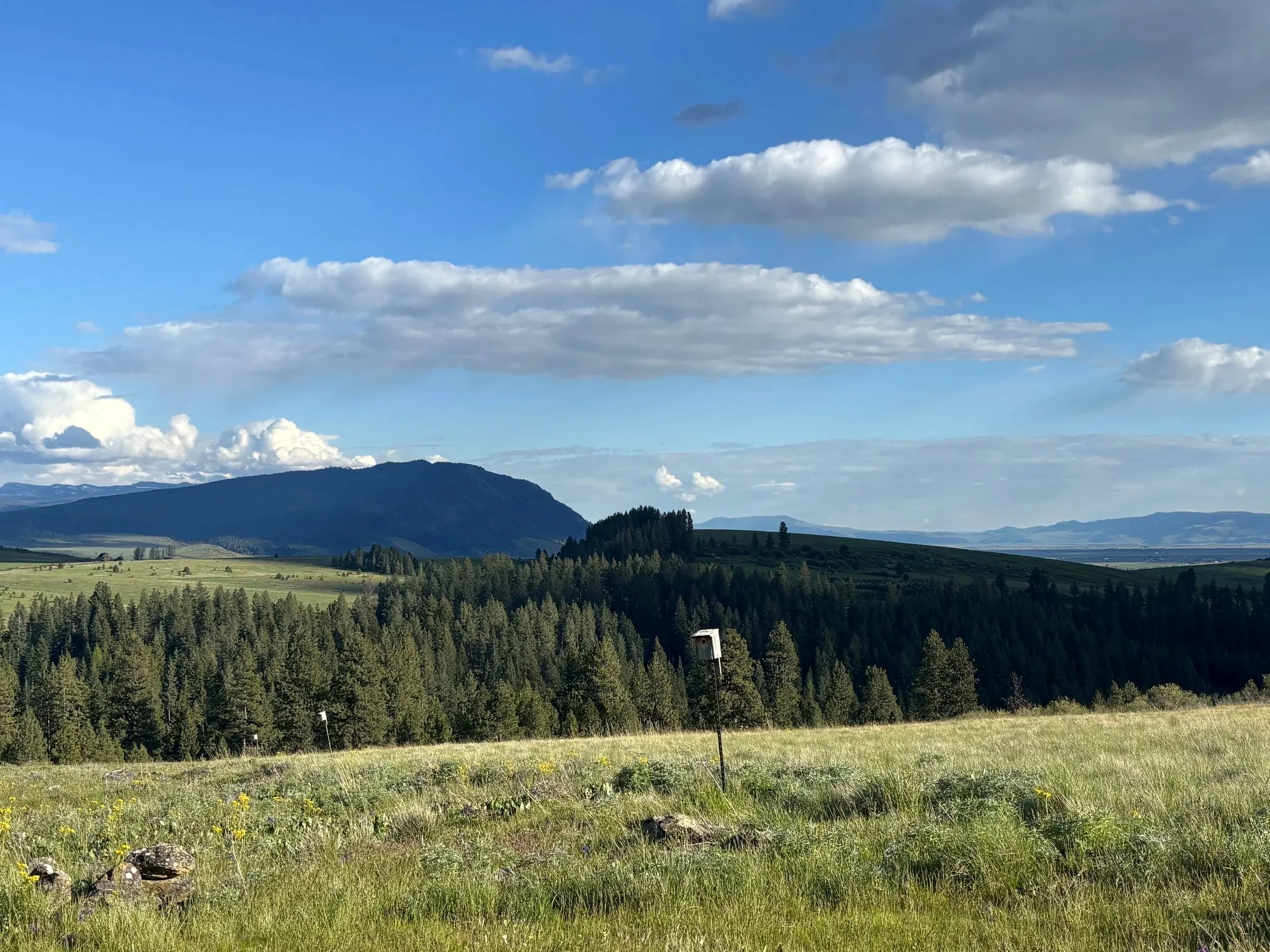
Image of a ridge-top of wildflower meadow above the mountain-ringed grand ronde valley - Image by Arie Farnam
May 10, 2026
Dear Heather,
I’m not fond of Mother’s Day anymore. I’m an adoptive mother, and when my kids were very little there was the occasional teacher who would tell them to draw a Mother’s Day picture or something similar. These usually didn’t make it home to me, and when they did, they were clearly created under duress—a heart drawn in a single wobbly line of crayon, a slapdash paper flower found at the bottom of a backpack. It wasn’t the kids’ fault. They both have developmental disabilities and ADHD. Focusing on something arbitrarily dictated by the calendar isn’t a strength.
Now, my fifteen-year-old cusses me out because I insist he brushes his teeth at least once a day. My seventeen-year-old demands why I won’t buy her “designer perfume.” Their neurology makes them such easy targets for the vultures of social media and advertising. No one else tells them it’s Mother’s Day and I’m certainly not going to mention it like I’m begging for a pinch of appreciation. I hug my mother. We visit a greenhouse full of spring beauty and walk in wildflower meadows together. But Mother’s Day still leaves me aching deep inside.
Mother’s Day just feels like another pressure point with more demands for performance on me, my mother and other mothers I know. I appreciate your letter, the idea that the original Mother’s Day was about women seizing our own power. That’s refreshing.
A woman mentioned you to me at the farmer’s market yesterday. I couldn’t even recognize her with my very nearsighted eyes. You’re becoming like a secret code. “Happy Mother’s Day! Have you read Heather’s letter?” A way to signal safety and solidarity. Keep on, please, keep on.
Arie
—
May 13, 2026
Dear Heather,
You’ve been grim the last few days, mostly recounting events in a dogged, weather-beaten tone. The Voting Rights Act is in tatters. You clearly feel a need to give us hope. You quote Tennessee state representative Justin Jones, “We’ll keep fighting. We will not stop getting in good trouble. We will not go back.” Those are tired stock phrases, and he’s likely to lose his job with the new map.
When you sound that exhausted, I think I should send you a letter just to say how much we appreciate you. I know you get tons of letters, thousands you can’t possibly read. You try responding to people in your letters sometimes, but you’d need a small army of staff. And I’m not a fan girl type. I have always detested celebrities. The only reason you’re an exception is because you appear to have an undisguised cold sore on your mouth in videos, you aren’t wearing makeup, and you don’t appear to have a staff to read your mail.
Dappled light falls across my page through the maple next door. Steam rises from the squat cup. My tea is brewed. All I really wanted to say is thanks for the letters. We need them.
Arie