Open letters: Dear Heather

April 14, 2026

Dear Heather,

I’ve been writing to you in my mind for months now. My ritual is to set the alarm for six every morning. I struggle for consciousness in bed for fifteen minutes and check the weather while the wind chime calls in the gray light outside my window. Then, I listen to your letter on my phone while I make green tea with my little electric kettle.

I ration your letters, since you don’t write every single day. I only listen for that ten-minute interval while I make the tea. Then, I put it away. I don’t listen again until the next morning, unless you’ve written so much that there’s two full letters stacked up. Then, I might finish one later in the morning in between grad school assignments, bureaucratic meetings, and editing gigs—savoring it like sweets sneaked from my mother’s pantry when I was a child.

What would I do if you ever stopped writing these letters? I’d survive, I guess. But it would be devastating. I have never written back. I’ve thought of it. I’ve thought through whole letters to you in my mind. This is the first time I’ve ever written it down, and I won’t send this letter either.

But I’m writing today because you touch on a place near where I used to live in Central Europe. My friends there write either with bitter cynicism or cautious optimism. But you say it's the demise of a government built on “the idea that society works best if a few wealthy men run everything.” And that’s hope, isn’t it? After sixteen years of oppression. Still, you don’t push the hope too far, just a sign of positive change. We could do that, couldn’t we?

I’m glad you see that too. Not many people here are watching the news from Europe. My kettle marks me out as European here. So, when you wrote about that, I finally gave in and wrote down my letter to you. I’ll write but I won’t send it. You bring a bit of hope into my kitchen each day, even when your letters are deeply sad.

Arie

IMAGE of purple Rocky Mountain Irises in long grass - photo by Arie Farnam

April 16, 2026

Dear Heather,

My mother reads your letters too, you know. She doesn’t ration them like I do, so she’ll text me to urge me to read your latest. She has a harder time with hope than I do. I’m relatively tough. I’ve been through a few things, after all. But so has she. How does one stay that tender after living through everything she has. She tells me your letters keep her going.

I want to give her hope the way you do. I should be able to, right? Should I just focus on the positive more? Why is that so hard? My kids may be having a lot of trouble, but they’re still alive. We have food and a roof over our heads, even if it’s a bit rickety. She says our family is deeply dysfunctional and it’s her fault. She says she failed at the most important mission in her life. Not true. I came back, didn’t I? I tell her all the good things I got growing up the way we did—justice-centered values, empathy, understanding for struggling people, deep connection with the earth. Would I be the writer I am now if I hadn’t had that? She didn’t fail and if she did, aren’t I many times worse as a mother? She backs off then. She won’t let me say that, but she knows it’s true by the standards she set for herself—keeping the family together and all that.

This is why I am never going to send these letters to you. You don’t need to hear about our drama. In your letter today, you wrote about the grief after a dream is killed. You reminded me that the struggles I’m living have a long history and that how I respond matters. Your letters keep me hanging on.

Arie

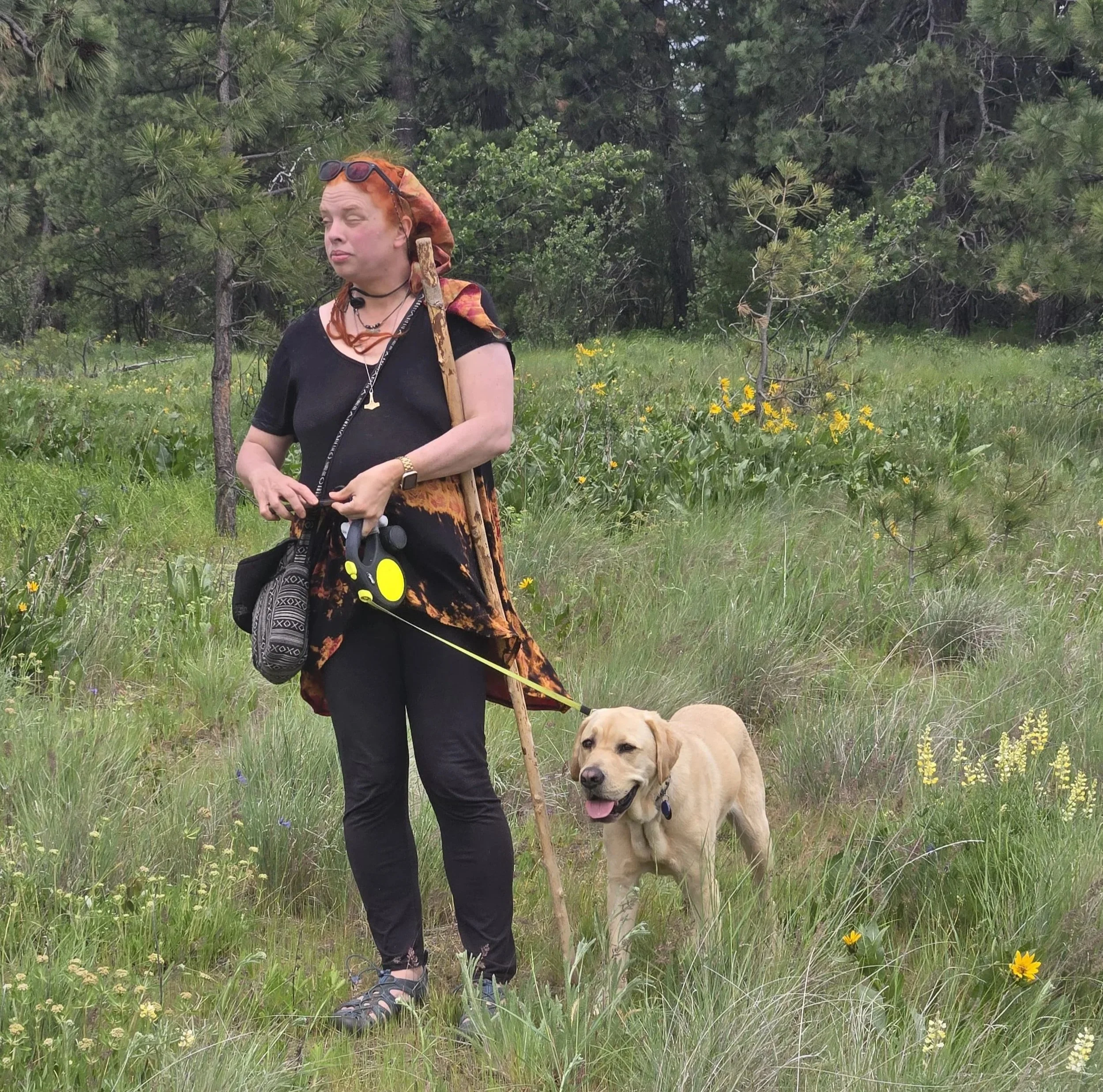
Image of a red-haired woman with a yellow lab in a meadow of wildflowers - Image by Julie Farnam

April 25, 2026

Dear Heather,

Obviously, the strain gets to you too. You sound exhausted. You keep saying in letter after letter that it’s almost over, that things are crumbling. He’ll be gone soon. But it doesn’t end. Somehow, the situation keeps getting worse. Just when it seems like everything is on the brink of collapse, more things fall apart. Then, you tell me about ever more depraved abuse and criminality.

But today you went on a tangent about international law, the founding of the UN, and all the structures that made the first four decades of my life feel stable and relatively privileged, even when we were living in a shack without plumbing. I remember learning about all that as a young adult. I was so hopeful that the grown-ups were going to nail down an international court. War was going to be a thing of the past. We already had what felt like a much more stable world. I tried to tell everyone about “international rule of law” when I was twenty. I was such a nerd. It was my first big thing. I was obsessed. That’s part of why it feels like you’re talking directly to me across the kitchen table. But I feel how tired you are too.

I wish I could offer you a cup of my tea, gentle greenish yellow, earthy flavor in a sand-colored ceramic cup. I hope you stay strong, because I don’t know what we’d do without you.

Arie

April 29, 2026

Dear Heather,

I love the historical rabbit holes you go down, and I love reading about history, even the dark parts of it. But today, your letter leaves me with a deep sense of shame. It’s not your fault. Really, it’s not. It’s his fault. Only his.

You know how they’re always saying that “white children shouldn’t be made to feel ashamed of being white” in school by being taught about the history of our country. I’m old enough that I wasn’t taught any of the things that make those old men so uncomfortable. Not in school at least. I was taught about Columbus in early September every year, then the Pilgrims by Thanksgiving, and the Civil War by May. That was it for history class, and it was mind-numbingly boring.

I learned real history only by reading on my own and by talking to people who lived it. It was amazing, thrilling, shocking, terrible, and tragic. But it never made me feel ashamed. Maybe, some moments made me feel a sense of responsibility, but responsibility to do something different in the future, not responsibility for things that happened before I was born. Even though I knew the version of history I was taught in school was, in and of itself, a crime of erasure, it didn’t make me ashamed. I was a child. I had been assaulted with propaganda. I felt kinship with the Eastern European dissidents who told me about the propaganda they’d had forced on them as children. I wasn’t ashamed when I learned real history. I was angry.

But today I’m ashamed. You quoted him talking about the importance of "Anglo-Saxon bloodlines," about how the English settled “a wild and untamed continent” here, as if no Americans lived here before then and no others live here now. And it isn’t just the echoes of psychopaths of the past. It’s the violence of these lies. I feel a deep sense of shame for being primarily Anglo-Saxon when he drags my heritage through the sludge of his hate. I can’t look my friends in the eye without apologizing every other sentence. It’s humiliating.

You remind me that each of us has value and dignity. You soothe away the shame. And I’m glad for that. I will try to hold my head up and do what I must. I’ll be here with my teapot again tomorrow.

Arie

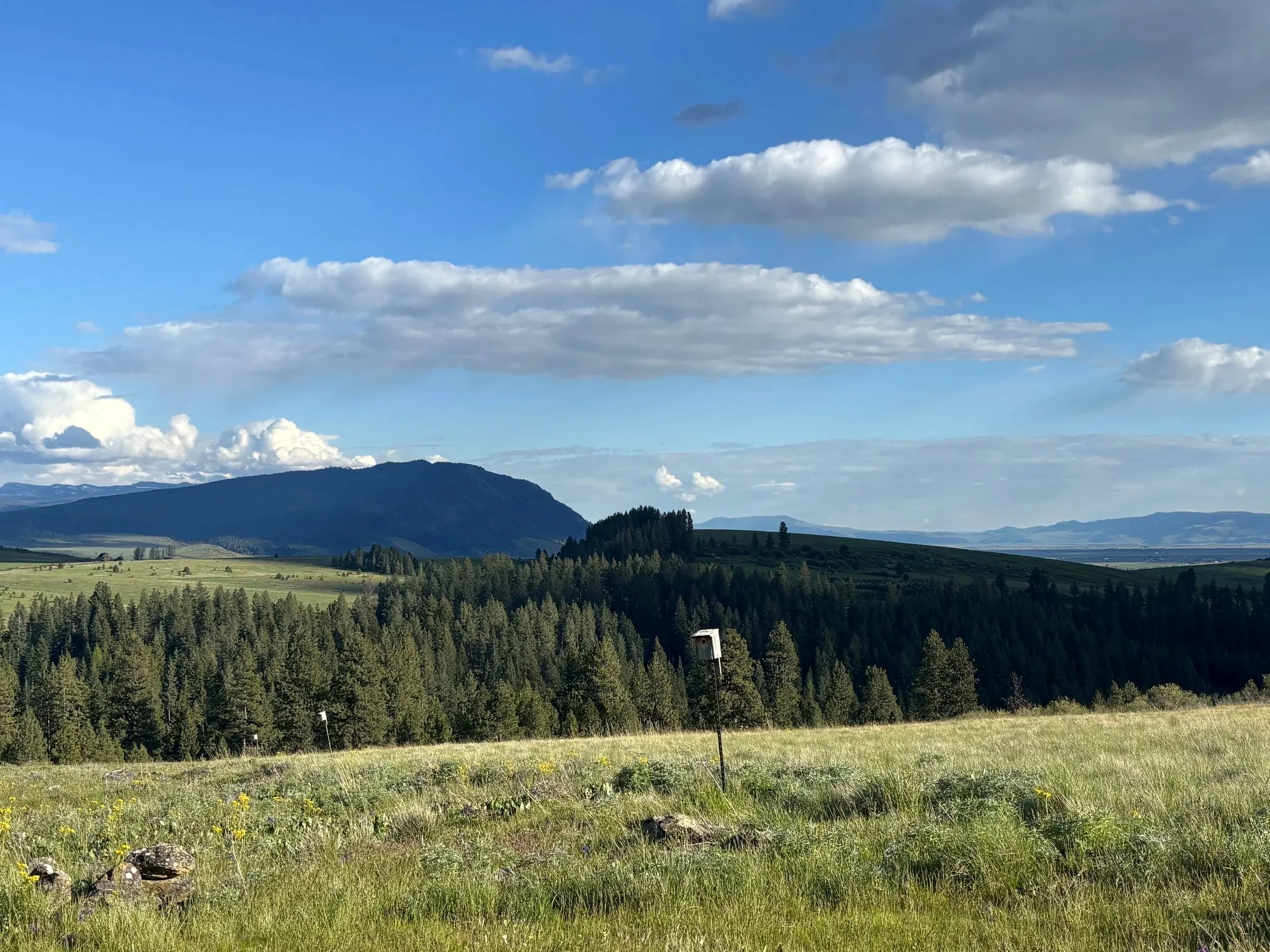
Image of a ridge-top of wildflower meadow above the mountain-ringed grand ronde valley - Image by Arie Farnam

May 10, 2026

Dear Heather,

I’m not fond of Mother’s Day anymore. I’m an adoptive mother, and when my kids were very little there was the occasional teacher who would tell them to draw a Mother’s Day picture or something similar. These usually didn’t make it home to me, and when they did, they were clearly created under duress—a heart drawn in a single wobbly line of crayon, a slapdash paper flower found at the bottom of a backpack. It wasn’t the kids’ fault. They both have developmental disabilities and ADHD. Focusing on something arbitrarily dictated by the calendar isn’t a strength.

Now, my fifteen-year-old cusses me out because I insist he brushes his teeth at least once a day. My seventeen-year-old demands why I won’t buy her “designer perfume.” Their neurology makes them such easy targets for the vultures of social media and advertising. No one else tells them it’s Mother’s Day and I’m certainly not going to mention it like I’m begging for a pinch of appreciation. I hug my mother. We visit a greenhouse full of spring beauty and walk in wildflower meadows together. But Mother’s Day still leaves me aching deep inside.

Mother’s Day just feels like another pressure point with more demands for performance on me, my mother and other mothers I know. I appreciate your letter, the idea that the original Mother’s Day was about women seizing our own power. That’s refreshing.

A woman mentioned you to me at the farmer’s market yesterday. I couldn’t even recognize her with my very nearsighted eyes. You’re becoming like a secret code. “Happy Mother’s Day! Have you read Heather’s letter?” A way to signal safety and solidarity. Keep on, please, keep on.

Arie

May 13, 2026

Dear Heather,

You’ve been grim the last few days, mostly recounting events in a dogged, weather-beaten tone. The Voting Rights Act is in tatters. You clearly feel a need to give us hope. You quote Tennessee state representative Justin Jones, “We’ll keep fighting. We will not stop getting in good trouble. We will not go back.” Those are tired stock phrases, and he’s likely to lose his job with the new map.

When you sound that exhausted, I think I should send you a letter just to say how much we appreciate you. I know you get tons of letters, thousands you can’t possibly read. You try responding to people in your letters sometimes, but you’d need a small army of staff. And I’m not a fan girl type. I have always detested celebrities. The only reason you’re an exception is because you appear to have an undisguised cold sore on your mouth in videos, you aren’t wearing makeup, and you don’t appear to have a staff to read your mail.

Dappled light falls across my page through the maple next door. Steam rises from the squat cup. My tea is brewed. All I really wanted to say is thanks for the letters. We need them.

Arie

Flash writing: "Inventory," "Instructions to an adopted child," and "Earth Mother"

Perhaps you’ve noticed that I’m a bit wordy. My Master of Fine Arts program is working on improving that.

I’m headed for surgery next week, amid holidays, so things are hectic. Instead of writing another long post, I’m sending you a couple ultra short (mostly fictional) pieces that came out of school assignments. I couldn’t help but make them relevant to the times, but seriously, dear readers, someone read the first one and worried that I was having financial trouble, instead of worrying that I was under investigation by the FBI. If this piece were nonfiction, I’d think the second connotation would be worse. In any event, hopefully, you’ll enjoy something new and unconventional.

I have three short pieces to share: "Inventory of objects on a subject's desk," written from the perspective of a surveillance officer looking into protest activity; "Instructions to an adopted child," a snippet of dialogue that tells the story of the desperation white parents of adopted brown children feel when they start waking up to reality; and "Earth Mother," a super short prose poem from an uncommon perspective.

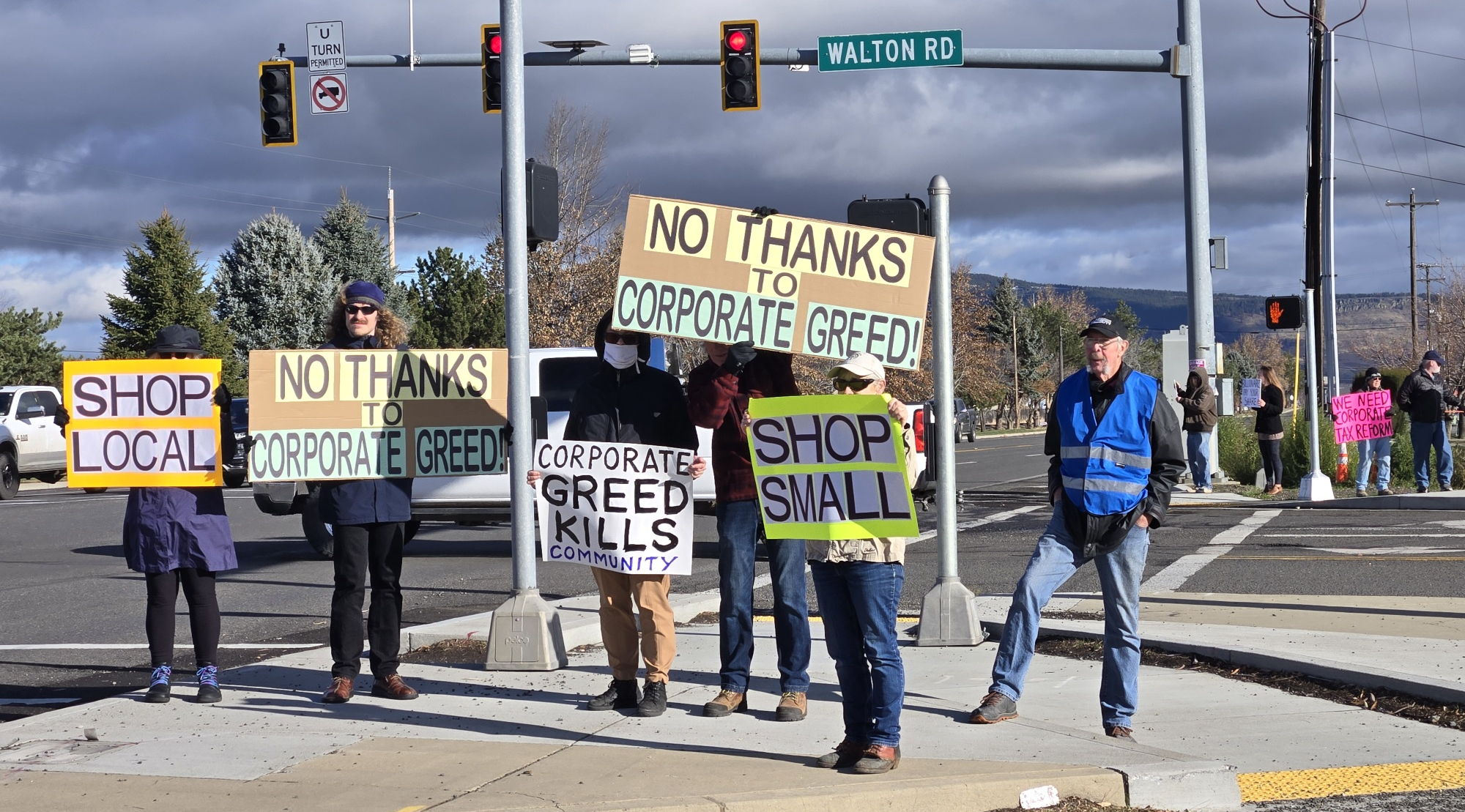
photo of protesters on a main road with signs reading “shop local,” “no thanks to corporate greed,” “shop small,” and “corporate greed kills community.” - image by julie farnam

Inventory of objects on subject’s desk

  • Three pens (Two dried up)

  • An old-fashioned manual nutcracker made of stainless steel

  • A check payable to the order of the subject from the State of Washington for $8.16

  • A Medicaid insurance card in subject’s name, ID no. BD78934A

  • An after-visit summary document for subject’s child from a dentist, outstanding bill $154

  • Electric bill in subject’s name for $216.29

  • A stack of seven stapled, hand-written papers in widely varied childish hands, with commas and editing marks added in blue pen

  • Empty packaging for an iPhone 13 screen protector

  • Samsung TV remote control (TV is in the other room)

  • Battered Apple MacBook with pieces of plastic flaking off corners, locked with code.

  • Sticky notes on computer reading: “Call Jen about getting on Signal.” “Sandy’s medication management appt – Tues. 2:30” “FREEZE WARNING! Cover garden on Mon. night!” “Call water company about brown, stinky water.” “Return call about Cascade editing gig.” “Call insurance fuckers and deal with fuckery” (punctures show extreme force in writing)

  • Nearly empty roll of packing tape

  • 5 fat black markers, 2 fat red markers, 1 fat blue marker, all nearly used up

  • Scissors with pink plastic handles

  • Long-neck lamp with stainless steel base

  • Small plastic bag with a child’s costume jewelry inside—a plastic ring, a locket with a yellow plastic fixture, and a metal broach

  • A bookmark advertising the subject’s book launch ten years ago

  • A laminated vaccination record in Spanish for the subject’s child

  • Canine heart-worm and tick medication in original packaging

  • Safeway receipt for cucumbers, lemon juice, chicken thighs and mozzarella cheese: $44.19 (Noted: SNAP balance remaining $3.22)

  • Letter from OHP denying care for mental health care for subject’s child

  • Letter from OHP denying care for subject’s postoperative recovery medication

  • Stack of more than 100 fliers for protest at City Hall: Saturday at 1:00 pm, decorated with a red-painted fist

  • Fidget toy made of interconnected triangles in blue and purple designs

Instructions to an adopted child (2025 edition)

“Honey, please sit down a minute.”

“I want you to listen, just for a bit because this is important. When you’re in town, you know what to do if you’re stopped by police, right? Just like we practiced, you call them ‘Sir’ or ‘Ma’am.’ You keep your hands out to your sides where they can see them. You ask, ‘Am I free to go?’ And if they say, ‘yes,’ you walk away slowly.”

“You remember all that, right? We practiced.”

“Well, now we need to add something. You also need to say, ‘I’m an American citizen.’ Can you repeat that for me?”

“Yeah, that’s great! If the police stop you, you tell them you’re a citizen. And even if someone who isn’t police stops you, you say that. ‘I’m an American citizen.’ Remember, okay?”

“If they don’t let you leave, you say, ‘I need to call my mom.” You keep saying those two things and say my phone number. Do you remember it? Go ahead. You might not get to use your phone. You have to remember it.”

“Good job! You just keep saying it. Don’t say anything else. Just ‘I’m an American citizen. I need to call my mom.’ Don’t answer questions. Just say that over and over.”

“No, honey! You can’t-- Don’t yell at them. It’s not funny! And you can’t call them names!”

“Listen! For real. Right now, kids with brown skin are being disappeared. This is how we try to keep you safe.”

Earth Mother

I call you up out of the humus of my soil, to rise with eyes and voice lifted toward hope, calling out your need for purpose—you, children of this wayward ape species, called into awareness by fire, by flint, by these damnable words that you call your exceptional birthright—and calling hopelessly, as you do, for mercy when you are in the pain of a body; I call you into being not because I am cruel or devoid of meaning, but because my molten heart could not resist your poignant voices calling.

Why aren't the kids protesting fascism?

Despite the parched season of early fall, my university campus is a peaceful landscape of intersecting concrete paths, heavily watered lawns, and juicy deciduous trees nearly hiding the facades of randomly designed college buildings—ranging from the traditional admin building that’s nearly a hundred years old to the self-consciously-modern art building. Above all this rise yellowish brown hills, the real world of drought and fire danger beyond the lush campus.

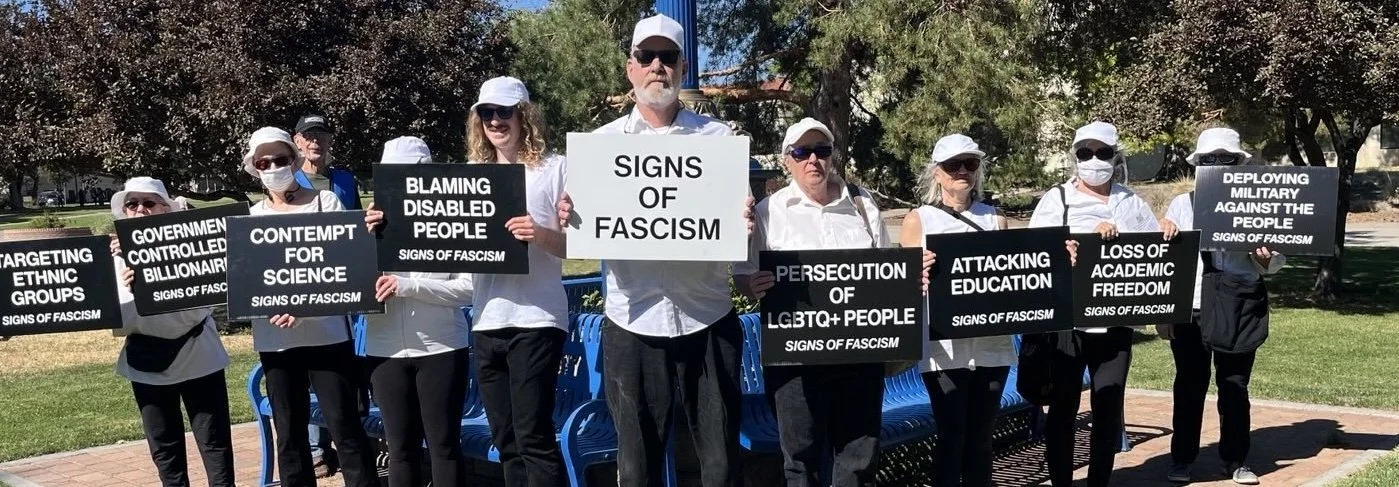
I walk at the end of a line of people holding signs. Each one bears the sub-title “Signs of Fascism” and a single symptom of the national disease—banned books, detention camps, intimidation of journalists, firing truth tellers, coerced loyalty, military deployed against the people, etc. Mine says “Government controlled by billionaires.” I’m last, not by plan but because I had to stop to talk to the campus security chief.

But I think my sign belongs either first or last. It’s the root, after all. Not just a sign but the ultimate cause, the reason that goes beyond any particular party or tyrant or social ill of the moment. I became aware of how our system is rigged to legalize bribery and hand the keys to the nation to the top one or two percent of wealth as a freshman undergraduate.

That was more than 30 years ago. I’ve been crying it from the rooftops in one way or another ever since. Not that it’s done any good.

Students wander past us, drifting between classes, mostly alone walking while looking at their phones, occasionally in small groups of two or three, talking loudly about “the game” or where to meet tonight. Mostly they won’t even look at our signs. Some peer cautiously, and then catching the drift, their eyes jerk down and away as if burned.

Maybe if they look away, the whole thing will disappear.

A few of us try to hand out fliers. I wave them at students who veer near me and speak to them only if I sense a bit of openness in their body language, a pause in their stride, a face turned toward me. A few take a leaflet and mutter, “Thank you.” Head down, hurrying on.

As we are heading back to the secluded corner where we started, I notice a somewhat larger group off to the side—four students together. They all seem to be looking vaguely toward us and even I can see that only one of them is white. The other three are various shades of brown. I don’t want to be pushy, especially not these days. They say the international students (most of the people of color in town are international students) are terrified, afraid to leave the campus even to get groceries. They might somewhat support our cause of crying out against the destruction of our democracy, but they have to protect themselves and being associated with us is unlikely to help.

But as our line passes near them, these four are still turned toward us, tentative in their stances, but not turning away. So, I take a few bold steps out of line. “Want a flier?”

The black guy, the largest of the group, takes one step toward me and reaches out a hand. “Thanks!”

I ensure he gets several to share as he makes a quick grab, and I’m encouraged by the genuine appreciation in his voice.

I’m a student again after all these years, but I’m clearly not like them. I’m not their age and I might as well have not been like them even when I was. I remember being a kid on a campus like this in my early twenties. No one wanted to hear it when I talked about the dangers to democracy, the drive toward militarism, Christian nationalism, the rhetoric of the far right against the poor, the disabled, minorities and immigrants, and so forth. It’s been the same all these decades. So, it’s no wonder young people are discouraged and checked out.

Still, I do have a sixteen-year-old daughter, a girl enjoying high school friends and obsessed with clothes and makeup. She’s rarely interested in politics of any kind and I don’t push her. She knows I go out to protest, and the best of my relationship with her dad consists of animated diatribes on the political situation on both sides of the north Atlantic. “Trump’s at it again! Unbelievable.” “Putin’s taken another step closer to World War Three.”

But today, she wants to talk while she puts her makeup on and to tell me about what she’s learned on the internet. It’s all about Charlie Kirk and “the greatest tragedy in history.” I nod along and make sympathetic noises as she describes his three-year-old daughter rushing toward the stage to get to her daddy when Kirk was shot. It’s a terrible image. No wonder my daughter is deeply affected.

She tells me how Kirk’s wife, Erika Kirk, “should be a saint because she forgives the bad people who killed him, even though they hate America and hate God.” I am starting to get concerned. Wait a minute! This is Erika Kirk, who is taking over the white supremacist TurningPointUSA organization. And it’s my brown, foreign born daughter saying it.

I take a breath and remember to ask questions, to help her think things through rather than forcing “facts” on her. “Are you sure. How do you know that’s true?” I ask.

“It is true. Trump even said that he would never forgive his enemies, that he hates people who are against him and wants them dead. He said he’s not as good and pure as Erika. That’s how you know it’s true.”

This little speech is more than my daughter has ever said about politics. Ever. And I’m now deeply concerned. She’s basing her idea of what is “true” on the fact that Trump says he doesn’t forgive people but Erika does.

I continue to try to talk it through with her. The fact that Trump hates his enemies proves nothing about Erika Kirk. I talk to my daughter about the racist ideology Charlie Kirk espoused and the actions of Turning Point members, attacking people like her—for not being white and for being born in another country. I send her videos of Kirk’s racist statements about women of color lacking the “brain processing power” to be successful in professional careers or academics, which he said proved they were taking opportunities “from a white person.” I send her videos showing how Trump directly lies and contradicts himself.

She says, none of that really matters. The only thing she needs to know is that “Charlie Kirk was a man of God and a good person.” I don’t argue with her on that. I don’t know Charlie Kirk’s relationship with God and I’m not in the business of saying who’s a good person or not. I’m only trying to help my kid differentiate reality from illusion.

She never watches the videos I send. She won’t even look. A few days later, I look up articles about the assassination. It turns out Charlie Kirk’s three-year-old, his other child and his wife were not present when he was shot. The little girl did not run to him after the single shot was fired. People started saying it after watching a video of the child running to him on a different stage, indoors, at a completely different event.

But my daughter has been brainwashed by the emotional, illusory image of that child running to him in the outdoor crowd amid a hail of bullets.

And this I realize is not just happening to my teenager. This is what is happening to young people across the whole country, on our local college campus and around the world. Their entire understanding of the world is being formed by influencer videos, Trump speeches and counter-factual social media memes.

There are exceptions of course. Social media will send you down whichever rabbit hole you happen to show interest in. There are healthier paths that some stumble upon. There are even extreme left-wing delusions out there, though the right-wing manipulation complex is vastly larger and more pushy online.

But this does explain to me why the majority of those protesting the rise of fascism in the United States are people over forty, many actually over sixty. We aren’t really any better at differentiating fact from fantasy or navigating the online world. But maybe we are online less in general and we take our information from established media and long-trusted sources, which—while not perfect—are less likely to support completely fabricated “alternative facts.”

More importantly, our first impressions of the world were not formed in this virtual reality saturated with propaganda. The fact that today’s young people are steeped in that easily manipulated online world is one of the most terrifying things I’ve seen in the past year. And that, as you know, is a high bar.

Open letter to the disability advocacy movement

I am writing here as one of the poster children of this movement, as a person who truly owes my chance at even the most basic education to the movement. In April 1977, when I was exactly one year old, a group of disability rights activists occupied the federal building in San Francisco for 26 days with minimal food and supplies (and what they had was donated by the Black Panther Party).

The direct result of that protest was the implementation of Section 504, the foundational document of civil rights for people with disabilities in the United States, including the right to attend public school which was not at all assured for blind students, like me, at the time. (See the documentary Crip Camp on Netflix for further info.)

I am writing to those who carry on that tradition in myriad capacities—activists, advocates, teachers, lobbyists, policy makers and everyone else still working hard for the civil rights and equity of people with all kinds of disabilities. I write with overwhelming love and gratitude. And I also write with concern and to raise a flag of caution.

Image of a camp fire and sunset from my solo backpacking trip in the blue mountains of eastern oregon - photo by arie farnam

We have come to a time in this movement where we must be very conscious of what we are doing and who we may inadvertently exclude or abandon. This movement was founded on ideals of radical equality. We are for all people with disabilities and no one is too disabled to be outside our concern.

When I entered school in 1982 in a tiny rural town in Eastern Oregon, I entered a school that had still never served a child with a visible disability, and they didn’t want any. It was a small rural school without great resources and this seemed like a lot of extra work.

But Section 504 was law by then and unwilling and unfriendly as the school administration might have been, I went to school. All through the ‘80s, I fought “the good fight.” And when I say I was a poster child, this is literal. There were several disability rights posters with a photo of me in a tie-dyed shirt and giant glasses peering avidly at a computer screen at a distance of one inch. I knew about them and I approved. I wanted to be included everywhere. I subscribed to the demand for universal integration and the belief that people with disabilities could do anything anywhere.

In 1990, the ADA opened up more opportunities for me and I pressed every advantage, went to college and graduated suma cum laude. I was determined to “show them” (i.e. those who hadn’t wanted me in elementary school and anyone else with an ableist tendency). I was loud and proud. I would just barely admit that I wasn’t going to be a pro-basketball player or a jet pilot, but that was about it for concessions. Instead, I decided to become an international newspaper correspondent and spent several years tramping around war zones while neglecting to mention to my employers that I was legally blind.

I have written incessantly on this blog about the social exclusion that people with disabilities so often face. And this month I started taking a course to help me become a more effective parent advocate for my kids, who both have developmental disabilities. From poster child to foot soldier, this is my movement.

But becoming the adoptive parent of kids with Fetal Alcohol Spectrum disorders has shaken some of the fundamental slogans of that movement for me, slogans like “integration first” and “dignity means the freedom to take risks” and “self-determination at all cost.”

Those things were important to me as a visually impaired student and dare-devil young adult. So what’s the problem?

The problem is that each disability affects a very specific part of a body. Mine affects my eyes. It is ableism then to restrict activities that rely on or can rely on other parts of my body. It would be unacceptable to restrict me from being a parent, because of fears that I might not “see” my toddler swallowing an object and choking. Blind parents keep their toddlers safe by both carefully cleaning and listening with specific attention. There is nothing that says parenting is primarily about seeing.

It’s a different matter though when it comes to driving. Driving does rely very heavily on seeing and so far we don’t have an alternative that makes it safe for a blind person. So, that is specifically and legally denied to us and that, in my view, isn’t ableism, even though I expect people with my level of vision impairment to exercise good judgement and stay the hell away from steering wheels without being legally forced to. So, essentially, I’m okay with that law.

Now, let’s take another example, Let’s say a person with ADD wants to be an air traffic controller and they have the training and otherwise qualify. There are some pretty hairy attention and focus acuity tests you have to pass to do that job. Should people with ADD be legally barred?

No, there’s already a test. Some people with ADD may not be able to focus in the way needed for air traffic control. Others may actually be better at spreading attention across the entire field and thus ensuring they don’t miss peripheral input that could be essential. They should take a test that simulates the actual requirements of the job, like everyone else, and be hired or not based on that, not based on their disability.

I’d even be willing to adopt this standard for vision and driving. What if you just had to take an exacting simulation driving test that included poor light situations, sketchy traffic and small children running out into the road, instead of being qualified or disqualified based on your ability to read a chart in an office? Maybe a good idea! (But I’m still going to flunk either way.)

Most disability advocates ought to be on the same page with me so far. But there are underlying assumptions in the disability rights movement that were so deeply engrained in my thinking that they took years and incredible pain to extract.

We often assume that only certain human faculties can be a legitimate disability. Everyone, regardless of disability, can strive and work hard. Everyone, regardless of disability, can make their own decisions and exercise self-determination. Everyone, regardless of disability, does better with more information and chances to learn. Even, everyone, regardless of disability, is better off when fully integrated with able-bodied peers.

I used to believe these things with fervor. I still wish they were true. But they are not true for everyone.

It’s relatively easy for people to understand that any part or capacity of our physical body can be disabled. But it’s harder for people to grasp the complexity of brain-based disabilities.

Most of us have learned that dyslexia is a very specific thing that affects a person’s ability to process written words. It often has a few other side effects, but we get that a person can be dyslexic and struggle terribly with reading and still be extremely smart and capable in other mental areas. My husband and my brother are both dyslexic and both are college grads and very possibly smarter than me.

ADD is harder for non-experts to grasp, but the diagnosis has become so prevalent that I’m betting you can accept that ADD and ADHD affect very specific parts of the brain that govern attention and focus. Again, different people may have a variety of side effects along with that central effect, but people with these brain differences actually score higher on average on standard intelligence tests than the norm. It’s a disability that is located in the brain but it does not make a person unintelligent any more than my vision impairment renders me completely physically incapable.

BUT (and this is a really tricky “but") brain science has progressed far enough for us to understand that there are specific parts of the brain and brain faculties for everything we do and for every human quality. Importantly in this case, there is a part of the brain governing what are called “executive functions.” This is essentially the control center of the brain and it is essential for making decisions, understanding logic, time, and cause and effect, regulating impulses, emotions, desires and everything else the brain does, and even driving the ability to get motivated, prioritize or cope with frustration.

We are used to thinking of these things as “moral” issues. A person either makes good decisions, shows up on time, controls their anger and momentary desires, makes an effort, shows motivation and swallows frustration or they just deserve what they’ve got coming, which is nothing good from us or from society.

A person with profound developmental disability may have some disability in making decisions but generally not beyond the rest of their mental abilities. As a result, even though they have difficulty making decisions, their general cognitive difficulties are obvious to themselves and others. Hopefully, we accommodate them and they are able to realize their limits and accept help with decisions (like whether or not to rent an expensive apartment), much the way I accept that I can’t drive.

You know who doesn’t have the kind of good judgement about whether or not they can make a decision without help that most developmentally disabled people have? Drunk people. Yup, that’s right. Alcohol attacks this very specific part of the brain, the center for executive functioning. More than any other drug, this is where it strikes.

Now, before you get up in arms about how drunks don’t deserve a level of social protection that would divide the disability rights movement, let me remind you that there is a group of people, a very large group in fact, that suffers from the disabling effects of alcohol permanently and without ever taking a drink—babies born to mothers who drank while their were pregnant.

It is no surprise really that, if alcohol disrupts inhibitions and decision making, lowers cognitive abilities, regulation, motivation and responsibility levels in a person who drinks it, it will also attack those same parts of the brain in a fetus. As we’ve all been told at some point, there is no safe amount of alcohol in pregnancy. While more alcohol generally creates worse effects, it depends on when exactly in the development of the fetus it happens and likely on many other factors.

To be clear, I am talking about just one specific disability. But it is a disability that according to neurologists affects 1 in 20 people in the United States. It is more common than autism and at least as disruptive to daily life. It is also much harder to correctly diagnose and accommodate.

Many people with Fetal Alcohol Spectrum disorders (FASDs) throughout history have been written off by their families, communities and society at large as unmotivated, lazy, uncaring and immoral, because society misunderstands that their lack of regulation and the disruption in basic logical concepts is a disability, not a choice.

An example came up in the disability advocacy class I’m taking. The instructor repeated our movement’s call for self-determination of all young adults with disabilities. Everyone deserves to make decisions for themselves and most decisions worth making involve a certain amount of risk. “The freedom to take risks” is a popular buzz term in disability advocacy.

Several parents, myself included, raised concerns, however, explaining that policies our movement is pushing at state and national levels are directly harming people with FASD because they do not take into account the diversity of needs. A one-slogan-fits-all approach will abandon these vulnerable members of our community to the prisons and homeless encampments where far too many FASD adults end up because our society judges their disability as moral failings or lack of effort.

When parents of teens with prenatal exposure raised this concerns in class, the instructors shot down each one, dismissing the concern as “overprotective.”

I know the scourge of overprotectiveness has hounded people with disabilities for far too long. Much of my success and independence as a legally blind person is the result of my parents’ very liberal parenting in a natural environment where I was allowed to “run wild” with sighted kids. It is also the result of all those years of “passing” for sighted as a young adult and thus avoiding many other potential protective barriers. I met other visually impaired kids at summer camps when I was a teenager and was shocked to find that many who could technically see better than me couldn’t walk on slightly uneven ground unaided or cross quiet streets or climb trees.

These are examples of risks that many parents want to protect a blind child from, fearing that we cannot see the dangers. But blind people with full executive functions know their own limits better than anyone else. It isn’t the seeing that is most important in this risk taking, it’s the assessment of limits and testing of cause and effect. I didn’t rush out and jump off a cliff when I was a kid, even though there were several handy. I explored at my own pace. I learned to throw pebbles ahead of me to test the ground, since using a stick on such uneven ground as our mountain backyard wasn’t feasible. I remembered keenly every rock and hollow and hole in the meadows and every tree and fallen log in the woods. That was how I ran free as a kid and it taught me skills that translated into adult independence.

But my disability was in seeing. My children’s disabilities are in exactly the tools needed to take measured risks. They cannot test cause and effect and gain from it. They cannot explore and then predict. They cannot remember past mistakes and avoid pitfalls the next time. They can improve a little in this with development, but not through “effort,” any more than I can try harder to see.

I’ve been criticized by disability advocates for saying things like this and accused of insulting my children. This is like saying it is an insult to a blind person to insist that it is not appropriate to hold up a printed sign they can’t see. My kids have all kinds of gifts—in social interaction, in athletics, in fashion sense, in just working hard at tasks others might find too boring. But just as I cannot receive information through sight very well as a legally blind person, there are channels that are disabled for them.

Those are partly sensory and partly cognitive, but they are precisely the channels our society leans on most heavily by forcing people to make hundreds of snap decisions each day, deal with contradictory stimuli intended to trick people into impulsive behavior, always consider the long-term effect of our actions and navigate attempts at manipulation and exploitation.

Upon moving to our small town two years ago, my son was picked out as “an easy mark” by a local drug gang within a few short months. The ringleader intuitively understood that this twelve-year-old couldn’t foresee consequences. He gave him candy and compliments, and then asked him to carry packages for the gang. My son was talked into taking hundreds of dollars in cash and distributing it to “friends” at school. He didn’t make decisions in order to end up in these situations. He responded to social interactions and the predictable dangers were not apparent to him. He could not look at the possible implications or resist the temptation of immediate inputs and his strong desire to be accepted. As hard as it may be for others to swallow, these faculties are the core of his disability.

When my children become young adults, the disability rights movement as it stands today would have them decide whether or not they want a parent or guardian involved in their decisions or whether or not they want medical care or developmental disability services. They respond to momentary feelings of comfort and discomfort, rather than long-range cause and effect and they cannot conceptualize either time or the implications of decisions. A young adult with FASD may have a true long-term desire to be employed and live independently, but when it comes time to leave for work, being able to recognize the time and overcome the momentary unpleasantness of getting up early both directly challenge their disability.

An adult with FASD can be misled, defrauded, exploited, made homeless and left with out health care far too easily in our society, especially when our movement insists that each person is able to make their own decisions and spur of the moment decisions are considered definitive.

At thirteen, my son is caught up in the disability services system, which by state regulation in Oregon, insists that he should have sole decision-making power with regards to his finances. At thirteen.

Okay, you may say that’s not so bad, since he doesn’t have a lot of money and I should be the one saving for his future. That’s fine. I’m not even concerned about some serious savings plan. But he talks regularly about wanting to buy a toy drone and fly fishing equipment. These are real interests. He saves his money and works hard to plan for these things. But when he enters a store with one of the disability workers who often take him places, the rules say he can buy whatever strikes his fancy and they have a card with his money on it. And because his disability affects impulsiveness, time sense, number sense and cause and effect, he cannot conceptualize the cost to his long-term goals of buying every shiny trinket or junk food marketed to tap into his impulses.

The rules say that the disability services worker can discuss the purchase with him and remind him of his plan to save, but they have to help him spend his saved money on impulse buys if he insists on it. And he generally does because his brain lives in the moment.

To be frank, I wouldn’t do this to ANY thirteen-year-old, but so much less to a thirteen-year-old with this type of disability, and yet this is one of the rules that the disability advocacy movement has “succeeded” in forcing into state regulations. While a parent has decision-making power when it comes to the finances of most youth, I have no say in my son’s case because his developmental disability puts him in a category where “self-determination at all cost” is the law.

Even more disturbing is the Oregon law that now states that children as young as fourteen can make their own medical decisions, including refusing medical care. At the age of sixteen, they can make all health care decisions for themselves and keep these secret from their parent or guardian. There is no accommodation for children with developmental disabilities in this law, and the disability advocacy movement continues to push for ever heavier burdens of decision-making to be placed on the most vulnerable children.

My daughter is approaching the age of fifteen. She has medication that helps her to function enough to attend school most of the time and to live in a family environment safely. But the effects of the medication take days or even weeks to differentiate. These time intervals are far beyond her grasp. She can only decide to take medication or undergo other medical care based on her momentary experience of it. And a lot of medical care isn’t fun in the moment.

My daughter doesn’t yet realize that it is possible to tell a doctor “no,” so we just do what doctors recommend. But like many individuals with FASD, she has a strong aversion to authority and particularly parental authority. Given the emphasis by the disability advocacy movement on educating developmentally disabled youth about their right to refuse parental authority, she will learn soon. Neither of my children will choose help from parents or guardians now or in the foreseeable future. And the decisions they make on the spur of the moment are not in their true interests or even their real desires. They are the symptoms of the disability.

I want my children to be able to be independent. I want them to make their own plans and have goals and dreams. They do have these, and as best I can, for the moment, I protect their clearly stated plans, goals and dreams from the impulsive symptoms of their disability and from the bewildering, manipulative and exploitative corners of society.

One of the things often said by medical experts in FASD is that if someone wants to help a person with FASD, they must provide “a surrogate frontal lobe.” And this is what I attempt to do. When I’m saving for necessities or long-held desires, and I see something attractive that I keenly wish I could buy, my brain’s executive functioning center says “no.” When I feel great reluctance to undergo dental work, my brain’s executive functioning center in the frontal lobe makes me do it anyway.

My children can’t and aren’t medically expected to be able to do that for themselves. It is no different from me not being able to see. To throw them to the wolves of our society where one’s executive functions are often the only protection, is no different than putting. me behind the wheel of a car on a six-lane freeway.

I’m not likely to be chosen to coin slogans for the disability advocacy movement But I hope that we can remember our roots in radical equity as envisioned by the pioneers of our movement in 1977. They embraced disability as a fact and an identity. They asked accessibility and to seen as more than just their disability. They did not ask for their specific disabilities to be ignored or dismissed as irrelevant. All of that still applies today, and neuroscience backs it up.

Disability can affect any part of the human body or brain. Each person with a disability is different and is still a person with value. We ask that our lives, health, safety, access, inclusion, freedom and prosperity be as important as anyone else’s. We ask that when society has set things up for a certain type of person and that set up threatens the life, health, safety, access, inclusion, freedom or property of an individual that society makes changes to protect the individual’s rights. That’s it in a nutshell, ins’t it.

We have differentiated between equality and equity in our movement. Equality is saying everyone is allowed to use the steps and come into the building. Equity is making sure everyone has realistic access. Equality is saying “every person should make their own decisions in a manipulative and exploitative world and they can choose to get help or not.” Equity would be saying, “every person should have the support they need to truly make their own decisions.”

Parents, guardians and helpers of people with FASD are not being “overprotective” when we say that these individuals need real and definitive help with decision-making and risk taking. We are recognizing their specific disabilities and attempting to honor the decisions, desires and goals they express at times when their disability is not being directly challenged by stimuli they can’t process. We need the disability advocacy movement to acknowledge this disability for what it is and stand with our children. Insisting on slogans that harm the most vulnerable, because they sound good and work for most of us has already caused harm and it will continue to, if we don’t change course.

A giant movement is like a massive ship. Turning something this big wont’t be easy. But we can adapt, as we always have, to ensure that none of us are sacrificed for rhetoric.

Taking action with what you've got

This post has turned out to be a kind of sequel to my July post about the limitations of taking action under adverse circumstances. I didn’t actually plan it this way, but here it is.

Having children pretty much always takes a lot of a person’s choices away—or at least it should. There are examples of parents who go off to do their own thing and voluntarily leave their children to be cared for by others, but barring that, parenting generally means a lot of restrictions on one’s own choices. Parenting kids with developmental disabilities multiplies that constraint many times over.

I did try to make my own choices within those boundaries while my kids were growing up, but the limited range of possible choices felt very restrictive at times. I couldn’t go to graduate school, travel or even work a solid job. I couldn’t choose what I was going to eat without the significant expense and time outlay of making separate meals. I couldn’t up and go someplace for a few days. On the vast majority of days, I couldn’t choose what I wanted to do beyond a few minutes early in the morning.

Night camp with the lights of the grande ronde valley - image by arie farnam

Events came and happened to me. Life got incrementally and sometimes suddenly harder. Any steps I wanted to take, even just to get help for my high-needs kids, were many times harder than they would have been alone. It was like slogging through knee deep mud while wearing chains. I rarely felt like I could take any particular action to change my life for the better. Now, that both of my kids are temporarily in other households, bits of my own agency have returned to me.

This return has dawned on me gradually. In the first weeks, it was all I could do to recover and put my home back together—as if after a hurricane. Then, a couple of weeks ago, I was sitting in my special chair by the window, enjoying morning chai and the golden light on the tree outside after my meditation practice, and that part of my mind began pining for the mountains again.

This comes on me every few months. I spent a good part of my youth backpacking either in the Blue Mountains of Eastern Oregon or in other countries around the world where I travelled. I loved being in the mountains far from cars and crowds, especially in Eastern Oregon where the natural environment is so magical, wild and relatively clean. The yearning came back that morning with a vengeance, and I was so used to just sitting with it and accepting it as a longing which cannot be fulfilled, that I didn’t go beyond that for some time.

When my children were very small, backpacking wasn’t an option. Even before that, I found that my health difficulties were making it complicated. Whenever I went on a hike with friends, my body ached and my feet were so sore by the end of the day that I was in extreme pain and couldn’t enjoy camp life. I was always too slow for the rest of the group and the length of the hike was beyond what I could handle.

Once my kids were old enough, we did take them camping fairly often, but it was a grueling ordeal. Their disabilities made camp life even more arduous than it usually is and their hygiene even harder to keep up to a bare minimum. At least one of them refused any kind of hike, so we always had to car camp in crowded, noisy campgrounds. Again, for various reasons, it was mostly miserable.

What I long for is not car camping next to a bunch of drunk college kids. It isn’t even hiking 15 miles with a 30 pound pack at a pace that is swift enough that I have to keep my eyes glued to the trail to keep from tripping. The more I thought about it, the more I realized that what I yearn for is not that unreasonable, at least not in my current situation.

I am no longer a young girl, afraid to be alone. I enjoy solitude. I have the skills to deal with the mountains. And if I hiked five miles, instead of fifteen, I wouldn’t be miserable and I’d still get away from the noisiest campgrounds. I no longer have to take kids with me who refuse to go to natural places or who can’t stay safe in a camp situation—at least not every day of the week. And for the moment, my work is flexible enough that backpacking doesn’t have to be restricted only to weekends when I have kid duty.

It hit me like a sudden revelation. In this case, despite the many barriers and difficulties, I can do something to change my life in a way that will make me happy.

I realized that one other thing that has held me back with backpacking is always having crappy, second-hand gear. So, I researched and saved and pinched pennies. And I was able to buy not just a new sleeping bag and pad but the type I actually want—not the top of the line necessarily, but a pad that is rated for people with back problems. And my gear is light enough to carry without making those problems worse. I ordered an ultra-light tent for just one person. I’m not going to count on anyone else coming along.

But the tent hasn’t come and the warm season is nearly over for now, so I borrowed an old rickety tent with a busted pole and a makeshift rainfly and tested out the rest of my gear on top of Pumpkin Ridge. I was delighted to find that the specialized pad really is much better than the old, twentieth century gear I’m used to. I made tea and watched the lights in the valley while the sounds of the meadow rustled softly.

While I lay in the dark, coyotes howled off to the west—a sound I find comforting, though I’ve seen others panic at it. I know from experience that coyotes won’t mess with a camp. Around about 4:00 in the morning, I was awakened by the thud of hooves nearby in the meadow—several elk or deer passed through. And again, I could be confident they would keep their distance.

To be clear, I am arming myself with high-end pepper spray and hope to soon have a dog. Taking action on your own is not about being reckless. But there is a great deal to be said for finding a way to do what you want that is not reliant on others or on circumstances.

A big part of what has made this possible is the improvement of my health, but that too has been a matter of taking the metaphorical bull by the horns. I am nearing two years on a strict ketogenic diet modified for diabetics and the results have been astounding.

My doctor has taken to telling me “whatever you’re doing, just keep doing it.” Another doctor wants to claim the original diagnosis must have been wrong because “no one can beat diabetes like that.” But I know I haven’t actually beaten it. It will come back—not just eventually but within hours—if I fall off the wagon, which I’ve found out by making the occasional unintentional mistake.

As the sun peeked through the pines on the ridge, I heated water on my tiny, lightweight stove, added tea powder, MCT oil, butter and dehydrated coconut. It makes for a fortifying, healthy, ketogenic drink that keeps me running for hours in the morning. I did my exercises on the ridge top, balancing in various poses above the crackly leaves of mule’s ear and the spiky dry grasses. Then I shouldered my pack and hiked down again.

Since my child-care duties have been relieved a bit, I’ve started a daily exercise routine, primarily to strengthen core muscles. I go to acupuncture and the occasional massage to help the arthritis in my spine. I can’t guarantee I’ll always be able to backpack and it took two years of hard work to get even to this modest level of fitness again, but this is my version of taking charge of my life.

My next adventure will be to apply for the Masters of Fine Arts in Creative Writing at Eastern Oregon University over the winter. It will take a minor miracle in financing, since there is only one scholarship for one student and I need to be the one chosen in order to make ends meet. It will also take my childcare supports staying put, which is by no means guaranteed. But by next summer, I hope to be a graduate student who occasionally gets to go hiking.

The morning rays of a new life have come and I’ve taken up the work of rediscovering my own agency. Sure, it’s tenuous and quite different from what I hoped and dreamed thirty years ago. But it has brought me back to the core elements of what my soul needs.

Words have power--to heal and to harm

The receptionist spoke in a hard voice. “Your son will be there, but you are not welcome at the appointment.”

“But he’s only twelve.”

“You can wait outside,” the desk worker stated without inflection

I felt my world shrinking, the walls of fear and ostracism closing in tighter around me. This wasn’t the first time I’d had this sort of reaction for no discernible reason. For years, reactions to me have become harsher and judgements of me more negative, even with strangers.

What had I done? I barely knew them. Sometimes it feels like there must be a sign emblazoned on my face, which I alone cannot see, declaring that I am a horrible person. My developmentally disabled child needed the medical therapy provided by this clinic, so I went ahead with it despite the humiliation and lack of clarity.

Creative commons by michael karrer

I took a deep breath and forced myself to stop thinking negatively, to focus on solutions rather than problems, to recognize that I’m doing what I have to for my kid with complex needs. I told myself it probably wasn’t me at all. Maybe they were having a bad day. I steeled my voice and words to remain courteous.

Afterward, I was careful not to dwell on the issue of being banned from my son’s medical appointment. I do meditations on gratitude, positive self-image and mental protection each morning without fail. I believe in that stuff—not slavishly—but I have seen that attitude counts for a lot and meditation provides vast reservoirs of self-mastery.

Yet, I suspect that it is the very laws of “positive thinking” that have been undermining me. There isn’t a sign on my forehead, but I have been absorbing a lot of negative energy—not by choice, but nonetheless.

I am, at the very least, living with kids who have undergone massive trauma which has caused significant psychiatric disturbance. A major symptom of that disturbance is that they spew insults and verbal abuse at the person in closest relationship to them (and that’s usually me). The children I adopted spent some time in Eastern European orphanages, and like many with that experience, they develop very conflicted responses to anyone who takes on the role of a parent.

The modern gurus of “manifesting one’s own reality” love to talk about how positive thinking can reshape even the hardest situations. They tell us to repeat affirmations three times every morning, in order to embody good qualities or to encourage good things to happen. If you repeat that you are loved and wealthy and successful, you will by virtue of “good vibes” attract a loving partner, make more money and have career opportunities showered upon you. Or at least you’ll have more of that sort of thing than you otherwise would have.

Both empirical scientific studies and a great deal of anecdotal evidence show that—mostly—it works. Whether you think positive thoughts, hear positive things from others or even listen to a recording of a stranger saying generalized nice things to you, there are dramatic health, social and sometimes even financial benefits.

Some people believe it works because of magic or “energy.” Others believe that a person with a positive self-image simply attracts positive reactions from others due to psychology. It’s science then… if subtle psychological science.

The weird, rejecting reactions I’m getting could be based on negative thinking. The proponents of manifesting reality say that people who think negative things create “self-fulfilling prophecies.” Maybe I am to blame after all in a round about sort of way. If positive thinking has real beneficial effects, then a person experiencing something negative probably just needs a more positive outlook.

Both scientists who study positive thinking and the affirmation gurus agree that negative thinking can cause detrimental health and social effects. If one is constantly pessimistic or under chronic stress, the immune system is suppressed, one is likely to appear less attractive or competent and one will have less motivation to do necessary things that promote physical, economic and social well-being.

The problem with this theory is that I have always been optimistic, motivated and self-confident. Early on, it might have been partly naiveté, but it was also enthusiasm and sheer belief. That positivity carried me through quite a few scrapes I had no right to glide through unscathed.

When I was a young journalist, I was dedicated and utterly convinced that if anyone could break into the Big Time of international newspaper reporting, I could. Physical setbacks and the industry-wide restructuring after 9/11 finally forced me to change my goals, but I managed not to take it as a personal failure.

When I wanted to have kids and the first warning signs of health problems arose, I sat in the waiting room at the fertility clinic overflowing with gratitude that I was only there briefly, that I wouldn’t have to suffer the long battles I saw so many of the other patients undergoing. When I failed to bear a child to term over a devastating six-year struggle nonetheless, I moved on to adoption with the unquenchable optimism of my fire sign. I knew that despite the perils, I would succeed here.

If solid belief in one’s capability and propensity for good fortune was truly the key to success, I should not have encountered so much hardship on my path. And when I did, instead of giving up or becoming bitter, I took up meditation and spirituality to carry me over troubled waters.

The thing no one wants to admit in positive thinking theory is the impact of negative statements from others. Just as listening to positive things said about you bolsters health and resilience, the reverse also holds true, especially with a lot of repetition.

We see that effect in advertising, which leads to poor body image and a host of health problems, even if one dislikes and distrusts advertising. And there the statements are subtle. It isn’t even saying explicitly, “You’re fat and ugly. Buy this if you want any hope of being worthy.” It merely implies that, and we have seen the social impact of that kind of psychological programming.

Still, it is rare that proponents of the theory of “thought created reality” acknowledge the influence of a consistently negative environment. It’s understandable that this is downplayed. After all, you can sell books and recordings with positive affirmations or even with warnings against negative thinking. You can’t sell a way to avoid a negative or abusive environment. But just as positive thoughts and words create reality, the constant drumbeat of denegration and ostracism can drive a person’s health and fortunes down.

And just as with those recordings of generalized affirmations from strangers, it doesn’t entirely matter if the negativity and verbal abuse comes from a credible source or not. One insult from someone deeply loved and respected could have a big negative impact. But even from a stranger, someone you don’t believe, or in my case, from a traumatized and immature source, a constant stream of insults takes a heavy toll.

A few months ago, someone did a straw poll in an international support group for caregivers of kids with similar disabilities, where verbal abuse of caregivers is one of the top symptoms, along with a need for constant supervision, rages and difficulty with empathy. Most of the parents and caregivers who had children with this type of disability for more than five years had developed serious chronic health problems that had not existed before.

The old childhood adage goes “sticks and stones will break my bones, but words will never hurt me.” But that turns out not to be as true as we would like. One word or two or even three certainly shouldn’t break the psyche of a healthy person. Positive thinking, meditation practice and other supports can all mitigate the stress of verbal abuse. But if they are relentless and constant, degrading words will wear away the most solid shield.

It isn’t all or nothing though. I had troubles before the verbal abuse began. Some of my difficulty in breaking into highly competitive field of international journalism stemmed from discrimination because of my disability and because I was a woman and because I wasn’t from a traditional publishing-industry family. But I was treated with respect and appreciation by most people, nonetheless.

My initial health problems were likely just a fluke of genetics. But there was a time when my adopted children were very young that some people close to me began to denigrate me with insults and prejudiced statements about my ability to parent with a vision impairment. This spread to others ridiculing anything I said about current events, because I was a mom with toddlers and no longer a somewhat successful journalist.

When my kids were little I was careful not to expose them to derogatory words, and that made it all the easier to tell when they repeated the words of those who derided me. And because of their trauma and developmental disabilities that pattern of verbal abuse grew and grew. It also grew because of the aura of negativity each successive wave of degradation wrapped around me.

Despite my fiercely positive attitude, this negativity wore away at my mental and spiritual defenses, until my health started to mysteriously deteriorate. Today, I can see the dramatic effects with complete strangers, like those at the clinic.

The automatic response of most people when I speak today is to discount and dismiss at the outset. It doesn’t help that my children’s attachment trauma affects only their closest relationships, and like many children with this kind of history, they put on an angelic mask around others. It is hard for outsiders to believe the verbal abuse is as extreme or as persistent as it is.

Several people working with my kids professionally have become staunch allies over time as they have seen the truth of the situation, through personal experience with us. And yet, there is something around me that picks up negativity, distrust and blame like lint in a dirty clothes drier.

I often feel the exhaustion and sickness creep over me late in the day and I berate myself for my thin skin. They’re just kids. It’s a symptom of disability. They don’t understand half the words they’re repeating. Neurologically, they can't imagine themselves in someone else’s place and understand how they would feel if these vulgar insults were hurled at them day after day.

And yet… it’s like affirmations, except in reverse. I can’t help but be affected.

In my positive thinking, I’m always trying to find some silver lining to bad situations, and throughout all this I have learned a lot. I’ve learned that words can be violence. Words truly can heal and words can harm. I feel powerless at times in the face of so much loss.

But it is worth remembering that words have power. As long as one can speak or write, that power cannot be entirely revoked.

Dismissal, excuses and faux neutrality are at the core of racism and ableism

We consider ourselves to be unbiased, color-blind, tolerant and accepting of all. And yet the accusations of racism and ableism against ordinary, good people in our society never cease.

It brings up defensiveness, anxiety and eventually anger. We don’t see the point.

So what if someone made a slip of the tongue? So what if a group of kids smirked in the general direction of a Native American elder?

Creative Commons image by Igor Spasic

Creative Commons image by Igor Spasic

"There are good reasons. The kids were provoked by a weird religious cult that was racist against white people! There you have it. It’s really all reverse discrimination, a bunch of losers whining because they don’t have what it takes to make it in direct competition, so they want affirmative action and cry ‘racism’ or ‘ableism’ at every turn.”

It is rarely said that coherently and in one breath, but it is what a lot of people think.

I know because I used to think essentially that, except for including ableism in it or resenting affirmative action. I was 18 at the time and I was and still am ninety percent blind. I was mildly, quietly resentful of the focus on racial justice at my university. There was almost no mention of ableism back then and I felt that discrimination against people with disabilities was given short shrift.

It was and often still is. But that did not mean that racism was any less of a problem than the students of color said it was. They were exhausted over the endless fight with it and they were far more tired of the topic than I could ever have been. That was the part I didn’t understand.

It took traveling and living in thirty different countries, listening to hundreds of people tell me their stories while I wrote about social justice issues as a journalist and becoming part of an ethnically mixed family to entirely change my views.

Today, I have to say that such dismissal, excuses and faux neutrality, which once had me duped, is not just the mild fringe of racism and ableism, but rather its heart and core.

Two days ago my third-grade daughter came home from school upset. Her hands were shaking while she told me that some boys had been drawing insulting pictures of Asians on the blackboard when the teacher wasn’t in the room. They were laughing and saying derogatory things about Asian people. A few Asian families have moved to our small town in the past few years. Most classes at the school now have an Asian kid or two in them. My daughter’s class doesn’t have an Asian kid, but it does have my daughter, the only person of color in the classroom.

My daughter, who is generally pretty timid, went up to the boys and asked them, “How would you like it if someone laughed at you that way?”

One of the boys turned to her and said, “You of all people had better shut up. You’re the most brown of any of us.”

My daughter went back to her friends. She was upset and one of her friends was sympathetic. My daughter was too afraid to do anything about it or report it. The classroom has an anonymous tip box for the teacher, where the kids can put a note if they have a problem they don’t want to talk to the teacher about personally but want to resolve. My daughter’s friend offered to write a note and put it in the box because my daughter was too afraid.

Then, in the evening I wrote a note to the teacher through the parent-teacher communication system. My daughter’s teacher has generally been wonderful and exceptionally kind.

I had done multicultural sensitivity workshops in the preschool but have since been overwhelmed with work, health problems and family troubles for the last few years. They had wanted me to come back but I just couldn’t do it. It takes several days to plan, gather materials and do the workshops, and I have to take the time off of work. There usually isn’t a budget for any materials, so I have to fund that myself. Obviously I’m doing it as a volunteer, not getting paid.

But I decided it was time to get back into it. I offered the teacher my help in doing some workshops for her class and told her what I had understood from my daughter’s description. I happily anticipated being able to solve the problem with the sympathetic and helpful teacher.

This evening I got the teacher’s reply, And it hit me like a sucker punch. The teacher didn’t dispute anything I said. She said that the note she got in the box completely agreed with the version I recounted. She said she doesn’t think it’s a problem that the boys draw pictures of Chinese people on the board because they draw pictures of the Simpsons as well. “They’re just having fun.”

She didn’t mention what the boy said to my daughter but she said that in general she doesn’t think the incident is important. She said she had heard the children laugh about “Chinese people“ and she doesn’t think that’s a problem. She said maybe I could do a writing workshop for her class.

I was concerned when my daughter told me about it. On the one hand, I wish my children would never have to be exposed to racism, either as a bystander or a target. But I am no longer the naive eighteen-year-old who used to think we lived in a post-racial world. It’s going to happen, and frankly, my concern was tempered by the small, relatively controlled environment of the third-grade classroom and my assumption of the teacher as an ally.

The teacher’s dismissal not only makes the situation many times worse, but it also shows me how much deeper the problem likely runs in the community. Hence my claim that dismissal and excuse aren’t some kind of benevolent mild fringe of prejudice but rather its fortifying center.

There is another scene that haunts me nearly daily from when my children were toddlers. Two family members had been making comments, saying they didn’t think I was “safe with kids” or “could be a safe parent” because of my vision impairment. I had never had a serious safety scare with my kids. My job involved teaching groups of preschool-age children. I had pulled a drowning child out of water four times and none of those was a child I was supposed to be watching at the moment.

I was very physically active and adept with many physical skills, and I was hurt by those comments. I was even more hurt by their practical implications, as I was prohibited from watching my nieces and nephews during my rare trans-Atlantic visits, it impacted my children’s ability to know their cousins.

One of the family members repeated the hurtful comments at the beginning of an extended family camping trip, and I could feel my whole world quaking. But I appealed to the rest of the family and asked for a family meeting. I was sure that with family consensus and the fact of my good track record on my side, I could be rid of these comments and the accompanying stigma.

My family has always been progressive and openly against all prejudice after all. My brothers and I were brought up to be independent and free-thinking. We always spoke out against racism and my vision impairment was rarely mentioned outside of medical necessities. We were the tolerant, accepting, progressive folks. And so I was sure I would be heard.

Instead I learned a bitter lesson.

The extended family meeting decided unanimously that I was overreacting. They agreed that there was no reason to doubt my safety with kids but also declared “neutrality” in the “argument” over it. “Everyone is entitled to their own opinion,” I was told.

My defense of my parenting bona fides was deemed “disruptive to the family,” whereas the prejudiced remarks and discriminatory actions of other members, which actively harmed children in the family, were deemed “a reasonable matter of opinion."

I felt as though I had been frozen inside a block of ice. A week later, I got on a flight back across the Atlantic and the incident was forgotten by most in the family. Water under the bridge.

This was how I learned how much greater harm dismissal does than even the initial prejudice. And I swore I would never again dismiss prejudice when I happened to land on the more privileged side of the equation, as is the case with racism.

That’s why I speak out against it and hold my ground. To truly feel you love people of all colors and shapes is not enough. Even to try to be unbiased and kind is not enough. We must learn to listen when someone says our actions or the actions of those connected to us have caused hurt or appear to come from prejudice.

Certainly, disingenuous accusations have been made somewhere in the world at some time, but believing the vulnerable party is always the better bet. Redress is rarely more than saying with open-hearted sincerity, “I am sorry my words or actions hurt you. What can I do to make sure prejudice isn’t perpetuated?”

Even sincere acknowledgement costs little. The cost of dismissal, on the other hand, is devastating.

ADHD, brain regulation and guided meditation: An actual parenting tip from Arie

I think my readers might tend to cringe, when I mention parenting. No one has told me they do. I’m just guessing because my posts about parenting tend to fall into three categories: 1. how blind people parent, 2. how not to parent and how miserable it can be, or 3. sarcasm and snark.

I really have read dozens of parenting books, actually implemented their methods, found them to work great with 90 percent of kids and occasionally to fail entirely. That has led to a lot of my cynicism.

Creative Commons image by Seattle Municipal Archive

Creative Commons image by Seattle Municipal Archive

It isn’t that the methods don’t work. If you are a frazzled parent and you don’t know about counting in an ominous tone, time outs, making everything out to be your kid’s choice when it actually means you are in charge, avoiding power struggles and teaching through your own example, by all means, go read the experts. I specifically recommend:

Parenting by Temperament,

Pick Up Your Socks,

Easy to Love, Difficult to Discipline,

and depending on your circumstances Attachment in Adoption

However, my posts tend to assume you are like me—a parent who is obsessive enough to research and read books before the kid can even walk (or let’s be honest, before the kid is even born). That’s why I don’t generally go on about the methods in these books, which you should most definitely read and practice.

It’s the five percent of the time when they just plain don’t work that will kill you, cause premature hair loss and end your marriage or partnership. And I usually don’t have much beyond commiseration to offer those of you who have run into that wall with me.

But today I do actually have something worth sharing, a technique I have NOT found in any expert parenting book, which actually worked wonders on my out-of-control, neuro-diverse kid.

Bedtime is often a nightmare for parents of neuro-diverse kids. Some kids don’t run on the same schedule as the school bells or even the sun. Some kids can’t just tell their brains it’s time to calm down and go to sleep. Some kids don’t know what to do with exhaustion and instead of winding down, they amp up.

I have kept a very strict routine with my kids, ever since the day we brought them home. Routine helps. Like a train on rails, my daughter will often stumble from one part to another—with hissing steam and screeching noises but in the end shunted from the teeth-brushing track, to the pajamas track to the story track to the bed track. On a good night, the routine takes only an hour and a half, now that she’s ten.

But not every night is a good night. At age ten, my daughter still has frequent meltdowns and needs the kind of supervision usually reserved for the under-three crowd. By the end of the day, whoever has been dealing with her—and her load of homework assigned by the school in hopes of keeping her somewhere in the ballpark of grade level—is staggering on their feet.

There are nights when after all of it, after the hours of one-on-one attention and the lengthy, carefully designed bedtime routine, she won’t go to sleep. She is up and around the house after bedtime. She wants snacks and she shrieks in protest. Getting her into bed is a literal physical battle that we still win by main force but only just. And then nothing can hold her there and no one can sleep with the racket.

This strife goes on anywhere from one to two hours on those nights and they averaged about once a week, up until recently.

I want to be very clear here about what directly preceded this bit of creative parenting. That is I had two full days and two nights at home alone. My husband took the kids on a skiing trip, returning so drunk with exhaustion out of a snowy night that I shuddered to think of how he managed the two-and-a-half-hour drive.

I sent him straight to bed and prepared to do battle alone, well rested as I was.

I got both kids out of their tight, damp skiing clothes and fed them. My eight-year-old son was blinking and crying, he was so tired. I knew I couldn’t physically handle both, so I got his teeth brushed and let him fall into bed first. He was literally asleep within seconds.

Then I tackled the more difficult kid. My daughter was exhausted too, lashing out randomly and swinging wildly from glee to rage. Her entire body hummed with tension. I could feel it as I helped her undress and brush her teeth. I told her a brief story and settled her down with her audio book in hopes that physical exhaustion would do its magic.

But no such luck. Not that night.

Thirty minutes turned into 40 minutes beyond bedtime and even my two-day reserve of regenerated energy was starting to flag. She wouldn’t even stay in bed to listen to her story and when she was up, she was into everything, requiring constant supervision and making nerve-rattling shrieks every one to two seconds. A hand on her shoulder told me that her body still thrummed with pent-up energy.

On most nights, this would have been the point where I started laying down the law and rolling out consequences, “You can choose. Either you stay up and keep me up and you won’t be able to have audio book tomorrow night or you lay down and relax and go to sleep and you’ll still have audio book tomorrow.” And so forth. It only occasionally works anyway.

Many nights the chaos continues for another hour and finally ends in her being locked in her room until she wears herself out—not a stellar parenting performance.

One of the more helpful things I had recently gleaned from rereading a few of the expert books was to focus on the concept of addressing the child’s deeper need. Clearly, my daughter needed sleep. She was exhausted, but she had no idea how to calm her dis-regulated brain and win some peace.

As a high-strung creative person, I do know what it is like to be exhausted after a long day’s work and to lie in bed with nerves jangling, a thousand thoughts whirling around my brain. Prominent among those thoughts is often the desperate need to sleep, in order to be ready for the challenges and trials of the next day.

So, I asked myself, how I get to sleep when I’m in such a state?

“Badly,” came quickly to mind. But also “quietly.” On such nights, I often lie awake in silence after it is clear that no audio book is going to help. I do relaxation exercises, deep breathing and progressive muscle contraction and release, which make me feel virtuous but don’t make me sleep. And then, more than anything I descend into a childhood fantasy and rehash versions of the adventurous and purposeful life I once dreamed of.

And that usually does help.

With that thought and the understanding that much of my daughter’s difficulty comes from an inability to regulate her own brain and do such things for herself, I came and sat on the edge of her bed and began to make up the fantasy for her.

At first, she was too jittery even to listen or lie down. I had to grab her attention mercilessly. I know what she obsesses over after all—preteen YouTube celebrity girls with shopping infomercials and flaunting conspicuous wealth. There isn’t much beyond kinky sex and hard drugs I would less like my child to be delving into at this age but desperate times call for desperate measures.

“Imagine you’re at the most beautiful park you’ve ever seen with all your friends from school and Everly, Ava and Jojo Siwa are there too, just to see you…”

She stopped jerking around and actually settled back on her pillow, her eyes wide and staring. I could still feel her muscles pulsing with nervous energy through the blanket but at least she was in the actual bed.

“It’s your birthday party,” I continued, “and everyone is there to wish you a happy birthday and play with you in the warm sunshine. There are fun things to climb on and the most beautiful cake you can imagine.”

The way my words came out made me think of those relaxation exercises I had so little luck with. I was originally taught those by an eccentric French teacher in my tiny rural high school in Oregon. She had the five kids in her class, me and four ranch kids, lie on the floor of loose wooden boards and do relaxation exercises.

She had also done guided meditation, which the boys had interspersed with rude comments. I had been cooperative but more because I felt a bit sorry for the teacher than anything else. I never did like guided meditation. I encountered it again at a handful of workshops and events over the years.

It didn’t work for me because my brain is entirely capable of paying full attention to the audio meditation, doing the visualizations and thinking of one or two other complex things at the same time. It isn’t relaxing because it doesn’t overwhelm me enough. It is not that other thoughts intrude on the meditation. They simply occur in a different place and the meditation continues without a hitch.

I did eventually find a form of meditation that consumes enough of my consciousness to work as intended but it requires memorized recitation along with practiced movements. Once the words and movements became automatic to me, the meditation worked because it was difficult enough that it took all the excess brain activity with it.

My daughter’s brain is probably the opposite of mine. That has been a large part of our miscommunication. For me, directing my mental attention to something or doing several mental things at the same time is no problem. The only significant problem is prolonged lack of mental activity.

So, it occurred to me that while guided meditation might be boring and insufficient for me, it might be immensely relaxing and freeing to her. Released from the need to try to control her brain, she could coast to sleep on a ready-made fantasy.

I could tell right away that the fantasy I had constructed for her, while successfully capturing her attention was too exciting to induce sleep. Slowly I shifted the focus of the words, describing more the surrounding natural environment and less of the celebrities and then even gently removing the other people from the picture.

“Your friends step into little boats on the lake and start to drift away over the waves. They float slowly up and down, up and down. And they wave back to you calling, ‘Good bye! We love you! Have a good rest!' As they drift away you sit down under the big oak tree. You can feel the warm, smooth bark on your back. You slide down to feel the soft, dry moss under the tree and lay your head on a soft, moss-covered root.”

I could feel her miraculously relaxing. Even her breath was calming. I included some deep breaths in the story and almost magically she took deep breaths as suggested, something that is usually impossible for her

Finally, I concluded the story with my daughter drifting into sleep in the beautiful park by the lake. The entire guided meditation took only about eight minutes. When I stood up, she made one drowsy noise but subsided again. I left the room and didn’t hear from her for the rest of the night.

Since then I’ve used guided fantasy to calm her several times in situations where she used to be unable to calm. Certainly children are as diverse as different species of animals. Just as this type of meditation didn’t work for me, it may not help many children. But what is universal in the technique is the parenting tool of looking at what the child needs on a deeper level and designing something that fits the child’s specific temperament to reach that goal.

How you get the exhausted child to sleep or the frustrated child to calm enough to complete their homework is not that important. We get stuck on having a specific way that such things should be done. There is a standard way that works pretty well with most kids, but not with all neuro-diverse kids.

“Do what works,” a fellow disability rights activist used to tell me. “Just do what works, regardless of how it looks.”

I hope someday my daughter will be able to learn to use guided meditation tapes to steer her own brain and gain a sense of self mastery. I’ve gained a new respect for a technique I previously rejected as too simplistic and manipulative. We all need different things.

On parenting, as usual, don’t judge other parents and do what works.